A University of Cincinnati 1819 Innovation Hub corporate partner, Sensory Robotics, says it has “broken through the fence line with a next-generation safety solution”.
Their flagship technology, the SR-1 system, is designed to be installed in and integrated with existing industrial robots, setting a new benchmark for how robots can safely transform into cobots and operate alongside humans.
Sensory Robotics, through UL certification, ensures the safety of their technology to work alongside humans and heavy robots with no restrictions on payload, reach, or speed.
Meet the SR-1 solution
The Sensory Robotics SR-1 system installs advanced 3D vision technology and sensors onto existing industrial robotic arm production cells to create safety zones. It is real-time safety software with a smart control system that understands its surroundings.
Toyota, the Department of Defense, P&G, and Caterpillar have already reached out to Sensory Robotics to have the SR-1 system installed in various industrial robots.
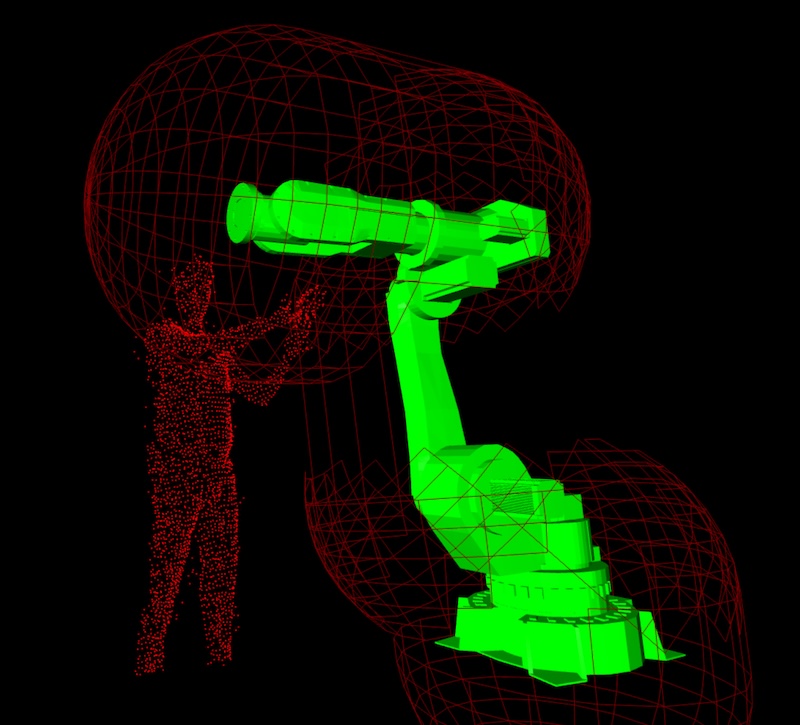
Visualization of Sensory’s SR-1 SSM Safety Zone shows a 3D model highlighting safe interaction boundaries between a robotic arm and a human operator, utilizing red and green wireframes to indicate proximity and safety limits.
“We designed Sensory Robotics SR-1 to work by continuously seeing people, adjusting robot movements all in real time,” said Edwards. “This UL certification now allows our technology to be purchased and installed on industrial robots, enabling them to safely operate alongside humans without physical barriers
Their mission is to modernize industrial robotic safety, a vision now formally realized as their patented SR-1 technology earned the coveted Underwriters Laboratories (UL) certification.
Those in the industrial robotics industry recognize that this certification is not easily achieved. UL is an independent safety organization accredited by the National Recognized Testing Laboratory (NRTL) and the Occupational Safety and Health Administration (OSHA), which has set global industry standards for more than a century.
“We designed Sensory Robotics SR-1 to work by continuously seeing people, adjusting robot movements all in real time. Having our technology validated by UL is a significant and meaningful milestone for our team and for the future of safe human-robot collaboration,” said CEO and co-founder Chris Edwards.
“It’s the most comprehensive and challenging safety test to pass in our industry. This demonstrates that our SR-1 system is built not only to meet strict safety standards but to maintain consistent, long-term protection for humans working alongside robots.”
For more than 15 years, advanced manufacturers in industries listed below have sought to bring people and robots together without safety fences; boundaries that resemble large cages and take up valuable floor space, hindering the efficient use of factory facilities.
- automotive
- aerospace
- assembly operations
- warehouse automation
But there was a problem.
Without official certification, companies cannot approve or purchase fenceless robot systems, even if the technology itself is effective. Stringent safety accreditations must be met to protect workers and equipment and comply with state and federal regulatory and insurance standards.
That long-standing barrier is why the side-by-side human-robot, or cobot industry, has remained stuck behind the decades-old fence line as a safety solution.
Until now.
After a 20-month journey, the SR-1 model’s fenceless safety system has now been officially certified under cULus 1740 and validated to PLd, Category 3, with a PFHd of 1.73 × 10⁻⁷.
What does this mean?
In short, UL certification is the deciding factor enabling new industrial technologies to move from innovation labs to factory floors across the US and Canada. It’s an independent, third-party stamp of approval that says “this is safe to put in a factory”, and one of the hardest to achieve.
It validates things like:
- Can the system prevent dangerous physical harm to humans?
- What happens if a sensor, controller, or safety function fails?
- Does the system fail in a safe way (or a dangerous way)?
- Is it built and tested to meet strict electrical and mechanical safety requirements?
“These combined certifications are the key that unlocks real-world industrial adoption and approval for companies to purchase fenceless human-robot collaboration systems like SR-1,” said Mark Gagas, chief operating officer.
“It means regulated manufacturing environments can now trust and deploy this technology into their robots with confidence. For Sensory Robotics, it’s a major milestone, and for the future of factories, it opens the door to creating more space for people to work safely alongside robots.”
Kill the downtime
Gagas shares that the SR-1 technology, in addition to increasing safety and reducing required floor space, also saves companies millions of dollars each year in lost time and productivity.
In traditional industrial environments, whenever a safety event occurs or a person enters a restricted zone, robots must often be fully stopped, powered down, and carefully restarted and revalidated before returning to operation.
This process can take up to 10 minutes in some cases and, across a production line, can result in significant downtime and a financial impact over the course of a year.
“By enabling safe, real-time human-robot collaboration without full shutdowns, the SR-1 system helps kill downtime of the stop-start cycle, keeping production running more safely, continuously, and efficiently,” affirms Gagas.
Meet the SR-1 solution
The Sensory Robotics SR-1 system installs advanced 3D vision technology and sensors onto existing industrial robotic arm production cells to create safety zones. It is real-time safety software with a smart control system that understands its surroundings.
Industry validation, certifications and commercial readiness
Sensory Robotics progressed from research to academic and state-funded validation, federal SBIR acceleration, and UL-certified industrial readiness, culminating in a deployable fenceless robotics safety system.
- Deployment of SR-1 into testing and certification environments
- $1.25 million Department of Defense SBIR Phase II grant supporting SR-1 safety technology for industrial and defense mobile applications
- Collaboration with industrial stakeholders to align with safety and compliance requirements
- UL 1740 certification through Underwriters Laboratories
- ISO 13849 Performance Level d (Category 3) validation with PFHd of 1.73 × 10⁻⁷ through Underwriters Laboratories
- Qualified for adoption in regulated manufacturing environments across North America for procurement, insurance, and EHS-approved pathways for fenceless robotics deployment
- A $200,000 Phase 1 TVSF grant from the UC 1819 Venture Lab program for the development of human ergonomics and predictive motion IP for integration into SR-Insight, advancing the platform’s ability to anticipate and respond to human movement in real time.
