Sereact has raised a $110 million Series B round led by Headline, with participation from Bullhound Capital, Daphni, and Felix Capital.
Existing investors Air Street Capital, Creandum (who led the company’s 2025 Series A round), and Point Nine once again invested in Sereact.
The round funds two priorities: scaling Cortex 2 and entering the United States. Sereact will open its first US office in Boston this summer and hire commercial, application, and engineering staff locally.
Cortex 2: the robotic brain that anticipates outcomes before it moves
Today’s Cortex sees and picks. Cortex 2 thinks first, then acts.
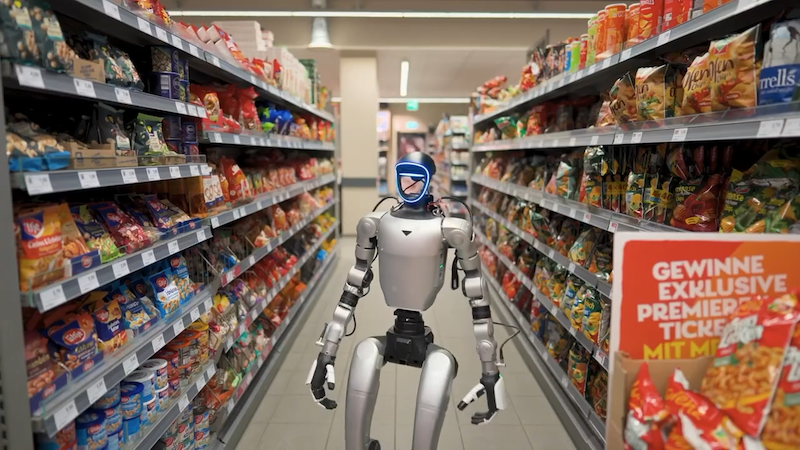
Cortex 2 augments a vision-language-action (VLA) with a world model. It runs possible actions against a learned model of physics and object behavior, picks the one most likely to work, and updates in real time as the scene changes.
World models are the next frontier in AI, and most of that work is happening in research labs on synthetic data. Cortex 2 is the one trained on more than a billion picks of real production.
The shift from reacting to reasoning is what takes Cortex out of the picking bin and into the kind of work where contact matters. Assembling a component under tension. Placing a windshield wiper without scratching it.
Kitting parts that have to land in exactly the right orientation for the next station. That’s the next market Sereact is going after, and Cortex 2 is how it gets there.
US launch
American warehouses and manufacturers want productized AI that works out of the box, not custom vision systems that take a quarter to deploy. Cortex already works that way; Cortex 2 extends the category.
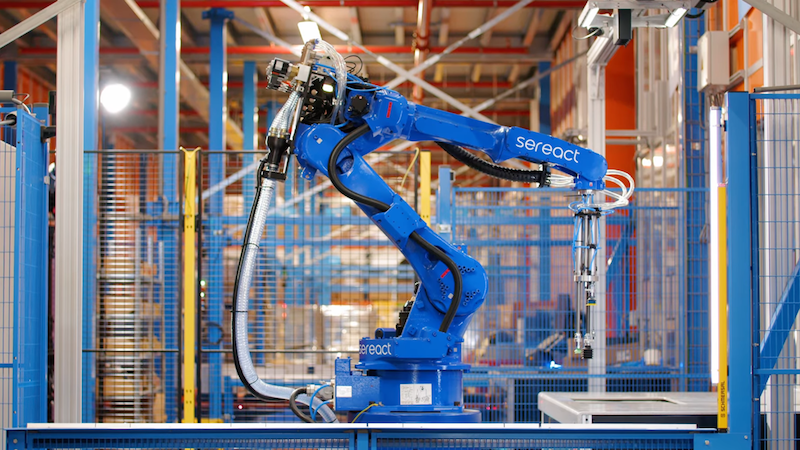
Sereact showed the current generation at Modex in Atlanta this month – single-arm picking, dual-arm returns handling, and the Sereact Lens 3D perception system – and North American interest has grown steadily since.
Ralf Gulde, CEO and co-founder, says: “We bet early that you can’t build real robotics AI in a lab. You build it with a data flywheel fed by real deployments – shipping into production, living with the failures, and letting the model learn from what actually happens on the floor.
“The numbers show it worked. Two hundred systems. One billion picks. One intervention per 53,000. Nobody else is close.”
Marc Tuscher, co-founder and CTO, says: “The robot dreams in latent space. We give it a form of imagination – the ability to anticipate how the world will respond before it moves.
“We don’t build robots. We don’t sell services. We ship one thing: the model that runs on any robot. Single arms, dual arms, humanoids, fixed cells – same brain across all of it. Hardware is becoming a commodity. The model isn’t.”
Sereact market fit
Sereact builds AI for robots that work in the physical world. Warehouses were the first deployment because no other environment provides the same combination of data points: billions of real interactions, every object shape imaginable, hard throughput constraints, and consequences when the robot gets it wrong.
Every shift, across every customer site, Cortex learns from real picks on real items in conditions no simulator can reproduce. That data is what moves the model, and the model moves with the robot: mobile, humanoid, fixed cell – whatever comes next.
More than 200 Sereact systems are already live across Europe, making Sereact the most deployed AI picking robot company in the world.
Those systems, all running the Cortex brain, have completed over 1 billion real production picks for customers including Active Ants, Austrian Post, BMW, bol., Daimler Truck, DeltiLog, Mercedes-Benz, Monta, MS Direct, PepsiCo and Rohlik Group.
One pick in roughly every 53,000 needs remote human help. Everything else, the robot handles on its own: that ratio is a critical differentiator.
Every pick Cortex does goes back into the model. Competitors are raising billions to train on simulated data and lab demos.
Sereact has spent five years training on real operations, at night, at peak, on the messy items that don’t look like anything the robot has seen before. It’s a gap that widens with every shift.
Investor sentiment
Trevor Neff, growth partner at Headline, says: “The physical AI opportunity is one of the largest we’ve seen in a generation, and we believe it will rewire global supply chains and manufacturing.
“Behind great opportunities and great companies are great founders, and Ralf and Marc are building into that opportunity the right way: real deployments, real data, and a model that compounds and gets better with every single pick.
“Customers love the product, which leads to continued expansion, only accelerating the data flywheel – this is why we are so excited to back Sereact.”
Bullhound Capital founding partner Per Roman says: “After looking at a deluge of humanoid robotics companies, my fellow Partner Alon Kuperman and I were delighted to meet Ralf and Marc, the co-founders of Sereact, who have built an AI operating system that seamlessly retrofits into the world’s vast fleet of industrial robots already in action.”
Antoine Nussenbaum, co-founder and investor at Felix Capital, says: “We see Sereact as a new generation European champion, combining deep industrial know-how with world-class AI and robotics talent to tackle one of the hardest challenges in global supply chains.
“At its core is a powerful, compounding data moat – where every warehouse interaction makes the system smarter and harder to replicate. We’re proud to partner with the team and support their ambition to define the category of physical AI for the world’s largest retailers and wholesalers.”
