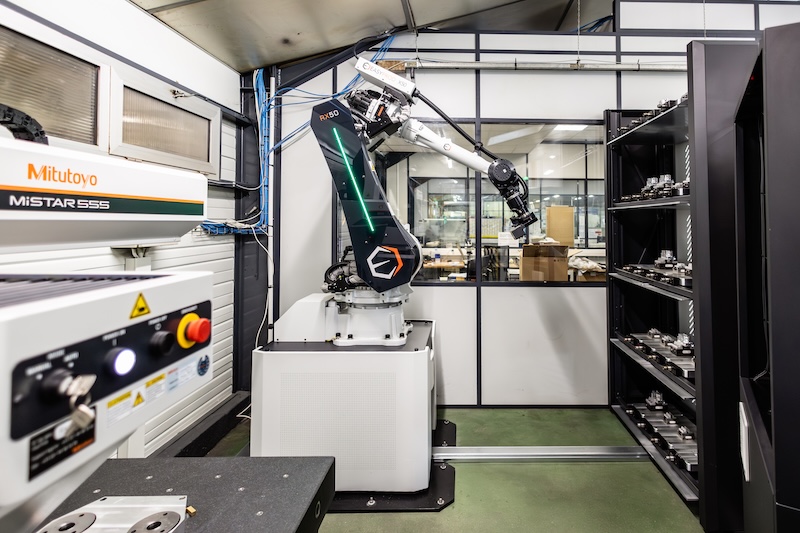
French precision engineering company Méca-Précis has automated part inspection using a robotic measurement cell that combines a coordinate measuring machine (CMM) from Mitutoyo with automation technology from a company called Engineering Data.
The system was introduced after inspection processes became a bottleneck as production volumes increased, particularly for aerospace and space-sector customers that require 100 percent dimensional inspection of every part before and after surface treatment.
Founded in 1975 and based in Châtillon-sur-Indre, Méca-Précis employs 45 people and operates 25 machine tools, including 18 CNC machines.
The company manufactures prototype parts, small and medium production runs, welded assemblies, and complex components for aerospace, satellite, and packaging machinery applications.
“Dimensional inspection of a single pin takes just one minute – but there can be as many as 300 to check. At the other end of the spectrum, inspecting a single complex component for a satellite can require up to 80 hours,” says Nicolas Mériaudeau, who took over management of the family business in 2023.
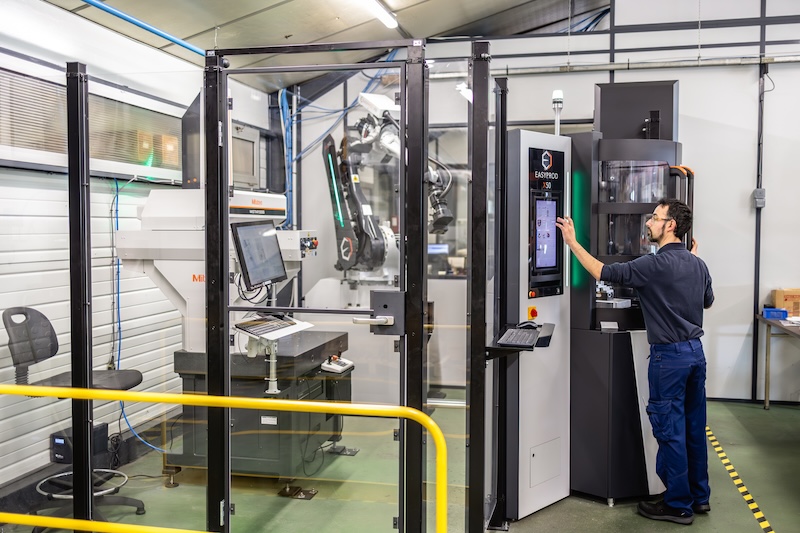
The company’s inspectors struggled to keep pace as palletized machining centers increasingly operated overnight.
“We therefore began searching for a way to automate and roboticise the inspection process,” says Bruno Mériaudeau.
Mitutoyo and Engineering Data developed a robotic inspection cell featuring:
- A Mitutoyo MiSTAR shop-floor CMM;
- A multi-axis articulated robot;
- Automated storage for up to 20 pallets;
- Automated loading and unloading; and
- Autonomous inspection during unattended shifts.
The system was installed less than a year after the project began, although programming, commissioning, and optimization required an additional six months before full deployment.
“We have effectively removed the bottleneck that was located in the quality control process,” says Bruno Mériaudeau. “This solution brings us greater flexibility and allows us to significantly increase inspection capacity.”
Nicolas Mériaudeau adds: “If we did not have this robotic measurement cell, we would not be able to cope with the growing production volumes of series-manufactured parts, which are highly demanding in terms of quality control.”
The robotic cell now performs inspections both during the day and overnight, reducing pressure on inspectors while increasing throughput and maximizing utilization of metrology equipment.
