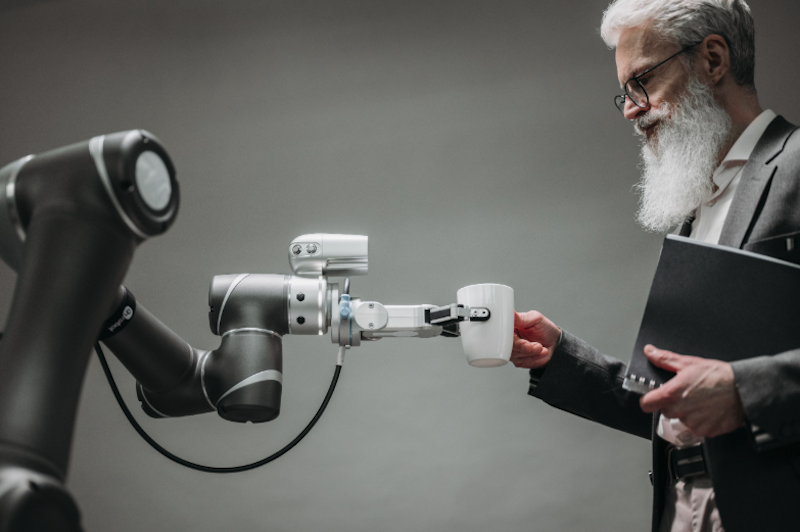
Automation is becoming a software problem. The deeper robots move into production, the more workers need to be confident handling dashboards, updates, alerts and data-driven decisions.
The old image of factory automation was a robot arm behind a safety cage, doing one repetitive task faster than a human being ever could. But whilst robots weld, lift, assemble and pack at speeds fast enough to warrant their own keepers and still save thousands of man-hours, the knowledge of that robot engineer is increasingly software-based.
Meanwhile, the International Federation of Robotics said that, worldwide, more than half a million industrial robots were installed in 2024 alone, topping up a figure approaching 5 million robots in operational use.
Annual installations have now topped that half-a-million mark for four consecutive years, so automation has moved from an investment story to an everyday-management challenge.
The Human Side of Robot Density
“Robot density” makes this change easier to see. In 2024, per 10,000 manufacturing employees, there were 267 robots in Western Europe, North America reached 204 and Asia averaged 131, though Asian countries represented three of the top five most automated economies, when measured by robot density.
Behind those figures sits a practical issue for manufacturers. Every new robot adds mechanical capacity, yet it also adds interfaces, settings, permissions and maintenance data. The value of automation depends on people who can read those signals before a small fault turns into lost production.
A line operator may now be checking vibration and temperature readings, cycle-time trends and error logs. When a motor starts drifting outside its normal range, the useful response may be software-led: check the alert history, compare shifts, then decide whether the machine needs attention now or at the next planned stop.
From Machine Minder to Workflow Interpreter
That is where the job changes. The worker closest to the machine becomes a workflow interpreter. On a packaging line, for example, a cobot might switch between product sizes several times a day.
The mechanical task is straightforward, but the surrounding judgement is harder: the world of a robot is very narrow, and it takes a human to spot even the most basic of problems encroaching from outside that world.
For example, a badly chosen setting can slow the line without causing an obvious breakdown, or a mismatch between a warehouse-management system and the production schedule can leave a pallet in the wrong place. In each case, the person adds value by understanding how the digital layer shapes the physical result.
Software literacy now belongs in the same conversation as robotics training. Reading a dashboard, recognising a failed update or spotting a suspicious permission change may sound ordinary in an office. In an automated factory, those habits protect uptime, quality and safety.
Where Everyday Tech Habits Help
The World Economic Forum’s Future of Jobs Report 2025, based on views from more than 1,000 employers representing over 14 million workers, puts skills gaps at the centre of business transformation. It says 63% of employers see skills gaps as a major barrier, while 59% of the global workforce may need reskilling or upskilling by 2030.
For manufacturers, that gap will rarely be solved by turning every production worker into a programmer. A better goal is broad, practical fluency. Workers need to feel comfortable moving through menus and questioning defaults, then understanding what an update has changed.
That is where the wider culture of everyday software knowledge becomes useful. Anyone who reads a good tech update site, such as Ghacks, won’t just be well informed as to the latest news and exciting developments in technology and software, but they’ll also be familiar with how app updates, browser settings, privacy tools, ai agents and operating system changes affect ordinary users.
The same attentiveness helps on the factory floor, where an overlooked setting can alter a workflow and a postponed update can leave a system exposed.
Security is Part of the Job
Connected robots bring cybersecurity into places that once felt purely mechanical. A robot cell may rely on remote access for diagnostics. A maintenance team may use a tablet to check machine status, then sync the data with a wider plant system.
A weak password or missed patch can create a route into the network. Good cyber hygiene in manufacturing starts with small behaviours: checking update messages and keeping shared devices controlled. On a highly automated site, the people closest to the machines often see warning signs first.
Training Should Follow the Work
Training programmes need to reflect that reality. Traditional robotics training often focuses on safety procedures, teach-pendant basics, fault recovery and routine maintenance. Those remain important, but they now need to sit beside digital-confidence training.
A useful session might walk workers through a real alert from start to finish. What did the dashboard show? Which data points mattered? Who had permission to change the setting? How was the fix recorded? In that format, software skills become part of production problem-solving rather than a separate classroom topic.
The strongest manufacturers will treat software confidence as a productivity asset. Robots can raise output and improve consistency, ultimately reducing strain on workers. To capture those gains, companies need people who understand the machines and the systems around them.
Factory automation still involves hardware, but the edge is shifting. Gains will come from workers connecting what they see on the line with what the software tells them.
