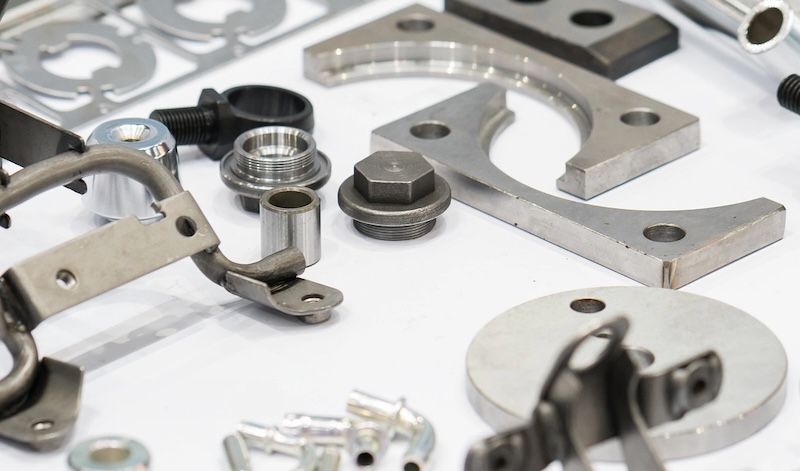
A collaborative robot arm contains hundreds of custom machined components. Actuator housings, gearbox flanges, joint brackets, and end-effector mounts each carry tight dimensional tolerances that determine whether the assembly performs to specification or introduces compounding error across the kinematic chain.
For robotics OEMs scaling from prototype to production volume, finding a CNC supplier that can consistently hold those tolerances is not a sourcing exercise – it is an engineering qualification process.
In 2026, a growing share of that qualification work is being directed at Chinese CNC manufacturers. The combination of machining capacity, material range, and unit economics makes China’s manufacturing base attractive for robotics hardware – and a new generation of structured platforms offering access to a verified CNC machining supplier network, where factories are pre-screened for equipment capability, tolerance range, and certification status before any RFQ is released, is changing how OEMs approach the search.
The challenge has never been whether capable Chinese CNC suppliers exist. It has been finding and qualifying them without absorbing the cost and schedule risk of getting it wrong.
What precision means for robotics hardware
The tolerance requirements in robotics are not uniform, but they are consistently demanding. Structural brackets might tolerate ±0.1 mm. Bearing seats and shaft fits typically require ±0.01 mm or tighter.
Surface finish requirements on mating faces, sealing surfaces, and optical components vary by application but are frequently specified to Ra values that push standard machining centres to their limits.
Material selection adds another layer of complexity. Aluminium alloys remain common for weight-sensitive structures, but robotics assemblies increasingly incorporate stainless steel, titanium, and engineering plastics in components that must survive thermal cycling, chemical exposure, or regulatory environments such as food processing or medical device integration.
A supplier that machines aluminium housings reliably may have limited experience with the specific alloys or heat treatment requirements a particular design demands.
For OEM procurement teams, this means that supplier selection cannot be based on price and general capability claims alone. The evaluation has to establish whether a specific factory has the equipment, process knowledge, and quality systems to execute a specific design reliably at production volumes.
Why qualification has traditionally been the bottleneck
Direct sourcing from Chinese CNC manufacturers has historically required significant upfront investment. Finding credible suppliers means navigating a fragmented market where capability information is largely self-reported, certifications are not always independently verifiable, and communication barriers create risk around drawing interpretation.
The cost of a bad qualification decision is high. A supplier that misreads a GD&T callout, uses a non-conforming material grade, or lacks the metrology equipment to verify its own output can produce an entire batch of non-conforming parts before the problem surfaces.
For an OEM under schedule pressure, the downstream impact of a late, non-conforming delivery cascades through assembly planning, customer commitments, and production cost.
The result has been that many robotics OEMs either rely on a small number of trusted suppliers they have qualified over years – concentrating risk – or accept the time and cost of extensive manual qualification for each new supplier relationship. Neither is a good answer for a company scaling production.
How OEMs are approaching supplier qualification in 2026
The qualification frameworks that experienced robotics procurement teams are applying in 2026 share a common structure, even if the specifics vary by application.
Capability-first screening. Before a drawing is shared, the supplier’s equipment list is evaluated against the part requirements.
Five-axis machining centres, live tooling capability, EDM, and Swiss turning each cover different geometry and tolerance ranges. A supplier without the relevant equipment cannot be qualified regardless of price.
Certification verification. ISO 9001 is a baseline, not a differentiator. For robotics applications that feed into automotive, medical, or aerospace programmes, IATF 16949, ISO 13485, or AS9100D certification may be required.
These are verified by third parties and indicate a quality management system with documented process control, not just post-production inspection.
DFM review before order award. Qualified suppliers ask questions. A factory that quotes without querying ambiguous tolerances, unspecified surface finishes, or potentially unmachineable features is not engaging with the design.
OEMs increasingly treat the quality of a supplier’s pre-quote questions as a qualification signal in itself.
Sample validation with full measurement report. First article inspection with a complete dimensional report against the drawing is standard for any new supplier relationship.
For tighter tolerance features, CMM reports are expected. The sample stage reveals whether the supplier’s quality control infrastructure can actually verify what their machines produce.
The supplier concentration risk behind the cost argument
There is a secondary driver behind the move toward structured supplier qualification that gets less attention than cost savings: concentration risk.
A robotics OEM that sources a critical machined component from a single supplier – however trusted – is exposed if that supplier hits a capacity constraint, quality failure, or geopolitical disruption. The qualification investment required to develop a backup supplier is often cited as the reason diversification does not happen.
When the qualification groundwork has already been done through a verified supplier network, adding a second or third qualified source for a given part becomes operationally tractable.
For OEMs whose production schedules are tied to customer commitments, the ability to redirect volume quickly is not a nice-to-have. It is a supply chain design requirement.
Getting qualification right before scaling
The economics of robotics hardware manufacturing reward getting supplier qualification right early. The cost of a qualification failure at prototype stage – a missed tolerance, a non-conforming material, a surface finish that requires rework – is manageable.
The same failure at production volume, with committed delivery dates and customer obligations, is not.
OEMs that treat supplier qualification as an engineering process rather than a procurement shortcut are building the supply chain infrastructure that production scaling requires. In China’s CNC machining sector, the capability exists. The discipline is in finding it systematically.
