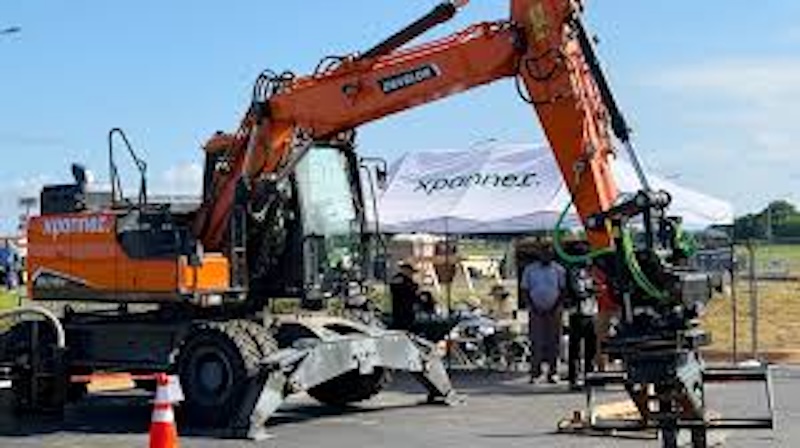
Xpanner, a provider of construction automation equipment, has raised $18 million in Series B bridge funding. The round was led by Korea Investment Partners with participation from KB Investment (KBIC), both existing global investors.
The raise brings Xpanner’s total funding to $38 million and marks a focused effort to expand its subscription-based automation solution across the US market.
Ryan Park, co-founder and CFO and CSO of Xpanner, says: “We’re thrilled to have KIP’s continued support as we enter our next chapter.
“This capital will accelerate our Physical AI solutions tackling labor shortages and jobsite productivity – and fast-track our subscription model expansion.
“Our focus now is building recurring subscription revenue on top of a proven customer base, driving both growth and profitability.”
Sangjoon Park, managing director at Korea Investment Partners, says: “Few Physical AI companies in construction, anywhere in the world, reach commercial traction and profitability this quickly.
“Customer conversations on the ground gave us the conviction to return as investors and the shift to subscriptions is what turns a strong product into a truly scalable business.”
Since its founding in South Korea in 2020 by industry veterans from Bobcat, BMW, Boeing, Hexagon, and Volvo Construction Equipment, Xpanner has grown into the only company in construction Physical AI with both meaningful revenue and proven profitability.
The company expanded to the US in 2023 with a mission to convert cutting-edge autonomous technology into tangible productivity gains for operators on active job sites.
Today, Xpanner partners with industry leaders including Mortenson, Black & Veatch, and QCells and has earned recognition on BuiltWorlds Global Robotics Top 50 List for 2023-2025.
The company expanded to the US in 2023 with a mission to convert cutting-edge autonomous technology into tangible productivity gains for operators on active job sites.
Today, Xpanner partners with industry leaders including Mortenson, Black & Veatch, and QCells and has earned recognition on BuiltWorlds’ Global Robotics Top 50 List for 2023-2025.
Since entering the US market, the company has grown 10x year-over-year with zero churn. As of Q1 2026, Xpanner is sustainably profitable, with cumulative revenue exceeding $31 million – more than 90 percent of it earned in the US.
Market penetration is equally significant. Xpanner has completed transactions with or entered active discussions with 19 of the top 20 US solar farm EPCs, a penetration rate that has earned it recognition as the only “market-proven company” in construction Physical AI.
At the heart of Xpanner’s offering is software-defined machinery (SDM) – the principle that existing construction equipment should evolve through software, not hardware replacement.
The company’s flagship product, X1 Kit, is a full-stack solution that integrates integrating SDM and retrofit hardware with task-specific automation licenses. Xpanner currently offers field-ready solutions for piling and material handling.
Rather than selling equipment outright, Xpanner delivers automation capabilities through its Automation-as-a-Service (AaaS) subscription model – essentially bringing the pay-as-you-go concept to construction machinery, making automation accessible without large upfront investment.
The timing of this raise reflects surging global demand for AI data centers, Battery Energy Storage Systems (BESS), and utility-scale solar farms; all of which require large-scale construction that is increasingly difficult to staff with traditional labor.
Xpanner’s platform sits at the intersection of two megatrends: the construction industry’s labor crisis and the explosive buildout of AI-era energy infrastructure.
With the top US solar EPCs already in its network, the company has effectively proven that its AaaS model works at enterprise scale.
Kiho Lee, director at KB Investment, says: “What makes Xpanner compelling is that they’ve already de-risked the hardest part by proving the product works with top EPCs at scale, and doing it profitably.
“Solar piling gave them the foothold. BESS and AI data centers give them the runway. That combination of proven execution and a rapidly expanding market opportunity is exactly why we doubled down.”
