The global snack industry is undergoing a structural shift that is forcing manufacturers to rethink how production lines are designed, particularly at the end-of-line stage where packaging and case handling take place.
While the sector continues to grow, industry observers say the more significant change lies in the increasing complexity of production. A proliferation of product formats – from single-serve packs to multipacks and e-commerce-ready cartons – is driving a sharp rise in SKU counts, placing new demands on manufacturing systems.
Production environments that were once optimized for long, stable runs are now required to handle near-continuous changeovers.
Seasonal launches, limited-time product variations, and evolving retail requirements are contributing to a more dynamic operating environment, where flexibility is becoming as important as output.
This shift is reshaping how performance is measured across snack manufacturing. Speed and scale remain important, but manufacturers are placing greater emphasis on adaptability, uptime, and the ability to maintain consistency across multiple packaging formats.
Industry participants say that end-of-line automation – traditionally seen as a relatively fixed and predictable part of the production process – is becoming a more critical factor in overall line performance.
In particular, secondary packaging systems such as case sealing are coming under increased scrutiny. In facilities with frequent product and packaging changes, manual adjustments and semi-automated processes can introduce small but cumulative delays, while also increasing the risk of inconsistent output.
To address these challenges, equipment manufacturers are developing systems designed to automatically adjust to varying case sizes without manual intervention.
These “random” case sealing technologies are intended to support production environments where variation is continuous, rather than occasional.
The broader trend reflects a shift in how manufacturers view production infrastructure. Rather than treating flexibility as an optional feature, companies are increasingly embedding it into the core design of their operations.
This evolving approach is expected to be a key theme at Interpack 2026, where suppliers are showcasing updated end-of-line solutions aimed at improving adaptability, reducing downtime, and supporting more complex packaging workflows.
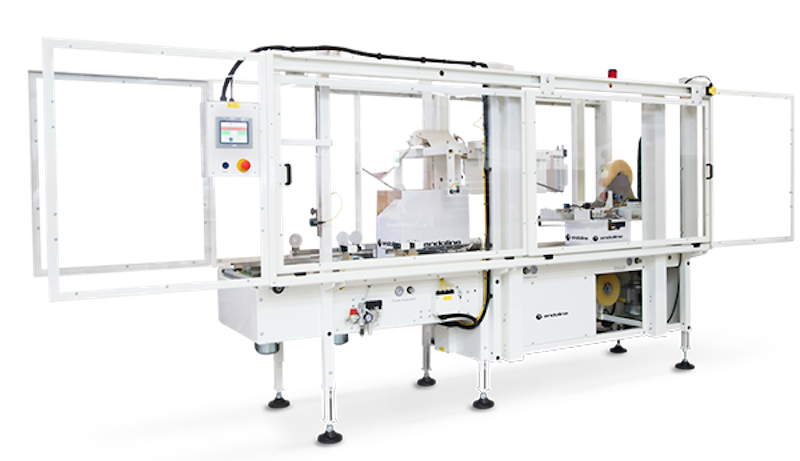
Among them, Endoline Automation is presenting what it describes as a re-engineered fully automatic random case sealing system (pictured above), designed to align with modern production requirements such as space efficiency, usability, and lifecycle performance.
The company says the system reflects a broader industry transition toward more flexible and responsive automation.
