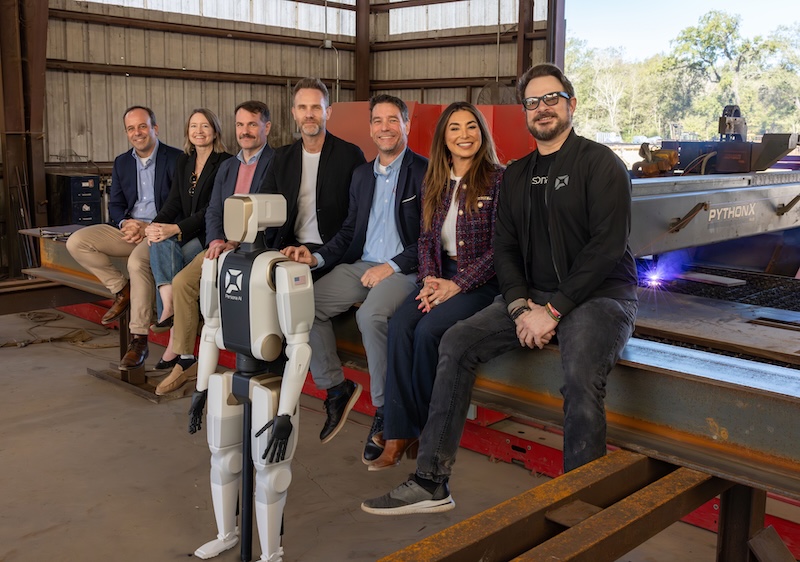
The State of Louisiana has signed a memorandum of understanding with Persona AI to launch a humanoid robotics pilot program inside an active heavy-industry facility, marking what officials describe as a rare instance of a US state formally supporting humanoid robot development in a live industrial setting.
The pilot will be conducted at SSE Steel Fabrication’s large-scale steel fabrication facility in St Bernard Parish and will focus on collecting real-world data on human movement and task execution in a working manufacturing environment.
According to the announcement, the initiative is intended to support the development of humanoid robots capable of operating in environments “originally built for humans rather than redesigned for traditional automation”, including the use of existing tools, navigation across uneven terrain, and adaptation to changing shop-floor conditions.
The agreement was facilitated by Louisiana Innovation, a division of Louisiana Economic Development, with support from Greater New Orleans.
State officials say the pilot positions Louisiana as a testbed for embodied AI systems in advanced manufacturing and industrial workforce applications.
“This is exactly the kind of applied innovation Louisiana should be leaning into,” said Josh Fleig, chief innovation officer at Louisiana Economic Development.
“Partnerships like these will allow our small businesses to adopt new tools, modernize the way they operate and compete at a higher level.
“As companies innovate, they’re not just growing their bottom line; they’re creating pathways to higher-skill, higher-paying careers that strengthen their workforce and expand opportunity across Louisiana.”
SSE Steel’s fabrication plant will serve as the proving ground for Persona AI’s humanoid platforms, which are being designed for deployment in heavy industry sectors facing persistent labor shortages and operational complexity.
“This collaboration allows us to explore emerging technologies where they matter most, on the shop floor, not in a lab,” said Justin Airhart, chief operations officer of SSE Steel Fabrication.
“SSE Steel has long embraced innovation in service of safety, productivity, and workforce sustainability. Supporting this pilot aligns directly with that mission.”
Persona AI is developing humanoid robots aimed at what the company refers to as “4D jobs”, defined as work that is “dull, dirty, dangerous, and declining”.
The company says its approach is focused on augmenting human workers rather than replacing them, with robots handling higher-risk or difficult-to-staff tasks while skilled tradespeople move into supervisory, quality assurance, and robotic operations roles.
“Partnering with the State of Louisiana allows us to accelerate humanoid development in one of the most industrially relevant regions in the country,” said Nicolaus Radford, CEO of Persona AI.
“Louisiana is actively investing in the innovation required to rebuild domestic shipbuilding and heavy manufacturing capacity. Working alongside LA.io, GNO, and industrial leaders like SSE Steel gives our humanoid the conditions it needs to mature and deploy at scale.”
State and regional leaders say the pilot reflects growing national interest in humanoid robotics across manufacturing, maritime, energy, defense, and infrastructure sectors.
Supporters argue that, historically, the adoption of advanced automation technologies has led to the creation of new roles such as robot technicians, systems operators, safety supervisors, and data specialists.
Michael Hecht, president and CEO of GNO, says: “Real innovation happens when you take what already works and responsibly push it into what’s next – exactly what SSE Steel and Persona AI are doing in St Bernard Parish.
“Louisiana has the industrial depth to deploy AI in the real world, at real scale, in ways that strengthen operations while preserving and upskilling jobs.
“This pilot is about modernizing proven processes safely, attracting sustained investment, and building a durable competitive advantage for our industrial workforce and communities.”
The pilot is currently focused on data collection and real-world validation ahead of any wider deployment. Officials say additional details will be announced as the project progresses.
