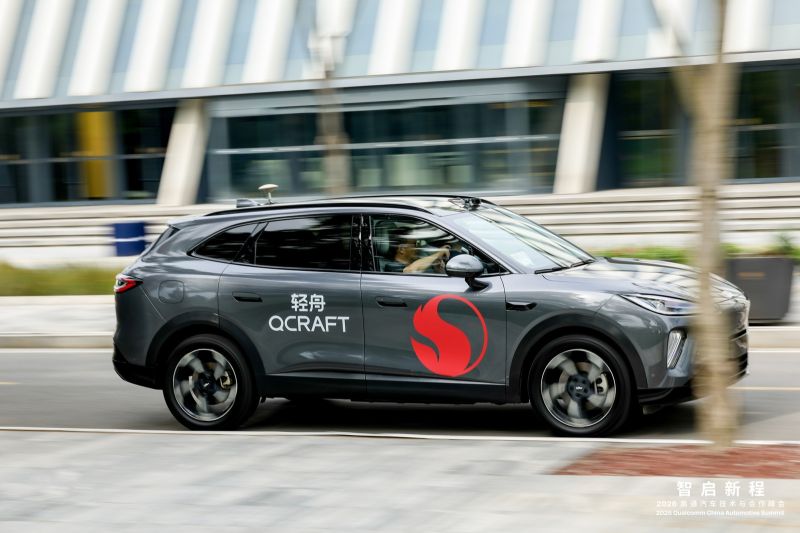
QCraft has demonstrated its urban Navigate-on-Autopilot (NOA) system running on Qualcomm’s SA8650P Snapdragon Ride platform in production vehicles, putting the autonomous driving company on track for global mass production this year.
The demonstration took place on June 5 at Qualcomm’s Automotive Technology and Cooperation Summit in Wuxi, China, where attendees took live test rides in SA8650P-equipped production cars navigating real urban traffic.
According to QCraft, the vehicles handled unprotected left turns, mixed pedestrian and vehicle traffic, tunnels, transitions between main roads and side streets, and congested maneuvering with smooth, human-like control.
The milestone comes roughly nine months after QCraft and Qualcomm formed a strategic partnership in September 2025.
In that time, QCraft says it has completed both development and on-road validation of highway and urban NOA on two Snapdragon Ride platforms – the SA8775P and the SA8650P – with global deliveries planned for 2026. A higher-compute solution based on Qualcomm’s QAM8797P platform is now in joint development.
Dr Dong Li, chief technology officer at QCraft, says: “QCraft’s development on the Snapdragon Ride platform has entered the fast lane toward mass production.”
QCraft is backing its mass-production push with fleet data. The company’s QPilot assisted-driving system has now shipped on nearly 30 production models, with more than 50 additional models expected in 2026.
Across its fleet, the system has supported more than 3.5 billion user-driven kilometers and over 100 million parking-assist uses, while maintaining an automatic emergency braking false-trigger rate of less than once per 500,000 kilometers.
The company estimates the technology helps users avoid more than 146,000 potential accidents each year.
In a keynote at the summit, Li argued that the industry has reached an inflection point in the shift from autonomous driving toward general-purpose physical AI, with world models and reinforcement learning serving as the essential bridge.
He pointed to QCraft’s cloud-based world model, which the company says offers controllable, physics-aligned video generation, alongside a zero-shot engine that uses natural language to generate training scenarios.
The positioning reflects a wider trend among autonomous driving developers, who increasingly present their driving stacks as the first large-scale commercial application of physical AI rather than an end in themselves.
For Qualcomm, the demonstration provides another proof point for its automotive ambitions, showing Snapdragon Ride silicon supporting city-level assisted driving in production vehicles – a segment where Nvidia and Horizon Robotics are also competing for design wins.
QCraft says global mass production of its Qualcomm-based solutions remains on schedule for 2026.
