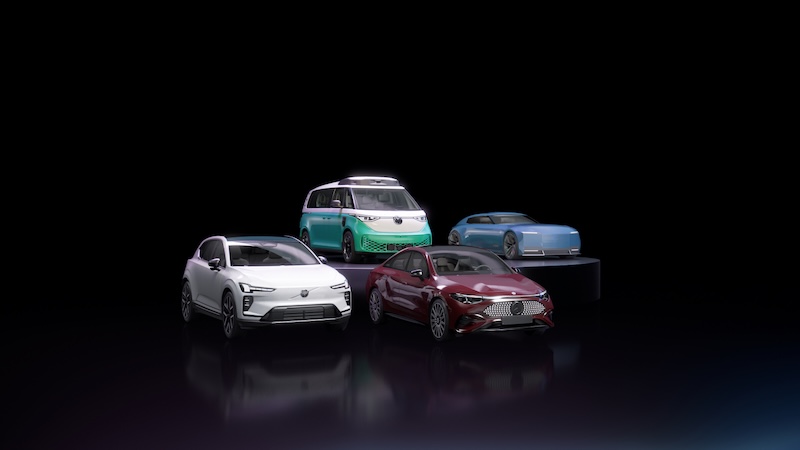
European automakers and mobility companies, including Mercedes-Benz, Volkswagen, Volvo Cars, Bolt and Einride, are expanding their autonomous driving programs through new technology partnerships and vehicle development initiatives.
The developments, announced at GTC Berlin, involve the use of Nvidia’s Hyperion computing platform and associated AI software to support advanced driver assistance, Level 3 automated driving and Level 4 autonomous vehicles.
The announcements cover passenger vehicles, robotaxis, autonomous freight trucks and public transportation, with several companies outlining plans for commercial operations in Europe.
Bolt plans European robotaxi expansion
Bolt has selected Nvidia’s Alpamayo autonomous driving software for its European robotaxi program, initially targeting future Lucid vehicles equipped with Hyperion.
The company plans to begin collecting real-world driving data in Madrid in 2027, subject to regulatory approval, with Germany identified as another priority market.
Bolt’s longer-term plans include a European fleet of at least 25,000 Level 4-capable Lucid vehicles.
Meanwhile, Volkswagen Commercial Vehicles is developing its autonomous ID. Buzz AD platform using Hyperion to support different autonomous driving systems and commercial transportation applications.
Volvo Cars is incorporating Hyperion and Alpamayo software into future vehicles, while Mercedes-Benz is extending its collaboration with Nvidia to support Level 3 and Level 4 driving capabilities.
Mercedes-Benz also expects its MB.DRIVE ASSIST PRO system to receive approval for urban point-to-point driver assistance in Germany.
Autonomous freight and public transportation
Swedish autonomous trucking company Einride is developing its next-generation Einride Driver system using Hyperion, Alpamayo and Cosmos AI models.
The company aims to improve autonomous freight operations through simulation, AI training and vehicle safety validation.
Separately, TIER IV and the Technical University of Munich are planning to use Hyperion in the development and testing of autonomous public transportation systems in Germany.
Automotive suppliers Aptiv, Valeo and Schaeffler are also developing computing platforms intended for integration into future autonomous vehicles.
New safety framework for autonomous vehicles
Alongside the automotive partnerships, Nvidia introduced Halos SAFE, a framework designed to help autonomous vehicle developers produce measurable evidence of system safety.
Developed with collaborators including dSPACE, IVEX and TÜV Rheinland, the framework combines simulation, laboratory testing, on-road evaluation and fleet monitoring.
Nvidia also announced Alpamayo 2 Edge, a new AI reasoning model designed for in-vehicle perception and motion planning, alongside additional tools for synthetic driving data generation.
Other initiatives include an autonomous vehicle data development partnership with Uber and a Porsche-led project using simulation and fleet data to improve autonomous driving model evaluation.
Nvidia says the combined technologies are intended to help vehicle manufacturers accelerate development while establishing more consistent methods for evaluating autonomous driving performance and safety.
