Here’s your quick checklist on how to hire automated manufacturing employees with skills assessments. Read on for more details.
- Map the job first: List what a new hire does in the first weeks and mark each skill as required on entry or trainable after hiring.
- Test only entry requirements: Leave plant-specific procedures you plan to teach out of the hiring test.
- Combine evidence types: Pair knowledge questions (mechanical reasoning, applied math, instruction reading) with a safe, controlled practical task.
- Write the scoring rules before testing: Use observable rubric levels and avoid arbitrary pass marks.
- Keep safety authorization separate: A pre-hire test never replaces the training and certification your safety program requires.
How to hire automated manufacturing employees
Picture two applicants for an operator vacancy on an automated packaging line. One talks fluently about robots and vision systems.
The other recognizes that 24.9 mm falls within a 25.0 mm dimension with a tolerance of ±0.2 mm, follows a four-step work instruction and explains why a large pulley driven by a small one turns more slowly.
Only the second applicant has shown skills a hiring team can record and compare.
That gap matters because the talent pool is tight. Deloitte and The Manufacturing Institute project that US manufacturing will need 3.8 million workers by 2033, with as many as 1.9 million jobs potentially unfilled if the skills gap isn’t addressed, a point covered in this look at how automation created a training problem for the industrial workforce.
Automation raises the skill bar on the plant floor, so interviews alone rarely tell you who can read a drawing, follow a procedure or reason through a mechanism.
A manufacturing skills assessment is a structured evaluation of job-relevant capabilities. The steps below show how to define the role, choose the right tests, score results consistently and turn them into hiring and training decisions.
Clearly Define the Role and Responsibilities
The US Office of Personnel Management (OPM) treats job analysis as the starting point for any assessment strategy: identify the tasks performed on the job, then the competencies needed to do that work.
For shared vocabulary, NIST’s Office of Advanced Manufacturing maintains the Manufacturing USA Advanced Manufacturing Occupation and Competency Framework, which aims to give industry, training providers and workers a common language. It helps describe capabilities, but it isn’t a ready-made hiring test.
- Key Responsibilities: Ask an experienced operator and the technical supervisor to list what a new operator does in the first weeks. Typical tasks include loading parts, checking a dimension, reading the HMI (the machine’s operator touchscreen), logging counts and calling for help when an alarm appears. Then separate the skills candidates must bring on day one from those your company teaches after hiring.
- Experience Levels: Keep operator and technician requirements apart. An operator may need to recognize an alarm and follow the documented escalation step. A maintenance technician on the same line may need electrical knowledge and controls troubleshooting. The US Bureau of Labor Statistics (BLS) notes that industrial machinery mechanics typically need a high school diploma and more than a year of on-the-job training, so a technician posting usually calls for proven experience that an operator posting does not. Include programming knowledge only if the job analysis establishes it as an entry requirement.
- Company Fit: In a smaller plant, one operator may cover several machines, basic changeovers and first-line quality checks. In a larger facility, roles are usually narrower and documented procedures are more detailed. Write the role around how your line actually runs rather than a generic job title.
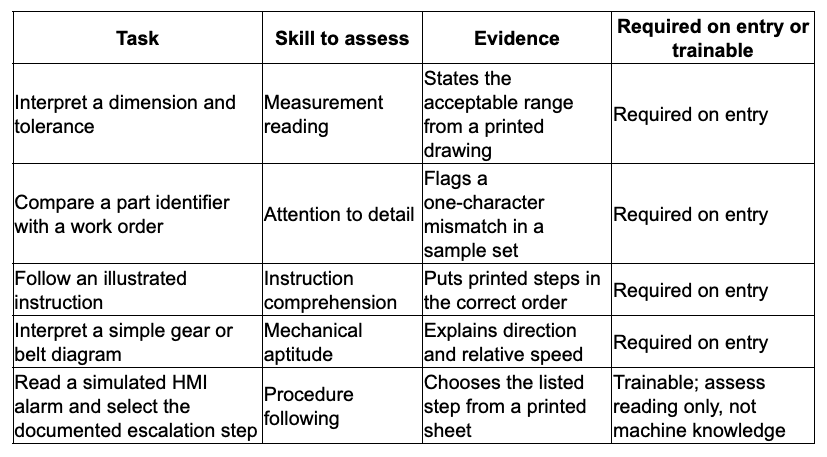
The illustrative matrix below describes one hypothetical automated cell. Adapt its entry requirements to the work and training your role involves.
Certifications
Certifications can support a hiring decision, but they shouldn’t replace a role-specific assessment.
- MSSC Certified Production Technician (CPT): The Manufacturing Skill Standards Council’s CPT program certifies front-line production skills. Candidates earn the full certification by passing four modules: Safety, Quality Practices & Measurement, Manufacturing Processes & Production, and Maintenance Awareness. A fifth module, Green Production, is also offered.
- How to use credentials: Treat a CPT or similar credential as a positive signal, not an entry requirement, unless your job analysis shows the role depends on that knowledge. Requiring credentials that many qualified local applicants don’t hold can shrink your applicant pool without improving the hire.
- Verify, don’t assume: Confirm any credential directly with the issuing body and still assess the specific skills your matrix marks as required on entry.
Leverage Multiple Assessment Methods
No single test covers everything an automated line demands. OPM’s assessment guidance lists estimated validity of .54 for work sample tests and .51 for cognitive ability tests, and notes that tools measuring different job-related factors each add unique information about the applicant.
Combine methods instead of relying on one score.
- Knowledge and aptitude tests: Multiple-choice tests on mechanical reasoning, applied math and instruction reading work well as an early screen because they are quick to administer and score the same way for every candidate.
- Work samples: A controlled practical task shows whether a candidate can do the work, not just describe it. OPM cautions that if training on how to perform the work activities will be provided after selection, the work sample method may not be appropriate. Testing candidates on a plant-specific changeover procedure you plan to teach can reward prior exposure to that process.
- Structured interviews: Use the same job-relevant questions for every candidate and review the answers alongside the test evidence.
Assess Technical Skills
Use the task matrix to select knowledge questions and, where practical competence is required on entry, a controlled task demonstration.
- Tools and Software: Match the math to your work orders. The NTMA Mechanical Aptitude Test, from the National Tooling and Machining Association, includes an Applied Mathematics section covering basic operations, units, conversions and decimal places, among other topics. Select the operations your role requires rather than testing every topic available. Shape each problem like a real work order. For example, a work order calls for 240 units and each carton holds 24. The candidate should answer 10 cartons and include the unit label.
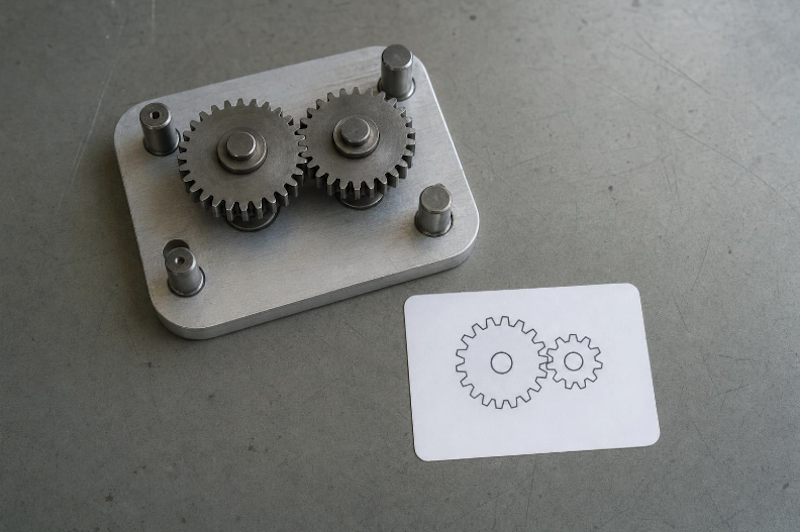
- Mechanical Reasoning: Questions about gears, pulleys, levers and hand tools assess a candidate’s understanding of how mechanisms behave. The Criteria Mechanical Reasoning Assessment (CMRA), for example, has up to 30 questions and takes about 15 minutes. Use any result as evidence about the concepts assessed, and confirm practical competence separately before authorizing equipment use.
- Assessments: Off-the-shelf vendor content can save time, provided you check each question against the role matrix. Platforms such as E Skill offer manufacturing assessments covering mechanical aptitude, reading and following instructions, interpreting blueprints and graphs, and units, dimensions and numerical sequences, with roles such as equipment operators and assembly line workers in scope. The platform’s customization options let employers edit tests and upload their own questions about plant processes. Have the supervisor review any custom questions for job relevance and clear scoring criteria, and inspect all vendor content for reading demands, completion time and wording that assumes knowledge candidates will learn after hiring.
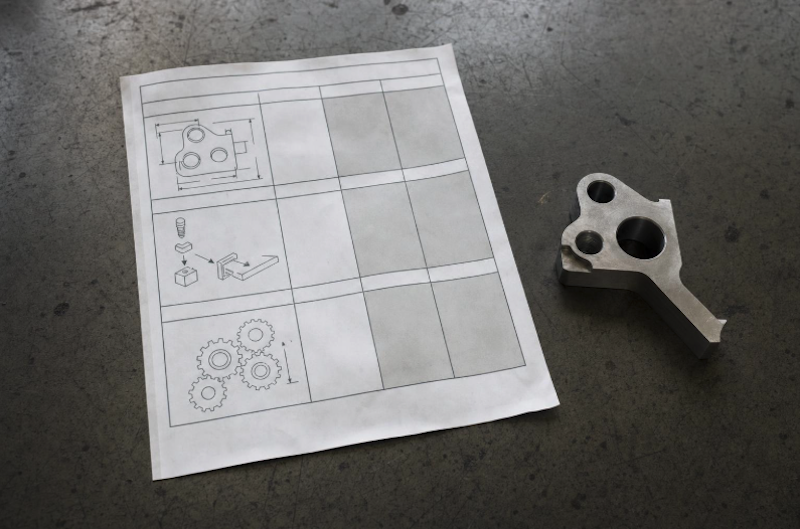
- Practical Demonstration: Use an inert sample part, printed instructions or a de-energized training rig approved by a safety reviewer. Where the matrix requires the skill on entry, ask the candidate to measure a sample part with calipers and record the reading, or put printed instruction cards in order. Never ask an untrained person to operate a production robot, work on energized equipment or bypass a safeguard.
- Scoring: OPM’s guidance calls for standardized reviewing and scoring procedures. Write the criteria before candidates take the assessment, then have assessors score the same sample responses independently and resolve differences before using the rubric for real decisions.
A three-level rubric for practical tasks can describe observable behavior:
-
- Measurement accuracy: incorrect reading; correct after a defined prompt; independently correct and recorded with units.
- Instruction following: steps out of order; correct order after a prompt; correct order unprompted.
- Documented escalation: chooses an undocumented action; chooses the documented step after a prompt; chooses it unprompted and explains why.
- Cutoff Scores: Avoid an arbitrary pass mark. Under the Uniform Guidelines (29 CFR 1607.5(H)), cutoff scores should normally be set so they are reasonable and consistent with normal expectations of acceptable proficiency in the workforce. There is no universal manufacturing pass mark, so tie cutoffs to documented entry requirements and seek qualified assessment advice before using a score to reject candidates.
- Reading Scores: A raw score records performance on the test, while a percentile places that result within a comparison group. The CMRA report shows both, and they aren’t interchangeable. Don’t assume scores from different assessments carry equivalent meanings.
Evaluate Soft Skills and Cultural Fit
On an automated line, soft skills show up as dependable habits around quality and safety. Assess them through behavior you can observe, not general impressions.
- Communication: Operators hand over shifts, report faults and call for help. Ask candidates to explain, in plain words, what they would tell a supervisor about a recurring alarm, and listen for clear, specific information.
- Problem-Solving: Give a short scenario, such as a count mismatch between the HMI and the shift log, and ask how the candidate would investigate. Look for a logical sequence and a willingness to escalate rather than improvise.
- Attention to Detail: Use the matrix task that asks candidates to compare part identifiers against a work order. Flagging a one-character mismatch is a direct, scorable signal of the care quality-critical work demands.
Make every assessment accessible. Under 29 CFR 1630.11, covered US employers must select and administer tests so that results for an applicant with a disability affecting sensory, manual or speaking skills reflect the skill the test is meant to measure rather than the impairment, unless the test is designed to measure those skills.
Name an accommodation contact in the invitation, give clear instructions and explain how candidates can report technical problems. Document any interruption so an equipment or access issue isn’t mistaken for a skills gap.
Conduct Thorough Background and Reference Checks
- Background Checks: If you use a third-party screening company, the Fair Credit Reporting Act applies. Before getting a background report, you must disclose to the candidate that you intend to get it and obtain their written authorization. Many states and cities add their own rules, so confirm local requirements.
- Reference Checks: Ask former supervisors job-related questions tied to your matrix: how the candidate followed written procedures, handled quality checks and responded to equipment alarms.
- Consistency: Ask every reference the same core questions and record answers in the same format, so you compare candidates on the same evidence.
Offer Competitive Compensation and Benefits
- Market Rates: Base pay offers on current wage data for the closest occupation. BLS wage data for May 2025 puts the US median for packaging and filling machine operators and tenders at USD 20.78 per hour (USD 43,220 per year), with the 10th percentile at USD 16.06 and the 90th percentile at USD 28.86. For industrial machinery mechanics, machinery maintenance workers and millwrights, the May 2025 median annual pay was USD 64,100 (USD 30.82 per hour). Adjust for your region, shift pattern and the skills your matrix requires on entry.
- Benefits: Spell out shift differentials, overtime rules, paid time off and any paid training or tuition support in the posting. Paid training is especially relevant when your matrix marks key skills as trainable, because it widens the applicant pool to capable candidates who haven’t run your equipment yet.
Provide Onboarding and Continuous Development
Review assessment evidence alongside the structured interview, and compare each candidate’s evidence with the documented entry requirements before deciding.
Ranking candidates by total score alone can hide a missing requirement or give too much weight to a skill you plan to teach.
If a candidate doesn’t demonstrate an entry requirement, review the response, the scoring criteria and any testing problems before rejecting. For candidates who meet the requirements, use the remaining evidence to plan training.
- Keep safety authorization separate: In the United States, OSHA’s hazardous-energy standard (29 CFR 1910.147) requires employers to certify that employee training has been accomplished and is kept up to date, with each employee’s name and dates of training. A pre-hire assessment doesn’t satisfy that obligation or authorize a new hire to operate equipment unsupervised. Other jurisdictions have their own requirements.
- Plan supervised instruction: A strong mechanical reasoning result can support a training discussion, but it doesn’t establish readiness for independent machine operation. If your company teaches caliper use or a plant-specific changeover, plan supervised instruction after hiring rather than testing for it.
- Pilot before expanding: Start with one role and review the process after a hiring cycle. Document which questions address the role’s entry requirements, record incomplete tasks caused by technical problems and note where assessors disagreed.
- Keep the matrix current: Resolve unclear instructions or scoring rules before the next hiring round, keep a record of revisions and revisit the task matrix whenever equipment, duties or planned training change.
