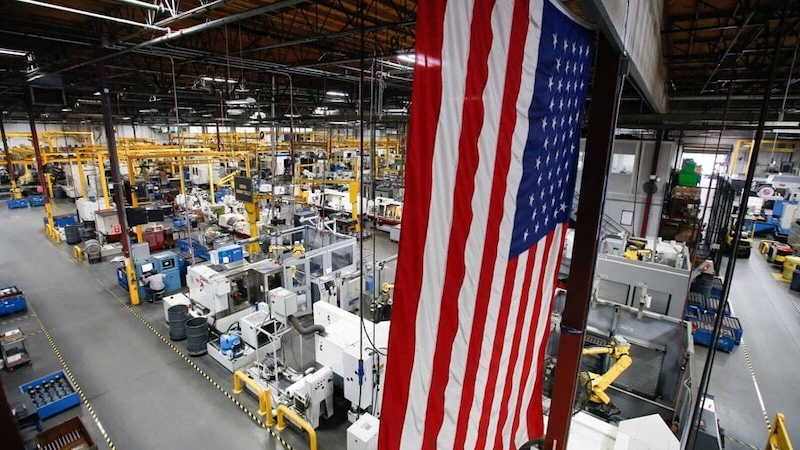
Every automation project is sold on efficiency – faster lines, fewer errors, lower cost per unit. What rarely makes the business case is the problem the same project creates the day the equipment arrives: a workforce that doesn’t yet know how to run it.
Robots and automated systems don’t eliminate the need for skilled people; they change what those people need to know, often faster than any training program was built to deliver.
The result is a quiet but growing gap between the machines on the floor and the skills to operate them – and closing it has become one of manufacturing’s defining challenges.
Why the gap keeps widening
Automation is being deployed faster than the workforce is being retrained. The International Federation of Robotics’ World Robotics 2025 report counted 542,076 industrial robots installed in a single year, with the global factory robot population more than doubling over the past decade. Every one of those installations changes the skills a plant needs.
At the same time, manufacturing can’t fill the roles it already has. Deloitte and The Manufacturing Institute project a need for 3.8 million manufacturing workers by 2033, with as many as 1.9 million jobs potentially going unfilled if the skills gap isn’t addressed.
Automation and the skills shortage aren’t separate stories – automation raises the skill bar at precisely the moment the talent to clear it is scarcest. That combination is what makes workforce upskilling an operational priority, not an HR nicety.
What the floor actually needs to learn
The skills automation demands are concrete and immediate. As lines automate, workers need to move from manual tasks to higher-order ones:
- Operating and monitoring automated production lines rather than running steps by hand.
- Maintenance and diagnostics – reading fault codes, performing preventive maintenance, minimizing downtime.
- Working safely alongside collaborative robots, where human and machine share space.
- Basic programming, parameter adjustment, and data monitoring to keep automated cells running.
None of this is covered by the training most plants built for a manual workforce. It requires deliberate reskilling of experienced workers and fast, consistent technical training for new hires entering an already-automated environment.
Why the classroom doesn’t fit a plant floor
The instinct is to schedule training sessions, but a manufacturing operation resists that model. Pulling workers off a running line is expensive in direct downtime.
Plants operate across multiple shifts and often multiple sites, so no single session reaches everyone. And turnover means the training need never stops – there’s always a new cohort entering.
A fixed classroom schedule simply can’t keep pace with those realities. Industrial training has to reach workers across shifts and locations, on demand, without stopping production – which is exactly where traditional delivery breaks down and digital delivery earns its place.
Where e-learning fits – and where it doesn’t
Digital learning solves the access problem. Self-paced e-learning lets a third-shift technician complete a module on a new system without a trainer flown in, delivers the same standard across every site, and updates the moment a process or machine changes.
For the knowledge layer – how a system works, safety protocols, diagnostic logic, operating procedures – it’s the only model that scales to a distributed, shift-based workforce.
What it can’t replace is hands-on competence. The tactile skill of a maintenance repair, the judgment of troubleshooting a live fault, the muscle memory of operating equipment safely – these still require real machines, supervised practice, and often simulation.
The workable model is blended: use e-learning to carry the knowledge and keep it current across the whole workforce, and reserve scarce hands-on and simulation time for the physical skills only practice can build.
How plants build the training
Developing this training to a usable standard is its own challenge. Internal engineers and senior operators hold the knowledge but rarely have the time or the instructional-design skill to turn it into effective learning content – and a dense procedures document uploaded to a portal is not training.
Plants generally either build that capability internally or bring in specialists; firms such as Blue Carrot e-learning development are among those that develop technical and industrial training content, pairing a plant’s own subject-matter expertise with the design and production to make it learnable.
Either route works; what fails is assuming that knowing the machine is the same as being able to teach it.
Treat upskilling as part of the automation plan
The manufacturers getting real returns from automation are the ones who stopped treating workforce training as something that happens after the robots are installed.
The skills gap an automation project creates is as predictable as the equipment lead time – and far cheaper to plan for than to scramble through once a line is live and no one can run it.
Budgeted alongside the hardware, delivered in a way that fits the floor, and kept current as the technology changes, automation upskilling is what turns an expensive installation into an actual productivity gain. The machines are only as capable as the people who run them.
Main image courtesy of Manufacturing Institute
