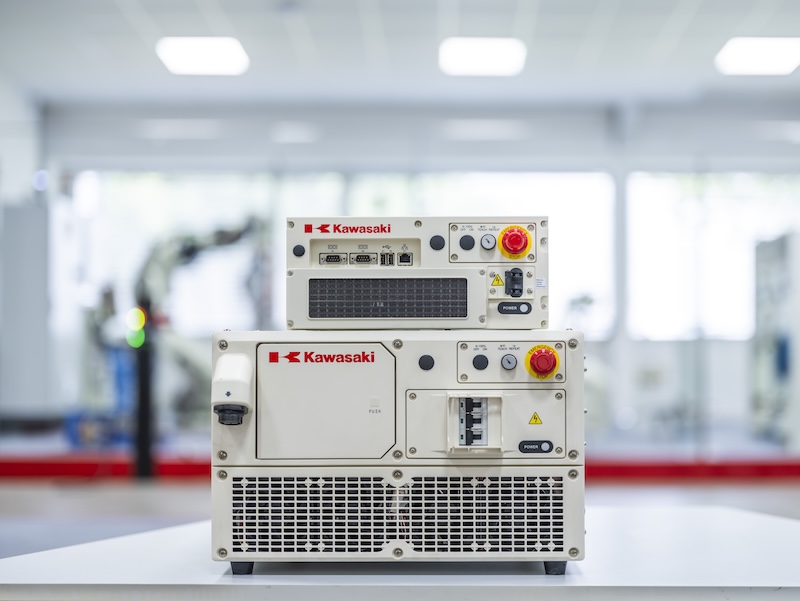
Kawasaki Robotics has introduced its F Series Controller S-type, a new industrial robot controller combining integrated safety software and cybersecurity functions with compatibility across its established F Series platform.
Available from November 2026, the controller is designed to help machine builders meet evolving European regulatory requirements while reducing engineering costs and protecting existing investments.
The S-type includes Kawasaki’s CoreCubic-S Lite safety software as standard, providing monitoring for one robot tool and one workspace. Additional safety capabilities can be added through hardware and software upgrades.
Built-in cybersecurity functions include user authentication, access management, secure communications and startup integrity checks.
The controller retains the familiar F Series hardware and operating environment, allowing customers to continue using existing programming knowledge and Kawasaki’s neoROSET offline simulation software.
Existing F Series B-type controllers can also be upgraded to the S-type without replacing the hardware.
Shuhei Kuraoka, president of Kawasaki Robotics EMEA, said: “Regulatory requirements are evolving, but our customers need solutions that deliver value well beyond compliance. With the F Series Controller S-type, we combine integrated safety and security, familiar operation and a clear upgrade path that protects existing investments.”
The controller also supports optional energy recovery technology, which Kawasaki says can reduce robot energy consumption by up to 30 percent, depending on the application.
CoreCubic-S Lite has undergone assessment by TÜV SÜD against ISO 10218-1:2025, while Kawasaki’s secure product development processes are certified to IEC 62443-4-1:2018.
The launch comes ahead of new European regulatory requirements, including the EU Machinery Regulation, applicable from January 20, 2027, and the Cyber Resilience Act’s main product requirements, which apply from December 11, 2027.
Kawasaki says the new controller will help manufacturers and integrators address these requirements, although responsibility for complete machine conformity remains with the manufacturer or integrator.
