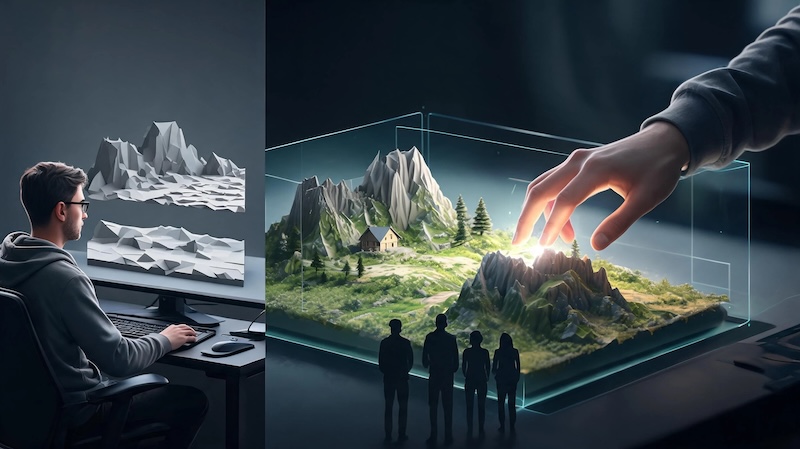
Automation is often measured by the number of individual tasks a system can complete. A more useful measure is whether the system can carry a goal across several tools and representations. Games offer a clear test because a playable experience combines language, code, 3D geometry, sound, rules and user feedback.
An AI game maker is therefore more than a content generator. It is an experiment in multimodal automation. The system receives an intention, assembles a working environment and responds to feedback after a human interacts with the result.
That loop resembles the kind of agentic workflow many robotics and industrial AI researchers are exploring: perceive a goal, act in an environment, observe the outcome and update the plan.
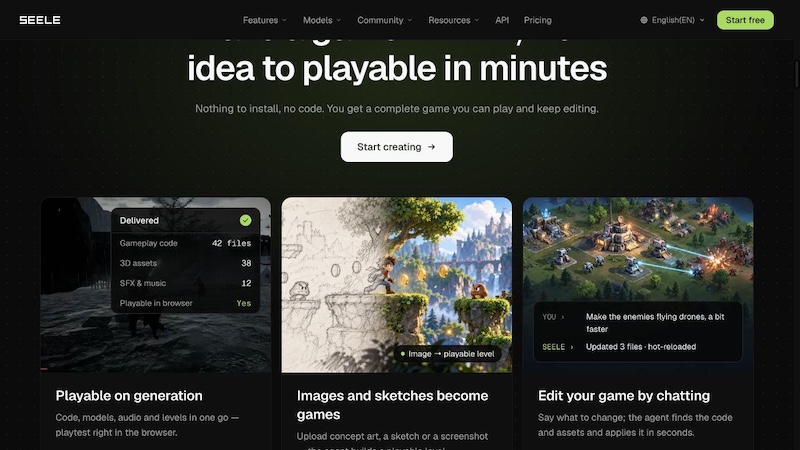
SEELE AI applies this idea to game creation. A prompt or image can become a browser-playable build with code, 3D assets, audio and levels. The creator can then describe a change and let the agent update the project.
The SEELE AI platform provides a public example of how multimodal agents can operate across a connected software pipeline.
Why games are a useful automation benchmark
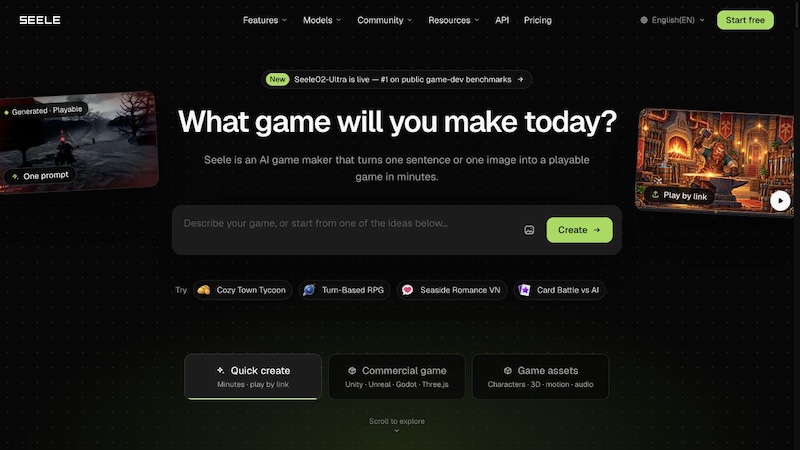
A generated image can be judged by visual quality. A generated code sample can be checked with tests. A game requires both, plus a human response. The player must understand the objective, control the system and receive meaningful feedback. This makes the game a compact environment for evaluating whether an agent’s outputs work together.
The challenge is partly structural. A change to the level may require a change to collision, navigation, camera framing, sound and UI. If the agent only edits one file, the result can break elsewhere. A useful game agent needs a representation of the project and the relationships among its parts.
That is why multimodality matters. Text can state the goal, an image can provide visual context and the project state can show what already exists. The agent has to connect those signals rather than process them as isolated prompts.
From generation to closed-loop interaction
Traditional automation often follows a fixed script. Agentic systems are more flexible because they can choose the next action based on the current state. In a game workflow, the creator might say, “the player cannot tell which door is active.” The agent must identify the relevant scene, material, lighting or interface element, apply a change and produce a new build for review.
The important output is not a paragraph explaining what changed. It is a new state that a human can test. This is a closed loop: instruction, implementation, playtest, observation and revision.
For robotics and automation professionals, the analogy is useful but limited. A game is a simulated environment, while a robot operates under physical constraints, sensor noise and safety requirements. Even so, game creation exposes the coordination problem in a form that is easy to inspect. The agent has to keep a world coherent while the human changes the objective.
3D-native understanding is a distinct capability
Three-dimensional assets are not simply images with depth added later. They have geometry, materials, scale, hierarchy, collision and relationships to the surrounding space. A model that can generate a texture may still struggle to produce an object that behaves correctly in a scene.
SEELE’s public research and product pages describe a direction toward 3D-native models and world models alongside its game foundation models. The practical implication is that future systems may treat mesh, space and temporal changes as native information. That could support applications beyond games, including simulation, training, digital twins and spatial design.
The game workflow is a natural proving ground because the object must be both visually plausible and operationally useful. A door has to look like a door, occupy the right space, respond to interaction and communicate its state to the player.
What automation teams can learn from the workflow
Several design principles stand out:
- Keep the goal explicit. Agents need a clear success condition, whether it is a playable level, a working scene or a completed task.
- Maintain project context. A sequence of isolated generations creates inconsistency. Persistent state allows the agent to make coherent edits.
- Expose intermediate results. Humans should be able to inspect and test the system before committing to a large change.
- Use feedback as data. A player’s hesitation or a failed interaction is evidence about the system, not just an aesthetic opinion.
- Separate exploration from production. A fast draft can guide later engineering, but production still requires review, observability and reliability checks.
These principles apply to many agent systems. Whether the output is a game, a simulated robot cell or a digital twin, the agent needs a world model, a tool interface and a way to learn from the result of its action.
A public-facing test of agentic UX
The most accessible AI agents are often the ones people can try without reading a long technical manual. A browser-playable game makes the loop visible: enter an intention, receive a world, interact with it and ask for a change. That simplicity can help teams evaluate whether an agent’s interface is understandable before they deploy similar workflows internally.
The long-term significance of AI game makers may therefore extend beyond entertainment. They demonstrate how an agent can coordinate creative and technical work, preserve context over multiple turns and produce an artifact that can be tested by a human. Those are central problems in automation. Try SEELE now.
