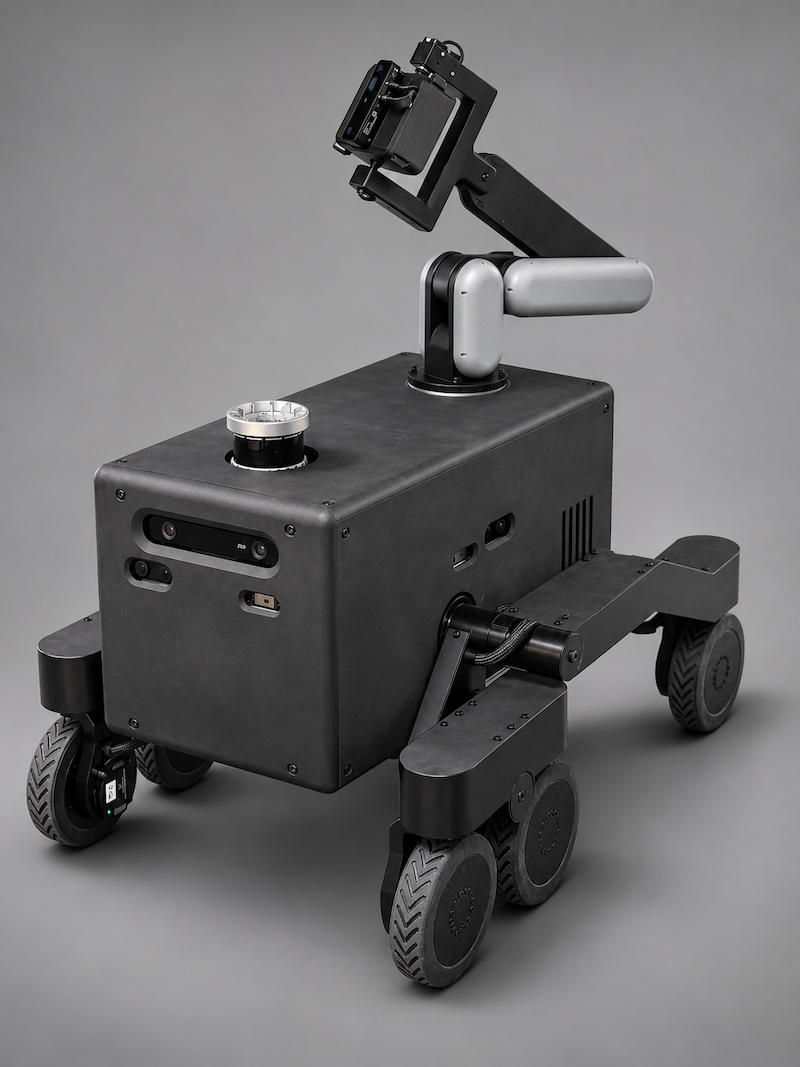
Hidonix Industries, a US-based developer of spatial intelligence and robotic systems, has launched its Hido II autonomous rover, designed to automate indoor mapping and geospatial data collection in complex environments.
First introduced as a prototype at CES 2026, Hido II is now being offered through a limited early-access program for selected venues and partners across the United States.
The rover combines autonomous navigation, advanced sensing and a modular robotic arm to collect geomagnetic and spatial data for ION, Hidonix’s indoor-outdoor positioning and navigation platform.
Operating under technician supervision, Hido II follows predefined survey routes, detects obstacles and navigates stairs and uneven surfaces without requiring continuous manual control.
According to Hidonix, comparative testing showed that the rover reduced mapping time by 50 percent and achieved positioning errors up to five times lower than manual data collection using the ION application.
The system features rocker-bogie suspension, a 2K stereo camera, Ouster LiDAR and a robotic arm designed to position its data acquisition equipment consistently while minimizing magnetic interference.
Operating time ranges from approximately five to eight hours, depending on conditions.
Achille de Pasquale, CEO of Hidonix, said: “Since introducing Hido II at CES earlier this year, our team has focused on transforming a promising prototype into a practical solution for real-world spatial data acquisition.
“Its official launch represents an important milestone in our efforts to bring robotics and automation into spatial intelligence, making indoor mapping faster, more precise and less dependent on manual processes.”
Although Hidonix primarily develops technologies for defense, public safety and mission-critical applications, Hido II is being introduced through its ION division, which focuses on commercial spatial intelligence and robotics.
The company has also previewed Hido III, a next-generation robotic platform expected to offer expanded sensing, computing and communications capabilities, with commercial availability targeted for 2027.
