An unexpectedly large event in Amsterdam offered a glimpse of how one Chinese robotics manufacturer has grown into a billion-dollar business – and how competition among Chinese companies is reshaping the global industry. Abdul Montaqim reports
I had no idea Pudu Robotics was so big. It was a complete surprise to discover that the company employs more than 1,600 people and has become one of the world’s major commercial service robotics manufacturers.
I’m not entirely sure why I was so surprised. I’ve known about Pudu Robotics for years and covered many of its developments, from its restaurant delivery robots to its more recent industrial and humanoid machines.
But robotics is still a relatively young industry in many respects, and there are plenty of companies with impressive technologies that remain comparatively small businesses.
For some reason, I had imagined Pudu was one of those companies, perhaps employing a couple of hundred people and developing a limited range of specialist robots.
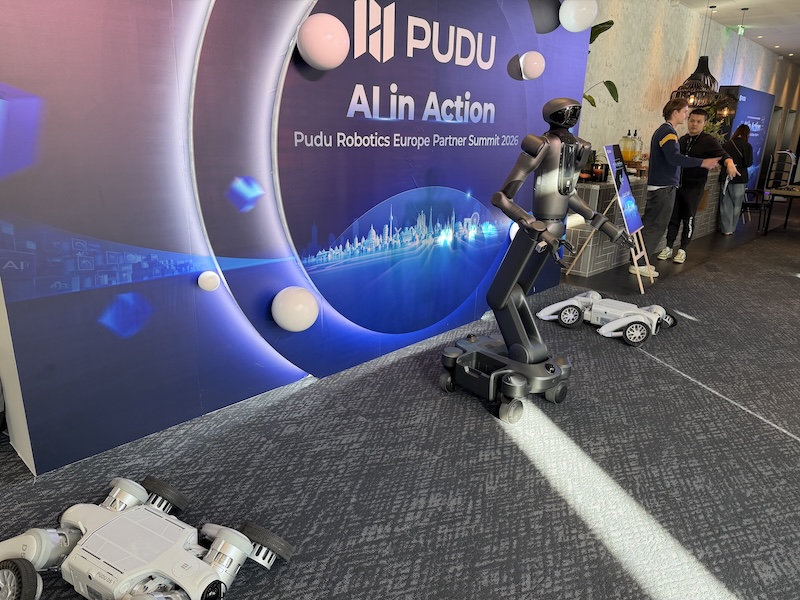
So when Pudu invited Robotics & Automation News to its European Partner Summit in Amsterdam on November 4, I pictured a relatively modest gathering: perhaps 10 or 15 journalists sitting in a meeting room, listening to executives explain the company’s latest products and plans.
What I found was something quite different.
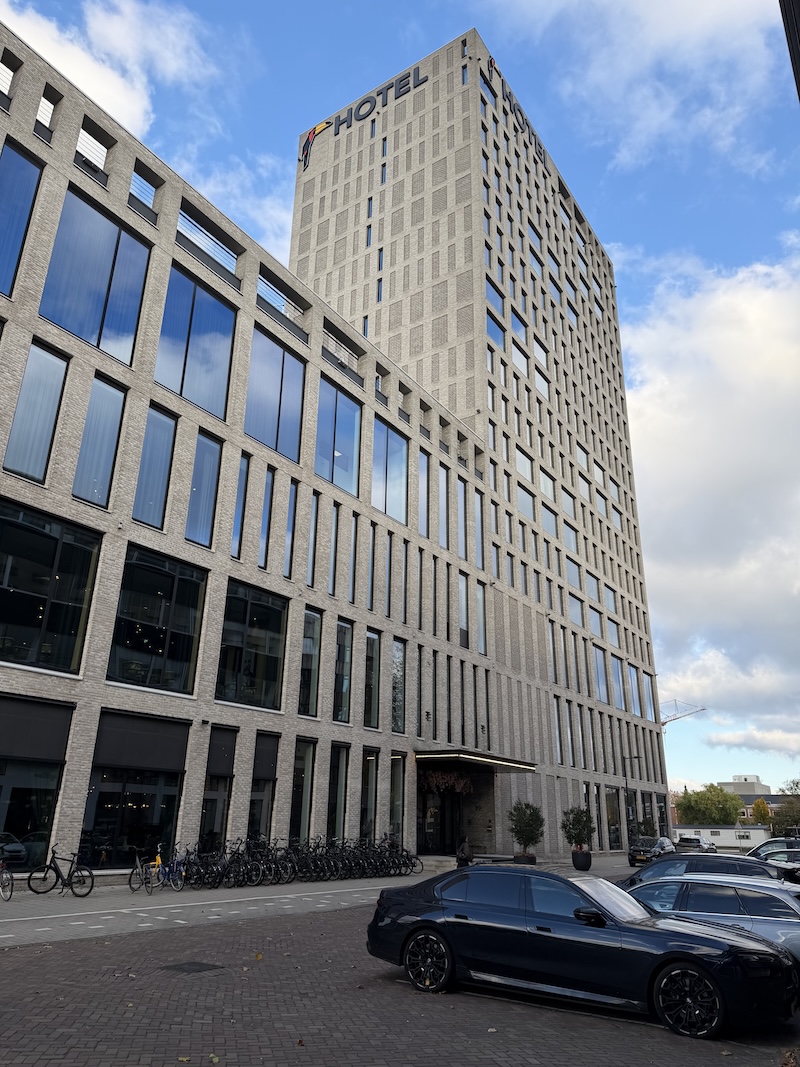
The event was being held at the enormous Van der Valk hotel (main picture), where Pudu had taken over a substantial conference area, including a large auditorium, several meeting rooms and extensive exhibition space.
There were executives, distributors, business partners, journalists and other guests from across Europe and beyond.
And there were robots. Lots of robots.
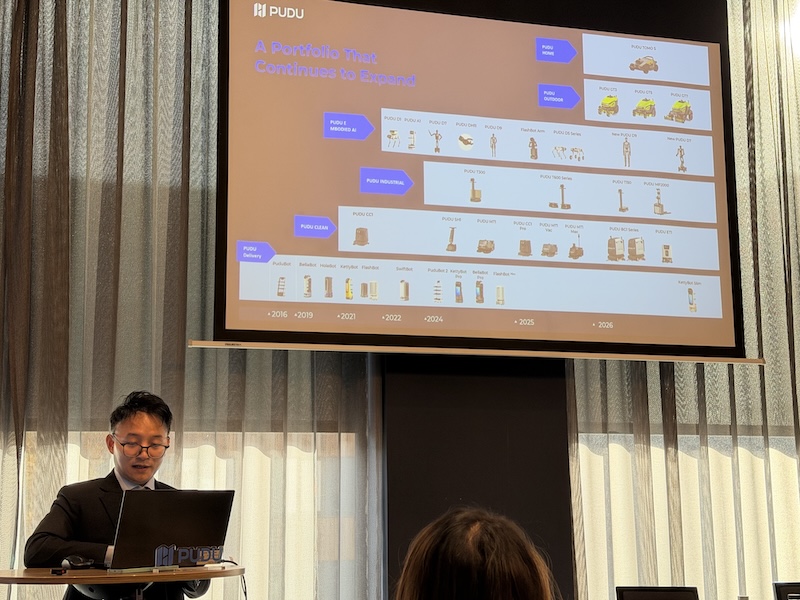
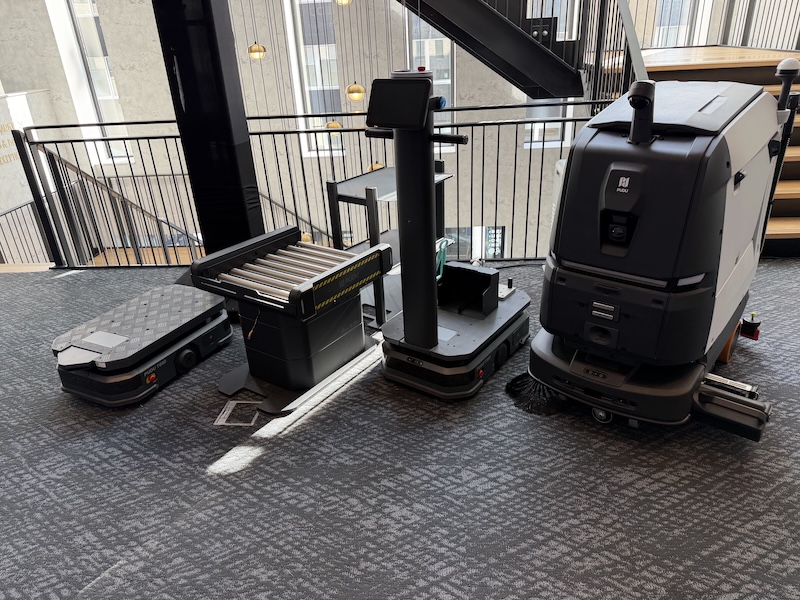
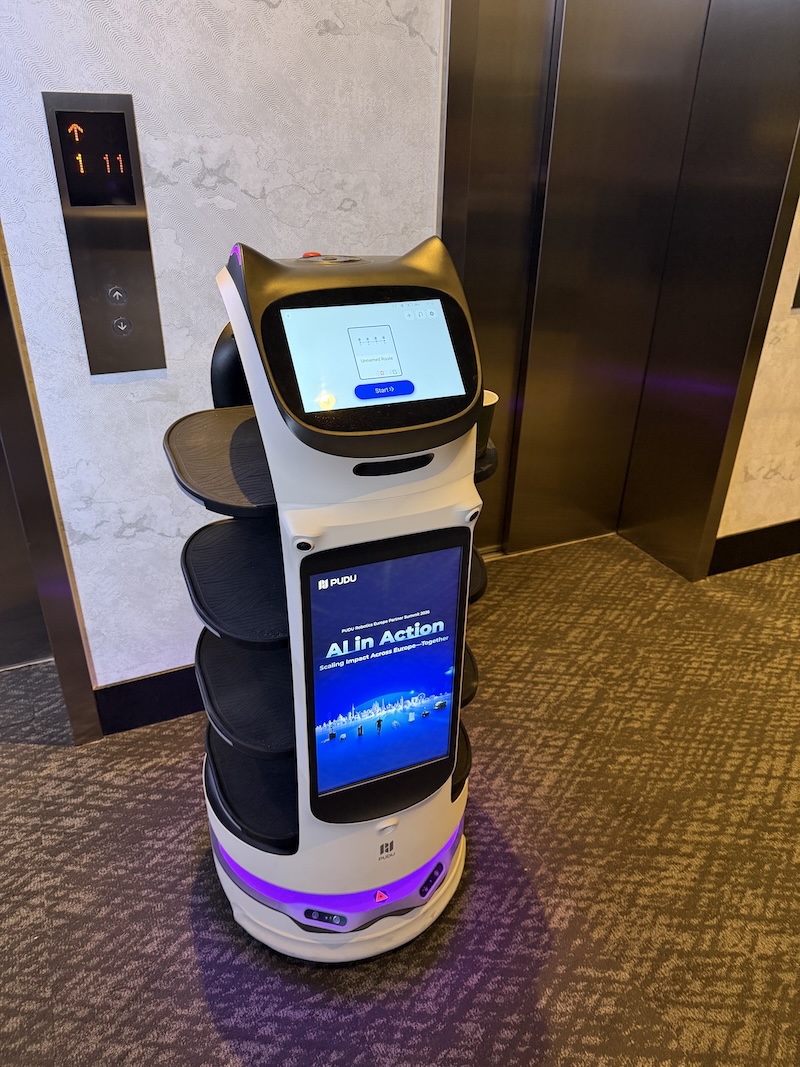
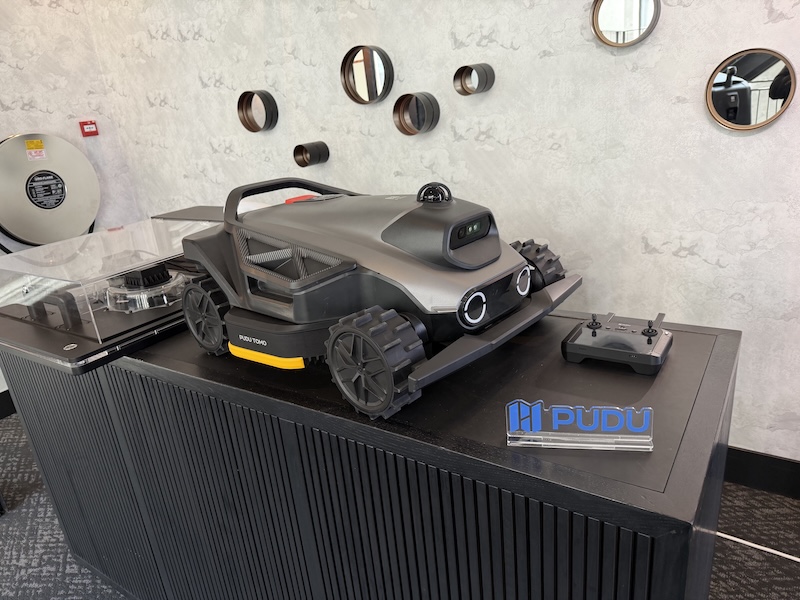
Pudu had assembled its entire portfolio of six product lines for the first time, covering everything from restaurant delivery and commercial cleaning to warehouse automation, robotic lawn mowers and humanoids.
The scale of the occasion was a reminder that Pudu had grown far beyond the company I thought I knew.
More importantly, it raised an interesting question: how many other Chinese robotics companies have quietly become substantial international businesses while the wider world’s attention has been focused elsewhere?
Meeting the people behind Pudu Robotics
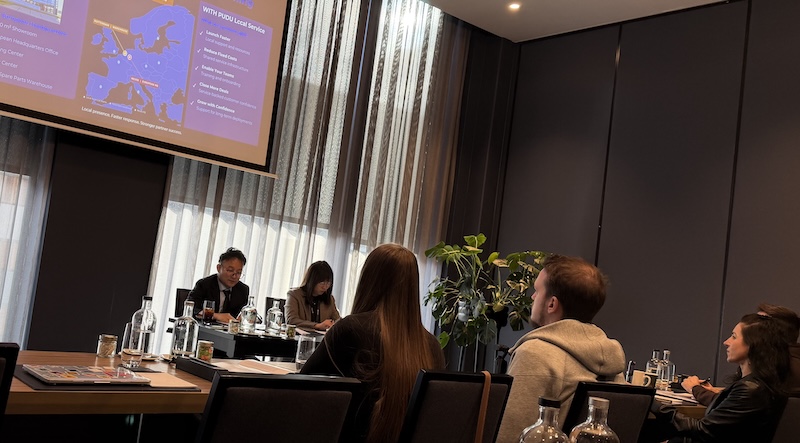
As part of the media contingent, I was invited to a presentation by Felix Zhang, founder and CEO of Pudu Robotics, and Bella Sun, the company’s vice president and general manager for Europe.
Zhang looked very much like the quintessential roboticist, if there is such a thing. He came across as an engineer who had built a company around his interest in machines, rather than someone who had entered robotics simply because it had become a fashionable investment opportunity.
Founded in Shenzhen in 2016, Pudu is approaching its tenth anniversary, and its development over that period has been considerable.
According to figures presented at the event, more than 80 percent of its revenue now comes from markets outside China, with Europe its largest regional market.
The company operates in more than 85 countries and regions and had shipped more than 130,000 robots worldwide by the time of the summit.
Pudu also has research and development operations in China, including facilities in Shenzhen, Chengdu and Hong Kong, alongside a growing international sales and support network.
Europe has become particularly important.
Pudu says its European revenue has grown by an average of more than 60 percent annually over the past two years. The company operates in more than 20 European countries and recently opened its regional headquarters in Neuss, Germany.
But the most interesting part of the presentations was not necessarily the numbers. It was the emphasis on turning robotics research into commercially useful products.
Sun discussed the difficulties of operating across different European countries, each with its own business culture, customer expectations, regulations and operating requirements.
A robot that works successfully in one environment cannot necessarily be introduced into another without adjustments to its software, hardware or supporting services.
She also emphasised an advantage that Pudu believes distinguishes it from some newer entrants to the robotics industry: years of experience working with actual customers.
That experience provides information about the problems businesses encounter, the tasks they want automated and the practical limitations that robots must overcome.
Developing a new robotic product can require an investment of around 15 million yuan, according to figures discussed during the presentation.
That is a substantial commitment, particularly when there is no guarantee that customers will buy the resulting machine.
The distinction Sun drew was between a commercial robotics manufacturer and a university research laboratory.
A research laboratory can demonstrate an impressive technical achievement. A commercial manufacturer has to produce something customers are willing to purchase, maintain and use repeatedly.
That means considering reliability, price, maintenance, ease of operation and the availability of technical support, as well as the underlying technology.
It is a less glamorous side of robotics, but arguably the one that matters most when determining whether the industry can grow beyond demonstrations and pilot projects.
From a robotics startup to a billion-dollar company
After the presentations, I had the opportunity to speak directly with Zhang and Sun.
Zhang seemed almost as surprised by the company’s growth as I was.
“I started off when I was much younger, just making robots because I found them interesting,” he told me.
There is something appealing about that explanation. Many of the world’s most successful technology businesses began with engineers experimenting with ideas that interested them, rather than with carefully constructed plans to build multinational corporations.
Pudu’s subsequent growth has also attracted considerable financial backing.
In April 2026, the company announced that it had raised nearly $150 million in a new financing round, taking its cumulative funding above $300 million.
The financing valued Pudu at more than $1.5 billion, putting it firmly in the category of billion-dollar privately held technology companies.
That valuation is particularly interesting because Pudu is not simply developing experimental robotics technology. It is manufacturing and selling machines to customers in established industries.
The company reported that its total revenue doubled in 2025, while its industrial delivery business shipped more than 4,000 robots within a year of entering that market.
Naturally, I wanted to know what Pudu’s annual turnover actually was.
I asked Sun, but she was unable or unwilling to provide a figure.
The company has been considering its future capital-market options, including the possibility of a public listing, and detailed financial information was not available for disclosure.
That leaves an important gap in the financial picture.
A valuation of $1.5 billion is certainly significant, but it does not tell us how much revenue a company generates, whether it is profitable or how much it spends developing and manufacturing its products.
Those figures would provide a clearer basis for comparing Pudu with other major robotics manufacturers.
Nevertheless, its funding, shipment volumes, international operations and expanding product portfolio suggest a business that has moved well beyond the startup stage.

One brain, multiple embodiments
The central announcement at the Amsterdam summit was Pudu’s new strategy, which it calls “One Brain, Multiple Embodiments”.
The idea is relatively straightforward, although the technology behind it is not.
Instead of developing each robot as an entirely separate system, Pudu wants different machines to share a common technological foundation.
The company has developed PuduFM, an embodied foundation model, and PuduAgent OS, an embodied AI agent platform, to support this approach.
These technologies are intended to allow different robotic systems to reuse AI capabilities, software components and learned skills, while retaining hardware and motion-control systems appropriate to their particular tasks.
A restaurant delivery robot, for example, has very different physical requirements from a warehouse pallet handler or a humanoid robot.
But they may share underlying requirements for perception, navigation, planning, interaction and autonomous decision-making.
By developing reusable technologies, Pudu hopes to reduce the time and expense involved in creating new products.
The strategy also helps explain why the company is entering so many different robotics markets.
Its six product lines now cover service delivery, commercial cleaning, industrial delivery, general embodied AI, commercial lawn mowing and domestic lawn care.
The portfolio includes the BellaBot Pro service robot, the CC1 Pro commercial cleaner, the MP2000 autonomous pallet handler, the D5 quadruped, D7 semi-humanoid and D9 humanoid robots, as well as commercial and domestic robotic lawn mowers.
In its earlier years, Pudu was best known for robots delivering food in restaurants. Now, it is attempting to become a much broader robotics manufacturer.
That expansion brings considerable opportunities, but also challenges. A shared software architecture may reduce duplication, but the engineering requirements of a humanoid robot remain very different from those of an autonomous floor cleaner.
The commercial success of the strategy will ultimately depend on whether Pudu can translate its common technological foundation into reliable, competitively priced products across these different markets.
The surprisingly important business of cleaning floors
Of all the robots on display in Amsterdam, the commercial cleaning machines were among those that interested me most.
Perhaps that is because they represent one of the clearest examples of robotics finding a substantial market in an everyday business activity.
Cleaning is not usually regarded as a particularly exciting application of advanced technology.
Yet large buildings, shopping centres, airports, hospitals, warehouses and factories all require regular cleaning, often across enormous floor areas.
Traditionally, much of this work has involved employees operating large cleaning machines, sometimes riding on them as they move around a facility.
Autonomous cleaning robots offer an alternative, particularly for repetitive work in environments that can be mapped and navigated reliably.
Speaking with Pudu staff during the exhibition, I formed the impression that commercial cleaning was one of the company’s most important businesses.
Subsequent research confirmed just how important.
According to Pudu’s own figures, commercial cleaning accounted for more than 70 percent of its total revenue in 2025.
That is an extraordinary proportion for a company whose public profile was originally built around restaurant delivery robots and which now promotes an extensive portfolio of advanced robotic systems.
It also says something about the current state of the robotics industry.
Humanoids may dominate headlines, but machines that perform relatively ordinary tasks can generate substantial commercial demand.
Pudu entered the commercial cleaning market in 2021, using navigation and obstacle-avoidance technologies originally developed for its delivery robots.
The company says existing customers, including supermarkets, hotels and factories, were already asking for cleaning solutions.
Its CC1 combined sweeping, scrubbing, vacuuming and dust mopping in a single autonomous machine.
According to Pudu, shipments of the CC1 exceeded 20,000 units by 2025, with Europe and North America accounting for approximately 60 percent of that volume.
The newer CC1 Pro incorporates AI-based cleaning detection and targeted cleaning capabilities.
Other machines, including the MT1 series, address larger spaces and more demanding operating environments.
One example of the scale of adoption is Swiss supermarket chain Denner, which Pudu says has introduced more than 200 CC1-series cleaning robots across its stores.
These are not experimental machines being demonstrated for publicity. They are products intended to perform routine work in commercial environments.
And that is where the economics of robotics become particularly interesting.
A robot that can clean a large area reliably, operate for extended periods and reduce the amount of repetitive manual work required may offer a relatively straightforward financial proposition.
There are still costs associated with purchasing, maintaining and supervising the machine, but the benefits can be measured in terms of cleaning coverage, labor requirements and operational consistency.
What about cleaning the streets?
One question that occurred to me while looking at the cleaning robots was whether Pudu might eventually develop a larger autonomous machine capable of cleaning streets and pavements.
Indoor cleaning is one thing. Outdoor environments present a different set of challenges.
A robot operating on a pavement must contend with uneven surfaces, kerbs, pedestrians, bicycles, unpredictable obstacles and changing weather conditions.
It may also have to deal with leaves, litter, dirt and other debris that are quite different from the material encountered on an indoor floor.
I put the idea to Zhang.
He explained that Pudu could develop new robots relatively quickly, with a typical development period of around ten months, although the precise requirements would depend on the application.
An outdoor street-cleaning machine would probably need to be larger and more robust than the company’s existing compact indoor cleaners.
Pudu already has experience with larger cleaning platforms and machines capable of operating in semi-outdoor environments.
Its MT1 Max, for example, is designed for applications such as parking garages and residential courtyards.
The discussion illustrated an interesting possibility: technologies developed for commercial buildings could gradually extend into public spaces and municipal services.
There would be significant engineering and regulatory challenges, particularly where robots share space with pedestrians and other road users.
But it is not difficult to imagine autonomous machines becoming more common in the maintenance of streets, parks and other public areas.
Indeed, commercial cleaning may turn out to be one of the industries through which autonomous mobile robots become an ordinary part of everyday life.
Why Europe matters to Pudu
The decision to hold Pudu’s first major European partner event in Amsterdam was not accidental.
Europe has become the company’s largest overseas regional market, and its business across the continent has expanded rapidly.
Pudu lists customers including Carrefour, Edeka, Albert Heijn, Marriott, Van der Valk, Pizza Hut and Paris Charles de Gaulle Airport.
The recently opened European headquarters in Neuss is intended to support that expanding customer base. It brings together sales operations, product demonstrations, warehousing, training, technical support and repair services.
Pudu says it has nearly 50 sales professionals and approximately 40 technical support personnel working across Europe.
This infrastructure matters because commercial robotics is not simply a matter of shipping machines to customers.
Robots must be installed, configured, maintained and integrated into existing operations. Customers also need access to spare parts, technical expertise and people who understand local working practices.
Sun made it clear that commercial success depends on adapting to the requirements of different markets.
Europe is not a single homogeneous business environment. Customer expectations, regulations, languages and operating practices vary considerably between countries.
For a Chinese manufacturer attempting to establish a long-term presence, building local relationships and support capabilities is therefore as important as developing the robots themselves.
The Amsterdam summit was partly a demonstration of Pudu’s technology, but it was also an exercise in strengthening its relationships with the distributors and partners who will help determine its future growth.
The competition is increasingly Chinese
Pudu’s expansion is impressive in its own right, but it also illustrates a much larger development in the global robotics industry.
For decades, Western companies and politicians have expressed concerns about Chinese manufacturers copying technologies developed elsewhere and competing through lower production costs.
That picture is becoming increasingly outdated in some areas of advanced manufacturing.
Chinese companies are now developing original robotics technologies, investing heavily in research and development, and competing internationally across a growing range of applications. And, increasingly, they are competing with one another.
Consider the autonomous mobile robotics market.
China is home to major warehouse automation companies such as Geekplus, Hai Robotics and Quicktron, as well as commercial cleaning specialists such as Gaussian Robotics.
Other companies specialise in machine vision, robotic manipulation, industrial automation and embodied AI.
Pudu itself now operates across several of these markets.
In October 2025, Robotics & Automation News published an admittedly unscientific list of 20 Chinese companies involved in warehouse robotics and related automation technologies.
Even a year later, the competitive landscape has continued to evolve.
New companies are emerging, established manufacturers are expanding their portfolios, and businesses previously associated primarily with electric vehicles and other technologies are investing in robotics.
XPeng, for example, has been developing humanoid robotics alongside its automotive business, while other companies are exploring opportunities in autonomous mobility and embodied AI.
The result is a rapidly expanding industrial ecosystem in which companies compete for engineers, investment, customers, distributors and technological leadership.
That competition may be just as important as the rivalry between Chinese and Western manufacturers.
From a European or American perspective, the growing number of Chinese robotics companies can appear to be a single wave of competition arriving from overseas.
But these companies are not acting as one organisation. They are independent businesses with different technologies, strategies, investors and commercial priorities.
They compete fiercely for market share, including in their domestic market. This creates pressure to improve products, reduce costs and accelerate development.
It also creates risks. Not every company will survive, and the expansion of competing manufacturers into similar markets could eventually lead to consolidation.
Nevertheless, the intensity of competition is helping shape the direction of the industry.
For companies such as Pudu, the challenge is not merely to compete with established European, Japanese or American robotics manufacturers.
It is also to maintain a competitive advantage over an expanding field of Chinese rivals.
A new phase in the global robotics industry
There is a temptation to describe China’s robotics expansion as a tidal wave threatening to overwhelm established manufacturers elsewhere.
That image captures the scale and momentum of what is happening, but it can also obscure the complexity of the industry.
European, American, Japanese and South Korean companies retain considerable strengths in industrial robotics, automation software, precision engineering, components and advanced manufacturing.
Many have decades of experience and substantial installed customer bases.
But Chinese companies are no longer simply following developments elsewhere.
They are increasingly creating their own products, developing their own technologies and establishing international operations.
Pudu is a particularly interesting example because its growth has been driven substantially by practical commercial applications rather than by the promise of future breakthroughs alone.
The company is investing in humanoid robotics and embodied AI, but its financial progress has been supported by machines performing familiar tasks in restaurants, supermarkets, warehouses and other workplaces.
That combination of ambitious research and established commercial demand may prove important as the robotics industry matures.
It also helps explain why Pudu is pursuing a shared technological architecture across multiple robot types.
The company wants to use the knowledge and infrastructure accumulated through years of commercial operations to enter new markets without having to start from scratch each time.
Whether that approach succeeds across all six product lines remains to be seen.
But the company’s growth is already evidence that robotics can support businesses of considerable international scale.
When I arrived in Amsterdam, I expected to meet a relatively small robotics manufacturer and learn about a few new products.
Instead, I found a billion-dollar company with a substantial international workforce, a broad product portfolio, established commercial customers and ambitions extending well beyond its original market.
And perhaps the most striking realisation was that Pudu is not alone.
Across China, numerous robotics companies are growing, diversifying and competing with increasing intensity.
What looks from the outside like a single tidal wave is, in reality, a vast number of companies racing against one another.
Pudu Robotics has become one of the more substantial participants in that race.
And judging by what I saw in Amsterdam, it has no intention of slowing down.
