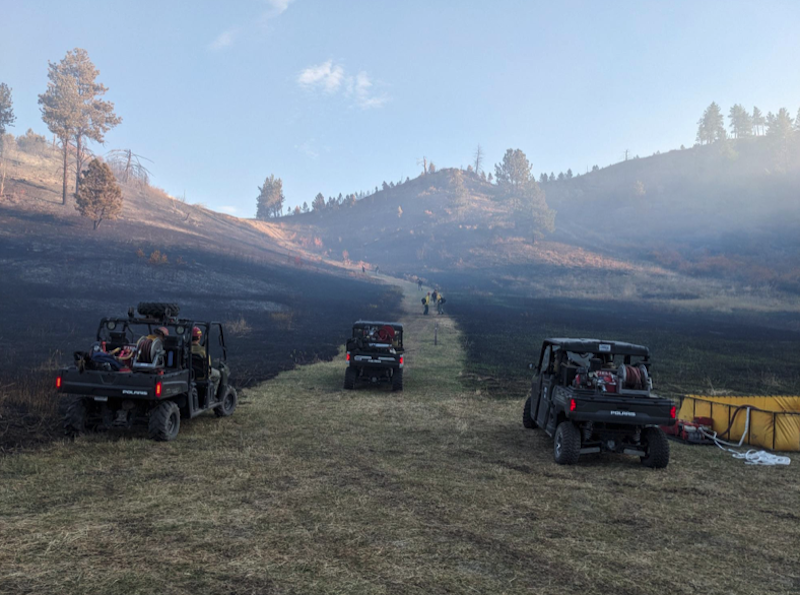
Wildfire response is quietly turning into an automation story. AI watches camera feeds for smoke, drones fly ignition patterns on planned burns, and fixed launchers can fire suppression capsules at a target. One job has barely changed. Someone still has to drive water to the flames and point a nozzle at them.
That ground leg runs on small vehicles, and its hardware is changing in a quieter way. BLZ Fire Skids builds skid units for UTVs and trucks.
Its UTV range uses a 24V electric pump instead of a separate gasoline pump engine. For robotics teams that is a useful case study: a field machine being electrified long before anyone tries to make it autonomous.
What follows maps the wildfire stack layer by layer, and why the order matters for anyone building outdoor equipment.
Where Has Autonomy Already Reached the Fire?
Detection went first, because cameras are cheap to mount and smoke is a visual problem. UC San Diego’s ALERTCalifornia program runs more than 1,300 cameras and sensor arrays across the state, as of November 2026.
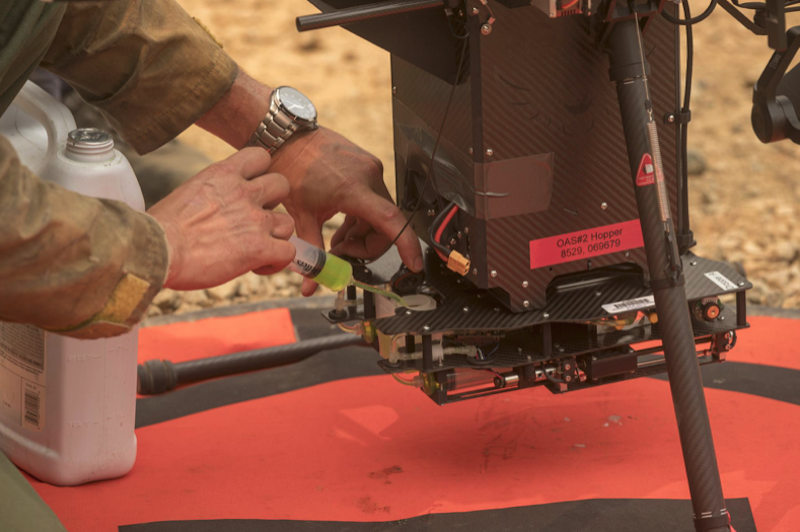
In 2023 it built an AI system with CAL FIRE and DigitalPath that flags likely fires on those feeds. In its first season the tool was used in all 21 CAL FIRE dispatch centers. It detected over 1,200 fires and beat 911 call reporting more than 30% of the time.
Coordination in the air came next. NASA’s ACERO project ran portable airspace management tests in Monterey County, California, from March 17 to 26, 2025. Its suitcase-sized units let ground pilots share flight plans and see other aircraft. They alerted pilots automatically when an aircraft left its approved path or the simulated fire zone.
NASA’s aim is aircraft that can fight and monitor fires 24 hours a day, even in low visibility. The work is not about a smarter drone. It builds a shared picture of the sky.
Suppression is the newest layer. FireDome has opened a US demonstration site at Yuba County Airport for its autonomous wildfire defense system. Its stationary launchers can identify a threat and launch capsules at it. A launcher protects a fixed site, but it cannot follow a fire up a ridge.
Why is the Ground Leg So Hard to Automate?
Moving water to a wildfire combines the problems field robotics finds hardest:
- Unstructured terrain. Water travels down trails and up slopes that change every season. BLZ pitches its UTV units at terrain that traditional apparatus “may not easily reach”.
- A heavy, shifting payload. Tens of gallons of water slosh as the vehicle moves. BLZ’s UTV range comes in 45, 60 and 80 gallon sizes.
- Exceptions are the normal case. Wind shifts, fences, livestock and people appear without warning. The fireline is one long edge case.
- Accountability. Someone has to decide where the water goes and answer for it.
Robotics & Automation News recently ran an argument that supervised autonomy should be designed around a robot’s worst day. On a fireline the worst day is most days, which is why the nozzle stays in human hands.
Why Electrify Before You Automate?
A gasoline pump engine is a separate machine to fuel, start and bring online. BLZ’s UTV pump shows what electric drive changes:
- Pump: the Redline electric pump is self-priming, with up to 16 GPM of flow and up to 175 PSI.
- Power: it runs on 24V supplied by an onboard battery.
- Runtime: the battery alone can run it for up to 4 hours, the company says.
- Charging: while the host UTV is running, BLZ’s Fight-Finity system keeps topping up the battery.
- Start-up: the operator flips a switch and the pump primes itself, with no hand pump or pull start.
BLZ calls that effectively unlimited runtime. None of this is autonomy, and BLZ does not claim it is. Its site describes a switch, not remote control.
The shift still matters. An electric pump draws from one power bus, can be switched by a relay and monitored electrically. A pull-start engine offers none of those hooks. Electrification turns a tool into something a controller could one day talk to.
The truck-based Defender line works at another scale. The Defender 200 carries 200 gallons and lists up to 10 GPM at up to 1,200 PSI.
How Do the Layers Compare?
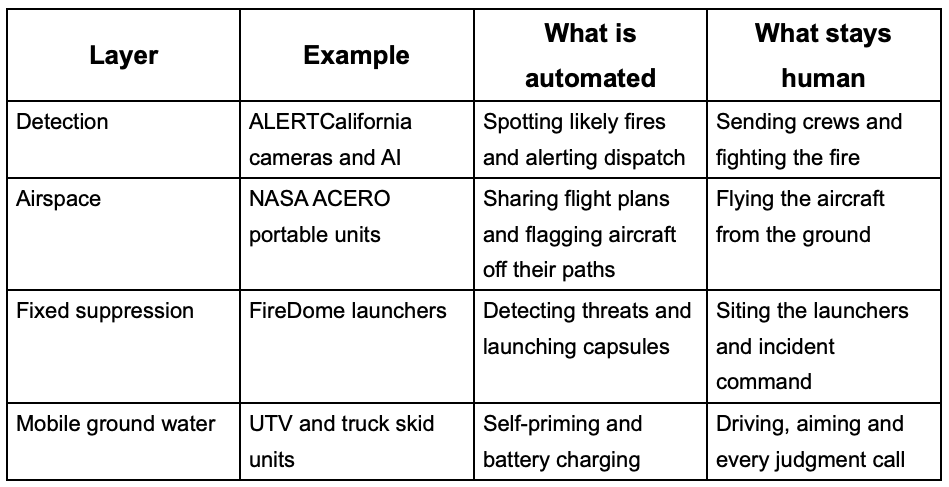
Read top to bottom, autonomy fades as the work gets physical. Detection is software; ground water is mass, terrain and judgment.
What Should Robotics Teams Take From This?
- Automate perception first: a hilltop camera fails in fewer ways than a vehicle on a slope.
- Build coordination before autonomy, as NASA is doing with shared airspace.
- Electrify the actuator early, so a future controller has something to command.
- Design for the worst day, not the demo.
- Keep a person at the point of consequence, where a decision cannot be undone.
The Hose is the Last Mile
Wildfire technology is following the order most field robotics follows: sense, coordinate, electrify, then automate. The ground leg sits at step three, which is sensible. A crew in a UTV with a self-priming electric pump is not a robot. It is the platform a future one would be built on.
Frequently Asked Questions
What is a Fire Skid Unit?
A fire skid is a self-contained tank, pump and hose package that mounts on a UTV or pickup. BLZ Fire Skids sells UTV units in 45, 60 and 80 gallon sizes, plus truck-based Defender systems.
Are Wildfire Robots Already In Use?
Some automated systems are in service or testing. AI cameras flag likely fires for CAL FIRE dispatch centers, and FireDome is demonstrating autonomous launchers in California. Ground crews still put most water on the fire.
Why Do Electric Fire Pumps Matter for Automation?
An electric pump runs from a battery and a switch rather than a separate gasoline engine. That makes it easier to monitor and, in principle, to control. BLZ’s pump is switched on by the operator, not remotely.
Can Drones Work Over Active Wildfires?
Agency drones already support fire operations, including aerial ignition on planned burns. NASA’s ACERO tests focused on coordinating approved aircraft safely in smoke and at night. Hobby drones should stay well away from any fire.
Main image by Sherri Renck, USDA Forest Service, Wikimedia Commons, public domain
