
ClearSpace has signed a new agreement with OHB System AG to provide critical navigation and capture technologies for the European Space Agency’s (ESA) ClearSpace-1 mission, marking another step towards the launch of one of Europe’s first active space debris removal missions.
The agreement follows the formalisation of the next phase of the mission between ESA and prime contractor OHB, which leads the European industrial consortium responsible for developing and delivering ClearSpace-1.
Under the agreement, ClearSpace will continue developing the technologies needed to approach, navigate around and capture objects in orbit.
The mission is intended to demonstrate that satellites not originally designed for retrieval can be safely captured and removed from space.
Demonstrating robotic capture in orbit
ClearSpace-1 will target ESA’s Proba-1 satellite, using autonomous rendezvous, close-proximity navigation and robotic capture technologies to demonstrate the removal of an unprepared object from Earth orbit.

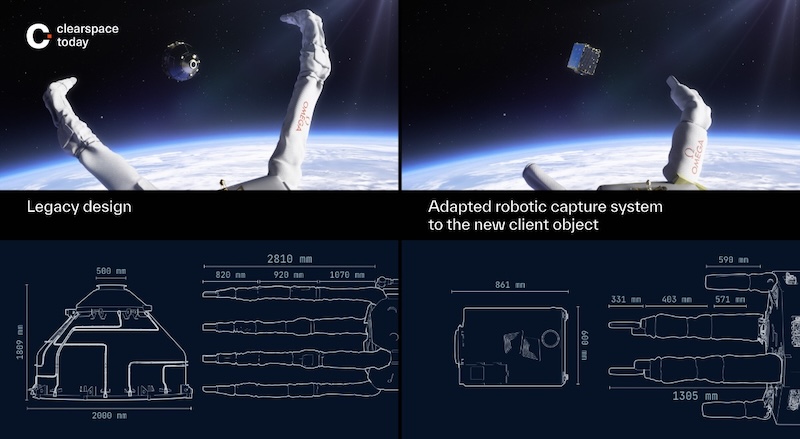
The mission is part of ESA’s wider efforts to address the growing problem of space debris, which poses risks to operational satellites and other spacecraft.
ClearSpace was originally selected as prime contractor for the mission in 2020. Although the industrial structure has since changed, the company retains responsibility for developing key rendezvous and capture capabilities.
The technologies could also support applications beyond debris removal, including satellite inspection, maintenance, life extension and end-of-life disposal.
Luc Piguet, CEO and co-founder of ClearSpace, said: “ClearSpace-1 began with a bold ambition: to demonstrate that we can take responsibility for what we leave behind in space. Today’s milestone reflects years of engineering, determination and collaboration.
“We are grateful to ESA and its Member States for their continued confidence, and to OHB and our European industrial partners for bringing together the expertise needed to advance this mission.
“For ClearSpace, our focus remains on delivering the critical rendezvous and capture capabilities at the heart of ClearSpace-1.
“We are equally grateful to Omega, whose belief in our pioneering ambition since 2022 has remained constant throughout the mission’s evolution. Partnerships built on this kind of trust and shared determination are what make meaningful progress possible.”
Incidentally, Omega was the first watch worn on the Moon in July of 1969.


Expanding in-orbit servicing activities
ClearSpace is also developing its capabilities through other European space programmes.
The company has been selected as prime contractor for the UK’s first nationally commissioned active debris removal mission, which aims to capture and remove two defunct satellites registered in the United Kingdom.
It is also working with ESA on Prelude, an in-orbit inspection and technology demonstration mission, and Phoenix, a programme focused on extending the operational life of satellites in geostationary orbit.
Together, these projects form part of ClearSpace’s strategy to develop commercial in-orbit servicing capabilities, including satellite inspection, maintenance and disposal.
Swiss watchmaker Omega, which has supported ClearSpace since 2022, is continuing its partnership with the company as ClearSpace-1 progresses towards flight. Omega is not a contracting party to the ESA-OHB mission agreement.
Founded in Switzerland and headquartered in Luxembourg, ClearSpace operates across Luxembourg, Switzerland, the United Kingdom, Germany and France.
The company is developing robotic technologies intended to support a more sustainable space economy by enabling spacecraft to be inspected, serviced and eventually removed from orbit.
