The construction industry has been slow to adopt robotics, despite decades of technological progress in manufacturing and logistics.
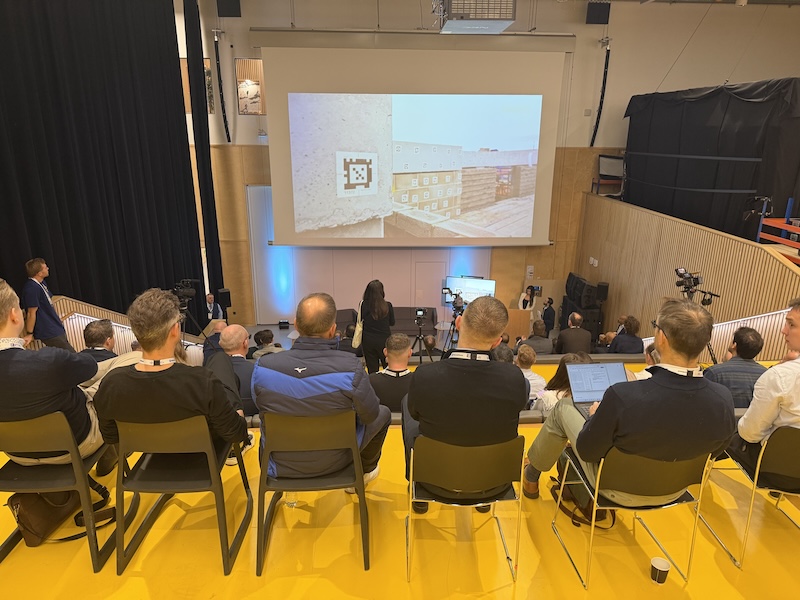
At the inaugural Groundworks Summit in London, robotics companies, contractors and investors discussed what it will take to bring automation into everyday building operations.
Now may not be the best time for advanced robotics technology to enter and revolutionize the construction industry.
In London, England, at least, property developers are scaling back their activities, postponing major developments or abandoning projects altogether.
In October 2026, FTSE 100 property developer British Land reportedly paused the second phase of its £4 billion Canada Water regeneration project in southeast London.

The company had completed the first phase of the development, but rising construction costs and disappointing residential sales prompted it to postpone further work until market conditions improve.
The decision illustrates a wider problem facing London’s construction industry.
The capital has a chronic shortage of affordable housing, yet developers are finding it increasingly difficult to make new residential projects financially viable.
Canada Water was intended to deliver thousands of homes, alongside offices, retail space and other facilities. Although much of the development was aimed at the private market, affordable housing was also included in its plans.
And British Land is not alone.
Landsec also decided in October to deprioritise its proposed redevelopment of Lewisham shopping center, another major southeast London project, citing concerns about financial viability.
Across the industry, high financing costs, expensive materials, labor shortages and regulatory requirements have made new construction projects increasingly difficult to justify.
The situation varies internationally, but the problems are familiar to developers in many markets.
Yet the underlying demand for buildings has not disappeared. People still need homes, businesses need offices and industrial facilities, and governments need infrastructure.
Construction activity will eventually recover, although when and how strongly remains uncertain.
And perhaps, counterintuitively, this is precisely the right time to introduce robots to building sites.
When the industry becomes busy again, project managers may be less inclined to experiment with unfamiliar technologies. Under pressure to meet deadlines, they may prefer established working methods, even if those methods are comparatively inefficient.
A quieter period could provide an opportunity to test new machines, develop working practices and prepare construction teams for a more automated future.
That, broadly speaking, was the proposition underlying the inaugural Groundworks construction robotics conference, held on November 11, 2026, at UCL Here East, part of University College London, in Queen Elizabeth Olympic Park.
The event brought together construction companies, robotics developers, investors, government representatives and technology specialists to discuss how robots might finally become a routine feature of construction sites.
The problem with bricklaying
Construction has a workforce problem.
Skilled tradespeople are getting older, younger workers are not entering the industry in sufficient numbers, and contractors frequently struggle to recruit people for physically demanding jobs.
Bricklaying is one occupation where these concerns are particularly apparent.
Estimates of the average age of British bricklayers vary – some say it’s above 50 – but the broader issue is that experienced workers are approaching retirement while the industry struggles to attract replacements.
“No one wants to work anymore,” lamented Steve Davies, managing director at Beton Bauen. “And it’s not just in the construction industry.”
Davies was speaking during a presentation at Groundworks titled “What it Really Takes for a Specialist Contractor to Adopt Robotics”.
His company, Beton Bauen, is a UK-based specialist contractor working in areas including concrete repair and structural waterproofing.
Davies explained that the business had already experimented with robotic systems and was beginning to incorporate automation into some of its operations.
“We put robots to work on drilling,” said Davies. “They’ve been working in construction and I believe robots are good for the industry.”
His comments reflected a growing recognition that construction companies may have little choice but to investigate automation if they want to address persistent labor shortages.
But the workforce problem is only part of the story.
Construction also has a productivity problem, and it is one that has proved remarkably resistant to technological progress.
“Productivity increase in the construction industry has been 1 per cent,” said Davies.
The precise figure depends on the period, country and method of measurement, but construction has consistently struggled to match the productivity improvements achieved in sectors such as manufacturing.
Indeed, several people I spoke to after the presentation suggested that even 1 percent might be optimistic.
“It’s probably closer to zero than it is to one,” said Mingyu Zhu, who works at Scott Brownrigg, an international architectural and design practice specializing in architecture, masterplanning, urbanism and interior design.
Zhu’s work involves introducing digital processes into the company’s operations.
“That is where the productivity increases and efficiencies are found these days, but on the ground, at the building site, there’s not much change at all.”
The distinction is important.
Architectural practices, engineering companies and developers have adopted increasingly sophisticated digital tools, including building information modelling, simulation, digital twins and AI-assisted design.
But the physical process of putting one brick on top of another, installing pipes, pouring concrete or moving materials around a building site remains heavily dependent on human labor.
The robots are here – finally
Robots have fundamentally transformed manufacturing, logistics and numerous other industries over several decades.
Automotive factories, for example, would be almost unrecognisable without industrial robots. Modern distribution centers increasingly depend on autonomous mobile robots, automated storage systems and robotic picking equipment.
Construction, by comparison, has changed relatively little.
Of course, modern building sites have cranes, excavators, concrete pumps, power tools and an enormous variety of specialised machinery.
But much of the actual work still relies on people using their hands, physical strength and experience.
In parts of India and other Asian countries, it is still possible to see construction workers carrying baskets of earth, rubble and other materials on their heads.
One team excavates the ground while another carries away the material.
Mechanisation has reduced the amount of manual labor required in many countries, but the fundamental organisation of construction work has remained surprisingly similar.
This is where robotics companies see an opportunity.
At Groundworks, several exhibitors demonstrated technologies designed to automate individual construction tasks.
One was Flo Mobility, an India-based company developing autonomous vehicles for material transportation.
Its machine resembles a small, self-driving dump truck, designed to move materials around construction sites without requiring a human driver.
Abheer Mehrotra, the company’s business head, explained that the vehicle was available in two sizes, with pricing ranging “from around a thousand pounds a month to fifteen hundred pounds a month”.

Compared with the cost of employing a construction labourer in Western Europe, that price could appear attractive, particularly if the vehicle can operate for extended periods.
The economics may be different in India, where labor costs are generally lower.
However, the potential benefits are not limited to replacing manual labor. Autonomous transport vehicles could also reduce the time skilled workers spend moving materials instead of performing the tasks for which they were hired.
Nearby, Hyperion Robotics was displaying scale models of concrete construction components produced using robotic 3D printing.
The company’s technology uses industrial robots to manufacture concrete elements according to digital designs, potentially reducing the need for conventional formwork and enabling more complex geometries.
“We have robots that make them to order,” said Sarah Brown, the company’s director of sales, who was attending the exhibition.

Another exhibitor, Canadian company Mechasys, demonstrated a projection-based layout system designed to transfer construction plans directly onto working surfaces.
The technology projects guides onto floors and other surfaces, helping workers position pipes, fittings and other building components according to digital plans.
Christophe Roy, the company’s EMEA managing director, explained that the system was proving useful to construction teams.
Unlike an autonomous bricklayer or excavator, the Mechasys system does not physically perform the construction work.
Instead, it automates part of the measurement and layout process, potentially reducing errors and saving time.
That distinction highlights an important point about construction automation.
Not every useful construction robot needs to replace a human worker. Some technologies simply make existing workers more accurate, productive or efficient.
Construction robotics: 15 technologies already on the market
The machines demonstrated at Groundworks represent only a small part of a rapidly expanding industry.
Robotics companies have developed systems for bricklaying, demolition, excavation, surveying, material handling, concrete printing and numerous other construction activities.
The following examples illustrate the range of technologies already commercially available or undergoing real-world trials. Availability and commercial maturity vary by product and market.
| Company and technology | Construction application |
|---|---|
| Monumental – robotic bricklayer | Mobile robotic systems for laying bricks in building walls |
| FBR – Hadrian X | Truck-mounted robotic system for automated block wall construction |
| Construction Robotics – SAM100 | Semi-automated bricklaying system designed to work alongside masons |
| Brokk – demolition robots | Remote-controlled machines for demolition, breaking and concrete removal |
| Husqvarna – DXR series | Compact remotely operated demolition robots |
| Hilti – Jaibot | Robotic drilling for overhead mechanical and electrical installations |
| Dusty Robotics – FieldPrinter | Autonomous floor layout and marking from digital construction plans |
| Canvas – drywall finishing robot | Robotic drywall finishing, including sanding and application processes |
| Advanced Construction Robotics – TyBOT | Automated tying of reinforcing steel on bridge decks |
| Advanced Construction Robotics – IronBOT | Robotic lifting and placement of reinforcing steel |
| Kewazo – LIFTBOT | Robotic material transport on scaffolding and construction sites |
| Built Robotics – autonomous equipment | Automation technology for heavy construction machinery and specialized site work |
| COBOD – BOD2 | Large-scale robotic 3D printing of concrete building structures |
| Boston Dynamics – Spot | Mobile inspection, surveying and progress monitoring |
| Flo Mobility – autonomous transport vehicles | Self-driving vehicles for moving construction materials around sites |
These examples cover a mixture of autonomous, semi-autonomous and remotely operated machines. Not all are capable of performing their assigned tasks without human supervision.
Nevertheless, they demonstrate that construction robotics is no longer confined to laboratory research.
Many of the technologies have already been tested on real projects, and some are being used commercially.
The question is why they have not yet become commonplace.
Why has construction automation taken so long?
Most readers of Robotics & Automation News will already be familiar with at least some of these machines.
Robotic bricklayers, autonomous excavators and construction material transporters have been under development for years.
Some have demonstrated impressive capabilities.
Australia’s FBR, for example, has developed the Hadrian X robotic blocklaying system, designed to construct building walls at speeds that would be difficult to achieve using conventional manual methods.
But building walls is not the same as completing a house.
Foundations, roofing, electrical systems, plumbing, insulation, windows, doors and finishing work still require other trades and processes.
Even so, the technology suggests that some of the most labor-intensive elements of construction could eventually be automated.
Why, then, are robots not already working on thousands of construction sites?
One explanation might be the cost of acquiring and operating the equipment.
Another is that construction sites are inherently unpredictable.
Unlike a factory, where machinery operates in a relatively controlled environment, building sites change constantly.
Materials arrive at different times, workers move equipment around, weather conditions vary, and unexpected problems require immediate decisions.
A robot that works perfectly in a demonstration may struggle when confronted with uneven ground, restricted access, changing site layouts or incomplete information.
There are also questions about responsibility.
If a robot damages a partially completed building, delays a project or creates a safety hazard, who is accountable?
The equipment manufacturer? The contractor? The project manager?
And who trains the workers who will be expected to operate alongside the machines?
These are not necessarily insurmountable problems, but they help explain why construction companies have been cautious.
There is also the matter of established habits.
Project managers are generally judged on whether projects are completed safely, on time and within budget.
Few will want to be responsible for introducing an unfamiliar machine that might cause more problems than it solves.
The familiar approach can therefore appear less risky, even when new technology promises substantial long-term benefits.
One might suspect that organised labour has resisted construction robotics because of concerns about job losses.
But there was little indication at Groundworks of any coordinated attempt to prevent automation.
On the contrary, the discussions suggested that labor shortages are becoming one of the strongest arguments in favor of adopting robots.
The more immediate obstacle appears to be finding practical, commercially viable ways to integrate them into everyday construction operations.
A robot that can lay 800 bricks a day
Among the speakers at Groundworks was Salar Al Khafaji, founder and CEO of Dutch construction robotics company Monumental.
The company has developed a mobile robotic bricklaying system designed to work on construction sites rather than in a controlled factory environment.
Its machines combine robotic manipulation, mobility and software to position bricks according to digital building plans.
“The Monumental bricklayer robot can place 800 bricks a day,” said Al Khafaji during a panel discussion.
“The average human bricklayer can place around half of that number per day.”
The comparison is significant, although actual output will depend on the building design, site conditions, materials and supporting workforce.
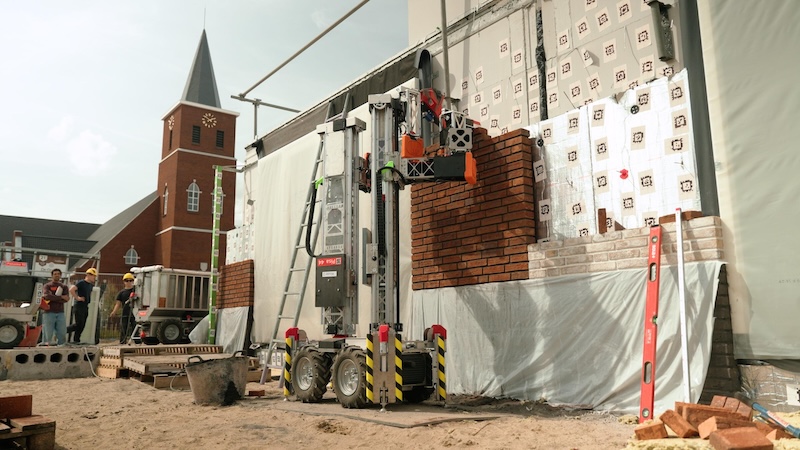
Monumental’s approach is also interesting because it does not depend on developing a humanoid robot. Al Khafaji said he considered humanoid robots “overhyped, especially for this sector – construction”.
It is an understandable position. A humanoid robot might eventually be capable of walking around a building site, picking up bricks and placing them much as a human bricklayer would. But reproducing the human body is not necessarily the most efficient way to automate a particular task.
A purpose-built robotic system can be designed around the materials, movements and working conditions involved.
For construction companies, the shape of the robot may matter considerably less than whether it can complete the work reliably and economically.
Who pays for the robot?
The commercial challenge was a recurring theme throughout Groundworks.
One panel, titled “Who Pays for the Robot? The Commercial Case for Automation in UK Construction”, brought together Al Khafaji, Mark Reynolds, executive chairman of Mace Group and co-chair of the Construction Leadership Council, and Fergus Harradence from the UK Department for Business and Trade.
The question goes to the heart of construction robotics adoption.
A technology company may be able to demonstrate that its robot works.
But that does not automatically mean a contractor will buy it.
Construction projects involve multiple businesses, including developers, main contractors, subcontractors, specialist trades and equipment suppliers.
Each operates under different commercial pressures and contractual obligations.
A robot might generate savings across an entire project while requiring one subcontractor to bear most of the initial investment.
That imbalance can discourage adoption.
The Groundworks discussions identified several ways to address the problem.
One is to consider automation during the design and planning stages rather than introducing it after construction has already begun.
Another is to give equipment manufacturers and specialist contractors greater confidence that there will be continuing demand for robotic services.
A third is to develop evidence from completed projects, allowing contractors to evaluate actual productivity improvements rather than relying on demonstrations or manufacturers’ projections.
Repeat use is particularly important.
A robot that requires extensive preparation and training for a single project may be difficult to justify financially.
The same machine, used across multiple projects by an experienced team, could offer a much stronger business case.
These considerations suggest that the transition to robotic construction may depend as much on contracts, procurement and project management as on technological breakthroughs.
A question of timing
There is an irony in the current situation.
The construction industry urgently needs productivity improvements, yet some of the companies that could benefit most from automation are operating under considerable financial pressure.
Investment in unfamiliar technology can be difficult to justify when projects are being postponed and margins are already tight.
But waiting until construction activity recovers may not be the best strategy either.
By then, contractors may face renewed pressure to recruit workers, accelerate projects and meet demanding schedules.
There may be little time to experiment with new equipment.
This makes the present period potentially important for construction robotics developers.
They have an opportunity to demonstrate that their machines can work under real site conditions, establish partnerships with contractors and develop operating models that make commercial sense.
For construction companies, the opportunity is to learn how these technologies can fit into existing operations before labor shortages and project pressures become even more acute.
The wider economic implications are considerable.
Construction is fundamental to housing, transport, energy, manufacturing and almost every other part of the built environment.
Improvements in productivity could help reduce costs, shorten project schedules and make developments financially viable that might otherwise be postponed.
Automation alone will not solve housing shortages, planning delays, financing difficulties or the many other problems affecting construction.
But it could become an increasingly important part of the solution.
An inevitable transition?
There is no guarantee that construction will follow the same path as automotive manufacturing, where robots have become an essential part of production.
Building sites are more varied, less predictable and often more difficult to automate.
But the direction of technological development is becoming clearer.
Robots are already capable of laying bricks, drilling holes, transporting materials, inspecting structures, printing concrete components and performing demolition work.
The remaining challenge is to make these technologies sufficiently reliable, affordable and straightforward to use that contractors regard them as ordinary construction equipment rather than experimental machines.
Groundworks founder Owen Drury said the response to the inaugural event had exceeded expectations.
“Groundworks has given people a platform to come together, have conversations about the challenges, share ideas and work out how we can get more robotics technology onto construction sites.”
The event’s emphasis on practical adoption, rather than distant technological possibilities, reflected an industry increasingly interested in what robots can accomplish today.
Construction may never be as automated as a modern automotive factory.
But given its persistent labor shortages, limited productivity growth and enormous importance to the wider economy, the pressure to modernise is unlikely to disappear.
Perhaps the greatest obstacle is not whether the robots can do the work.
It is whether construction companies are prepared to change the way they work to accommodate them.
And if the industry is waiting for the perfect moment to begin, the current slowdown might be as good an opportunity as any.
Perhaps construction’s long-awaited robotics revolution is closer than we think.
