Automated facilities have an unusual power profile. Robots, conveyors, charging stations and handling equipment draw modest power most of the time, then spike when several systems start together. The usual answer is to size the supply for the worst case, which means paying for capacity that sits idle.
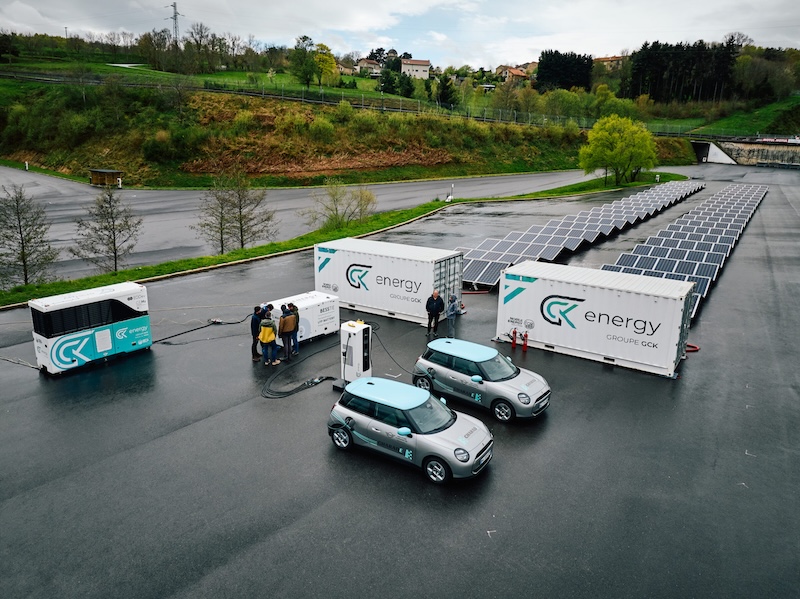
A mobile battery energy storage system such as the BESSTIE® 120 from French manufacturer EODev takes the opposite approach: size for real use, and let the battery cover the peaks.
The peak problem in automated operations
In a warehouse, a production line or a testing site, the average load can be far below the peak. A fleet of automated vehicles returning to charge at the same time, a line restarting after a stop, or a commissioning phase with equipment powered up in sequence can all create short, sharp demand.
Meeting these peaks with a permanent supply means a larger grid connection or a larger generator than the average load justifies. An engine running well below its optimal load burns more fuel per kWh than one running near it, and an oversized connection costs money whether it is used or not.
What a battery system does
A battery energy storage system fills three roles on this kind of site:
- Peak shaving: it supplies the short spikes, so the main source can be sized closer to the average.
- Smoothing: it charges when demand is low and releases energy when demand rises.
- Continuity: it keeps equipment running through a short interruption or while another source is being switched or serviced.
The BESSTIE® 120 offers 120 kVA of power and 124 kWh of storage capacity. Both figures matter, and they answer different questions: kVA is the power available at any instant, kWh is the total energy available. A site with sharp peaks needs to check the first; a site that must run for hours on battery alone needs to check the second.
Hybrid mode: a smaller generator running less
Battery storage is increasingly used in hybrid mode, coupled with a generator. The battery absorbs the peaks and avoids running the generator for nothing, particularly at low load. Depending on the configuration, fuel savings can reach 90%.
Beyond the fuel bill, a generator that runs less, and nearer its optimal point, wears less and needs less maintenance. The same logic applies to a temporary grid connection: with a battery covering the peaks, a smaller connection may be enough.
Temporary and mobile use
Automation projects are not always permanent. New facilities need power during construction and commissioning, and pop-up or temporary operations need power for weeks or months. A mobile battery system can be sized to the mission and moved when the mission ends, rather than leaving an oversized permanent installation behind.
Because it operates without local emissions and without engine noise while discharging, a battery system also suits sites close to residential areas or sensitive environments.
How to size it
Three inputs are enough for a first estimate:
- The real load curve of the site: average power and peaks, from measurement rather than a cautious guess.
- The duration the battery must cover on its own: seconds, minutes, or hours.
- The other sources available: grid, solar, generator.
A simple illustration: a load averaging 20 kW over 8 hours represents about 160 kWh. If the same site has 100 kW peaks, power becomes the deciding criterion, not just capacity.
Limits to keep in mind
A battery stores energy; it does not create it. Its capacity is finite, and for long, continuous loads it must be recharged by another source. It works best combined with a generator, the grid or solar. Cost depends on power, capacity, configuration and services, and is best assessed over the expected duration of use and the fuel savings.
Bottom line
For peak-heavy automated operations, the economic case rests on not sizing everything for the worst moment. Battery storage lets the main source be smaller and run more efficiently, while the battery handles the rare, short peaks.
