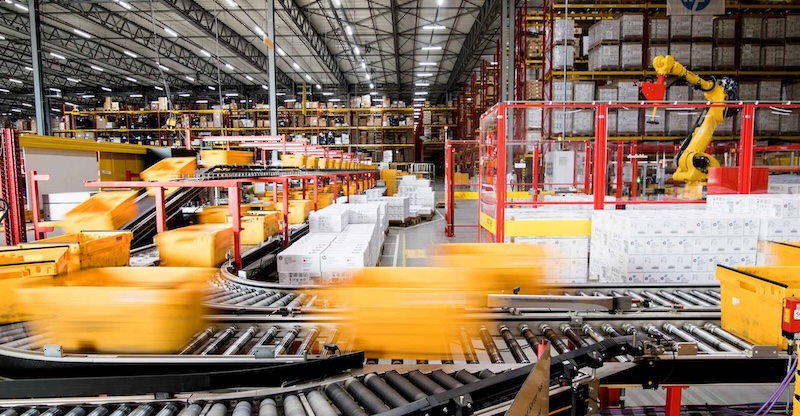
DHL Supply Chain is testing adaptive AI-powered robots and introducing AI orchestration into live warehouse operations as part of a wider strategy to coordinate robotics, artificial intelligence and human workers across its global logistics network.
The initiatives form part of the company’s Intelligent Supply Chain framework, which aims to move beyond automating individual tasks toward coordinating entire warehouse workflows.
Unlike conventional warehouse robots that largely follow predefined instructions, adaptive robots are designed to interpret changing conditions and adjust their actions to achieve specific goals.
DHL says it is testing these capabilities alongside AI orchestration software that connects employees, automated equipment and operational data.
Following a successful proof of concept, the company has begun introducing the orchestration technology into operational warehouses.
Connecting robots and warehouse systems
One application being tested combines autonomous mobile robots, packaging equipment and warehouse management systems to allocate resources dynamically according to changing order volumes.
The system is intended to help warehouse operators respond to demand fluctuations while improving throughput and operational flexibility.
Tim Tetzlaff, global head of digital transformation at DHL Supply Chain, says: “Our immediate priority is to continue scaling our proven robotics across more sites while moving the next generation of adaptive AI-powered robotics from pilots into live operations.”
DHL has already installed more than 9,000 robots across its global logistics network, completing more than 1.5 billion robotic picks.
Its operations have also recorded 10 million robotic case unloads using Boston Dynamics’ Stretch robot.
The company says more than 95 percent of its warehouses worldwide now use advanced digitalization technologies.
Combining physical and digital AI
DHL distinguishes between physical AI, which controls robots and other automated machinery, and digital AI, which analyzes information and supports operational decisions.
Tetzlaff says: “Digital and physical AI are complementary forces. Digital AI optimizes how information flows, while physical AI optimizes how material flows. When combined with our human workforce, they create the most efficient, flexible and resilient end-to-end supply chain.”
DHL reports that its analytics and AI solutions have been introduced more than 1,400 times across its network, including over 500 implementations during 2026.
Its conversational AI systems have also recorded more than 2.5 million minutes of interactions.
The company says human employees will remain central to its automation strategy, contributing operational expertise and judgment while robots handle repetitive and physically demanding work.
DHL is positioning the combination of adaptive robotics, AI orchestration and human expertise as the next stage of warehouse automation, with the aim of improving productivity without requiring every task or decision to be fully automated.
