Ron Zukerman, innovation director at Vishay Precision Group
When people first started trying to build human‑like robots, the roadmap seemed clear. The assumption was simple: if something feels hard for us, it must be hard for machines too.
So, we treated things like playing chess, doing advanced math, or analysing legal arguments as the “real” intelligence problems, and figured basic movement would be easy. In practice, it turned out to be the opposite.
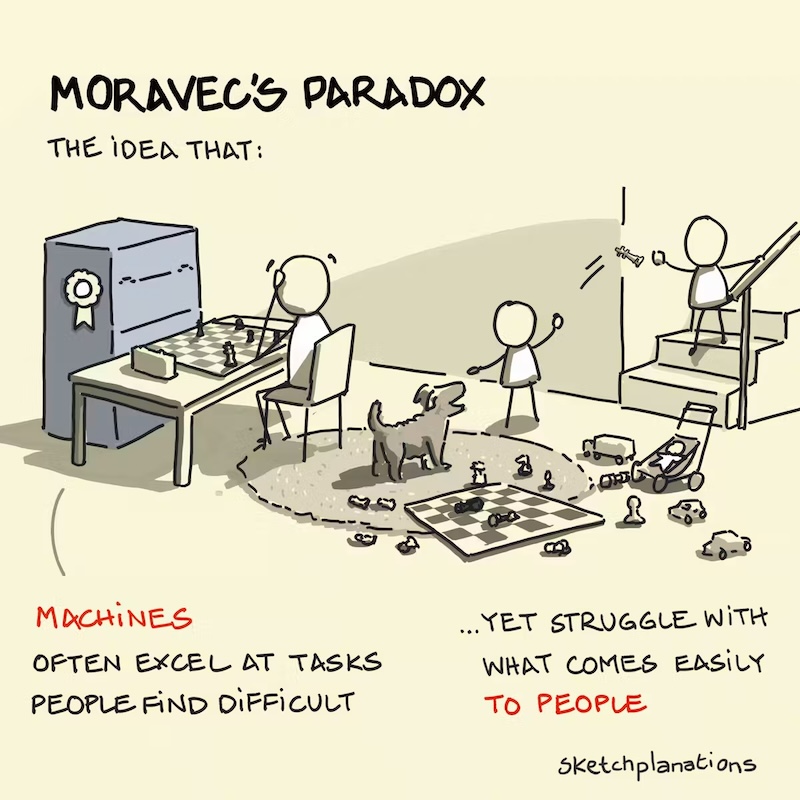
Computers quickly mastered complicated thinking tasks. But simple everyday physical actions, like folding laundry, cracking an egg, or picking up a mug in a kitchen they’ve never seen before, are still some of the toughest problems in AI and robotics.
This inverted reality is known as Moravec’s paradox: the tasks we find intellectually demanding are computationally easy for machines. Whereas the physical interactions we perform without thinking are brutally hard. In short, by building machines to copy ourselves, we discovered what we are truly good at, and it wasn’t what we thought.
The evolutionary blindspot
This disconnect stems from our evolutionary history. Sensory processing, balance, and fine motor skills have evolved over hundreds of millions of years into an extraordinary system that operates entirely below conscious awareness.
When you catch a ball, your brain simultaneously calculates trajectories, accounts for neural delays, and coordinates full-body movement. Yet, it hides this complex computation, leaving you with only the effortless sensation of catching a ball.
Abstract reasoning, on the other hand, is an evolutionary newcomer. It sits as a thin, crude layer over our ancient motor systems. But because it operates through deliberate, step-by-step logic, reverse-engineering it into software was relatively simple.
Your perception of what is “easy” is not a measure of how little work is involved. It is a measure of how effectively evolution hid that work from you. The physical actions that feel effortless feel that way because the underlying systems are so highly refined that you never see the machinery.
The intellectual tasks that feel difficult feel that way because you are consciously grinding through them. That manual processing makes them crude, slow, and ultimately copyable by digital systems.
The blind spot at the point of contact
This dynamic presents a fundamental hurdle for the humanoid robotics sector. As the industry attempts to transition physical AI from controlled demonstrations into commercial sites, it is confronting the fact that physical movement cannot be solved by language models alone.
This challenge asserts itself most at the exact point where visual predictions meet physical resistance: the moment of contact.
Camera-based vision systems provide essential spatial awareness, but they experience a fundamental limitation during manipulation. The moment a robotic gripper or hand closes around an object, the cameras lose line of sight to the contact surface. The system effectively goes blind precisely when the physical interaction begins.
Force and torque sensing addresses this directly at the point of contact. While vision provides positional accuracy down to millimetres, real-world tasks like connector insertion, bearing seating, or threaded assembly require tolerances measured in tens of microns. No optical camera closes that gap independently.
With integrated force feedback, the robot no longer relies on perfect visual accuracy, it can turn a hard perception problem into a controlled physical search.
Instead of computing exact coordinates, the controller lets the robot move downward until it makes contact, probe the surrounding area until the parts line up, and stops or pauses when the resistance changes.
It switches from trying to see the target feature to feeling for it, like human hands performing precise assemblies without direct line of sight.
There’s also a whole layer of physical information you simply can’t get from a camera. Things like mass, friction, softness, stiffness, or how close you are to losing your grip don’t show up in pixels.
That’s why vision‑trained models often understand how objects look and how they move but struggle to predict how those objects will push back when you touch them.
Force sensing fills that gap. It measures the real physical behaviour directly instead of guessing it from visuals. And if force data is the key ingredient for genuine physical intelligence, then built‑in force sensors are the tools that let robots collect that data in the first place.
Hardware demands and modality loss
A humanoid platform relies entirely on the quality of its sensory inputs. Machine learning policies only exploit control channels that deliver consistent, uncorrupted signals.
If a control policy receives a joint torque estimate that is distorted by gear friction, thermal expansion, or mechanical hysteresis, it learns to ignore that sensory channel entirely and rely exclusively on vision.
When force feedback is imprecise, system performance does not merely degrade; the control model systematically deletes touch as an operational modality.
Preventing this failure mode places strict demands on the physical hardware components. Maintaining performance across production deployments requires unit-to-unit repeatability, ensuring that a policy trained on a single platform can run across hundreds of individual units without requiring bespoke recalibration.
At the same time, long-term zero stability is necessary so that sensor baselines remain fixed across continuous operating shifts despite ambient temperature variations.
For real-world contact events, high signal bandwidth reaching kilohertz levels is critical to capturing rapid contact transients and mechanical impacts, while deterministic latency ensures that sensor data aligns precisely in time with incoming vision streams to preserve multimodal control loops.
A full multi-axis force-torque sensor is central to meeting these demanding criteria. While a single-axis load cell measures force magnitude alone, a complete wrench measurement reveals the vector, moment, and geometry of the interaction.
This multi-axis capability is what allows the control architecture to distinguish between routine task resistance and an impending jam.
Grounding physical AI in hardware reality
The humanoid robotics industry is discovering that scaling physical systems requires a different set of discipline than scaling software. In the digital realm, performance scales through model size and compute replication. In the physical realm, machines must negotiate power draw, thermal dissipation, mechanical wear, and physical contact.
Understanding Moravec’s paradox forces a shift in how we evaluate robot capabilities. Mastering abstract tasks proved to be a preliminary step.
Building machines capable of matching the unthinking, effortless physical dexterity of the human body requires precise, real-time ground-truth sensing integrated into the core hardware architecture.
The future of autonomous manipulation will not be solved by visual inference alone, but by giving physical AI the sensory instruments needed to feel, measure, and navigate the physical world.

About the author: Ron Zukerman is an innovation director at Vishay Precision Group. VPG is a leader in precision measurement and sensing technologies. The company’s sensors, weighing solutions and measurement systems optimize and enhance customers’ product performance across a broad array of markets to make our world safer, smarter, and more productive. To learn more, visit VPG at www.vpgsensors.com and follow on LinkedIn.
