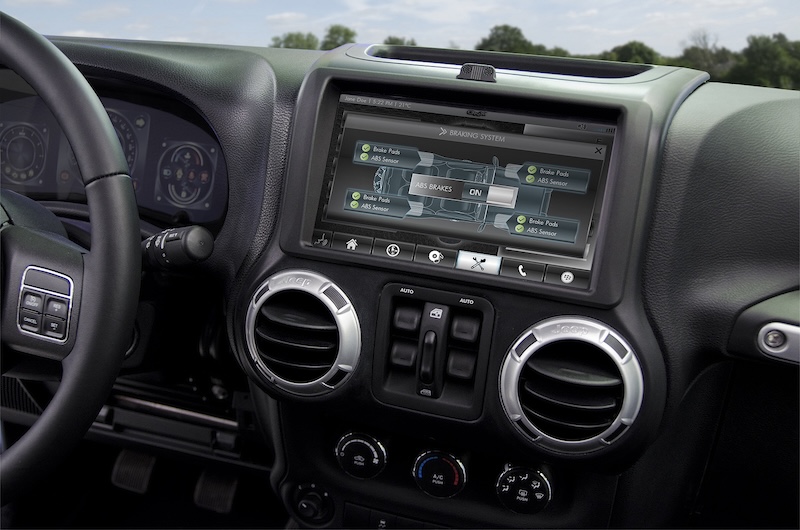
It’s a dim and distant memory now but, once upon a time, BlackBerry was by far the world’s favourite smartphone among business users.
Journalists and all sorts of other professionals were amazed that a phone could enable them to check and respond to their emails while they were out and about.
There literally was no other phone quite like it, and BlackBerry sold in its millions.
Then the iPhone came along with its touchscreen interface and helped transform what people expected from a smartphone. BlackBerry faced the difficult question of how far it should move away from the physical keyboard and business-focused formula that had made it successful.
The rest, as they say, is history.
BlackBerry is still remembered with some fondness, even by people like me who didn’t own one but occasionally used a friend’s or colleague’s device and appreciated the innovation and engineering that went into it.
So, a year or two ago, when I started receiving emails from “BlackBerry” about automotive software, highlighting QNX, I initially wondered: “So that’s what happened to BlackBerry.”
The real history is slightly different. QNX actually dates back to 1980 and was acquired by BlackBerry – then Research In Motion – in 2010. But today QNX has become one of the most important parts of the wider BlackBerry story, supplying foundational software technology to the automotive industry.
And it is now at the centre of another technological transformation – the emergence of the software-defined vehicle.
From smartphones to 275 million cars
The scale QNX has achieved is impressive. According to the company, QNX technology is embedded in more than 275 million vehicles worldwide, and its software can be found in vehicles produced by many of the world’s largest automotive manufacturers.
Unlike the operating system on a laptop or smartphone, however, automotive software is not necessarily something the driver sees.
Modern vehicles contain multiple computers, electronic control units and software layers responsible for everything from infotainment and connectivity to advanced driver assistance, powertrain functions and safety-critical systems.
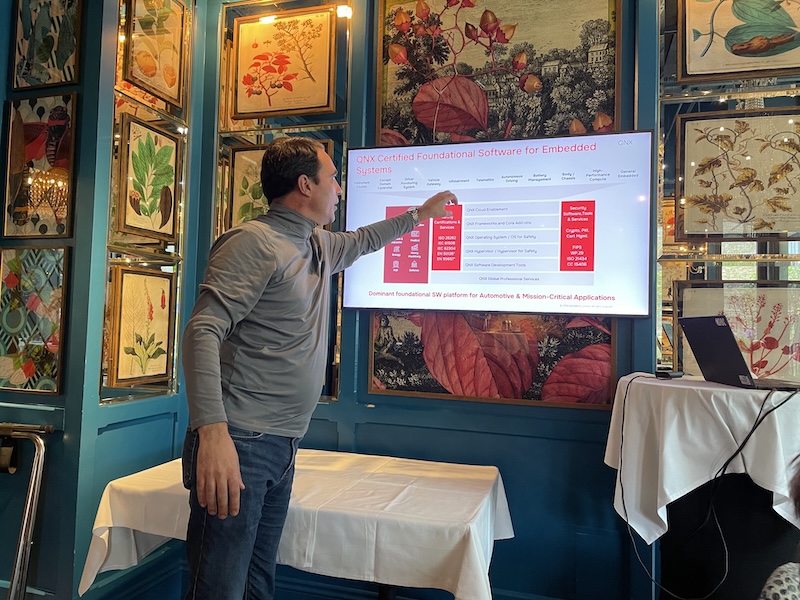
This was one of the points made when QNX invited journalists to the Granary Square Brasserie in King’s Cross, London, for a briefing on the changing automotive software landscape.
I arrived slightly late and, in my usual inadvertently provocative way, managed to bring up Apple.
Realising the potential faux pas, I apologised for “bringing up an old enemy”.
Niko Boeker, QNX director of business development, quickly corrected me. “Apple is not an enemy,” he said.
Boeker went on to explain that the automotive software market is fundamentally different from the smartphone market. A modern vehicle is not one computer running one operating system and a collection of applications. It is an extraordinarily complicated system involving different processors, operating environments, suppliers and safety requirements.
Boeker said: “A vehicle contains many different computing environments, and they have different requirements. Some functions are about the user experience, while others have very strict real-time, safety and security requirements. The challenge is making all of those elements work together reliably.”
Thomas Cardon, QNX director of EMEA automotive sales, illustrated the point by going to the presentation board and explaining the many layers of software and hardware involved in a modern vehicle – unfortunately, the part of the presentation I had missed by arriving late.
Cardon said: “There isn’t one company supplying everything inside the vehicle. You have the OEM, Tier 1 suppliers, semiconductor companies and software companies all contributing different layers. The important question is how you create a foundation that allows all of those technologies to work together.”
And Philip Hatcher, director of automotive OEM engineering at QNX, put the difference rather more succinctly when I spoke to him afterwards.
“Making cars is more difficult than making smartphones,” he said.
The easiest way to understand a software-defined vehicle is to think about where the intelligence resides. In a traditional car, a particular function tends to be closely tied to the hardware that performs it. In a software-defined vehicle, hardware and software are increasingly separated, with a common computing platform capable of running and updating many different functions.
That means a manufacturer can potentially change how the vehicle behaves, add features or improve existing ones through software rather than redesigning or replacing physical components.
For automakers, the attraction is considerable. Software can potentially be reused across multiple vehicles and platforms, features can be developed independently of particular pieces of hardware, and vehicles can continue to gain new capabilities after leaving the factory.
But achieving that separation between hardware and software creates an enormous engineering challenge of its own.
Developers want to spend less time plumbing
QNX’s latest research suggests that this complexity is becoming one of the automotive industry’s biggest problems.
Its second annual Under the Hood: SDV Developer Report surveyed 1,100 embedded software developers working for automotive businesses in Canada, China, France, Germany, Japan, South Korea, the UK and US. The research was conducted by OnePoll in July and August 2026.
The headline finding is that automotive developers are still spending an enormous amount of time building and integrating the underlying software infrastructure rather than developing features that drivers actually experience.
According to the survey, 35 percent of development effort is being spent on foundational integration tasks, while only 9 percent of respondents said their teams were primarily focused on application-layer features and user-facing functionality. Meanwhile, 79 percent said their organizations were under pressure from faster-moving competitors.
That helps explain QNX’s current strategy.
Rather than expecting every automaker to repeatedly construct the lower layers of its software architecture, QNX wants to provide more of the common foundation on which manufacturers and developers can build their own applications.
Three-quarters of developers surveyed said the lack of a common, reusable software foundation is slowing SDV development. Some 76 percent said automakers should concentrate more resources on application-layer innovation rather than foundational software infrastructure.
Only 22 percent said their organizations extensively reuse the same foundational software platform across vehicle programs or electronic control unit domains. Better integration between development tools was the most commonly selected measure that developers said would allow them to spend more time on application-layer innovation, followed by greater software reuse and pre-integrated foundational platforms.
Hatcher said: “If every engineering team has to solve the same foundational problems again and again, that is engineering effort that isn’t being spent differentiating the vehicle. The opportunity is to provide a trusted foundation so developers can spend more of their time creating the things that actually make one vehicle different from another.”
Security is another increasingly important consideration. Some 83 percent of the developers surveyed believe SDVs will become a major target for cyberattacks within three years, while 48 percent named security threats among their three biggest concerns about the future of automotive software development.
The research also suggests that attitudes towards artificial intelligence are becoming more practical. The proportion expecting AI to be “transformational” to automotive software development fell from 36 percent last year to 25 percent, while the proportion expecting it to have a significant role integrated into everyday development workflows increased from 55 percent to 62 percent.
In other words, AI may be moving from PowerPoint presentation to toolbox.
Cars follow the data centre
There is nothing particularly new about the idea of making hardware “software-defined”. The data centre industry went through a similar transformation more than a decade ago.
Traditionally, a particular application might have been closely associated with a particular physical server. Virtualisation gradually broke that relationship. Computing power, storage and networking could instead be treated as pools of resources controlled through software.
By around 2012, VMware was popularising the term “software-defined data centre” to describe the logical conclusion of that process – infrastructure in which the physical hardware remained essential, but increasingly disappeared beneath an abstraction layer controlled by software.
Something strikingly similar is now happening to the car.
Instead of every vehicle function being tightly coupled to a particular electronic control unit and its associated hardware, automakers are moving towards more centralised computing architectures and reusable software platforms. Functions can increasingly be created, changed and updated in software.
In theory, that should make developing cars faster and cheaper while allowing manufacturers to add new capabilities throughout the life of a vehicle.
And this is where QNX’s argument becomes particularly compelling. If the underlying computing platform can be standardised and reused, automotive engineers don’t have to keep rebuilding the foundations.
The company’s research suggests developers themselves broadly favour that direction. Some 95 percent of respondents said collaboration between OEMs, Tier 1 suppliers and software vendors is important to their current development projects, while 89 percent said their organizations support collaborative development practices.
Cardon said: “The automotive industry has always been an ecosystem. No manufacturer builds every component itself. Software doesn’t change that principle – but it does change the speed at which companies need to work together and the level of integration that is required.”
The QNX survey also found that 97 percent of developers believe platform engineering – integrating operating systems, middleware and hardware – will be important to SDV development over the next five years.
But the move towards common foundations also raises another question: what happens to the competitive value of owning those foundations?
But what about the Apple model?
That was essentially the awkward question I put to the QNX executives.
At a time when Chinese automakers are putting enormous competitive pressure on European, American and Japanese manufacturers, does it necessarily make sense for car companies to embrace common software platforms and increasingly standardised architectures?
Apple’s historic strategy has been almost the opposite.
Rather than allowing the fundamental architecture of its products to become a collection of interchangeable technologies supplied by different companies, Apple has sought tight control over the hardware, operating system and user experience.
That control became an enormously valuable competitive advantage.
So why shouldn’t an automaker try to do the same?
Why make vehicles easier for outside developers and suppliers to build components and software for? Would an automaker ultimately retain more value by owning as much of its hardware and software architecture as possible?
Boeker said: “OEMs still control what makes their vehicle unique. A common software foundation doesn’t mean every vehicle becomes the same. It means manufacturers don’t have to spend resources recreating foundational technology that does not differentiate the brand.”
It is an important distinction.
Windows did not make every PC identical. Linux does not make every server identical. Android certainly hasn’t made every smartphone identical.
What common platforms can do is create ecosystems.
And ecosystems attract developers.
There is also a practical reason why automotive manufacturers may struggle to emulate Apple’s vertically integrated model: cars are extraordinarily complicated.
A software-defined vehicle has to combine infotainment, connectivity, driver assistance, potentially automated driving, cybersecurity, over-the-air updates and increasingly AI-based functions while continuing to perform the rather important traditional function of transporting people safely from one place to another.
The QNX research found that 95 percent of developers regard functional safety as important to their work. In the US, 66 percent described it as “very important”, with the UK second at 59 percent.
And the software has to work reliably for many years, across different generations of processors, sensors and other components, while meeting regulations that vary between markets.
During 2025 alone, according to the QNX report, more than 700 new regulations or legislative proposals directly affecting the development of in-car technology were introduced worldwide, up from around 500 the previous year.
That is a rather different proposition from developing the next smartphone.
A world being taken over by Windows
There is something slightly counterintuitive about all this.
For decades, automakers differentiated themselves principally through mechanical engineering. An engine, gearbox, suspension system and chassis could give a vehicle an unmistakable character.
Increasingly, some of that differentiation is migrating into software.
One might therefore expect manufacturers to guard their software more jealously, not build it on common foundations.
But the sheer complexity of the modern vehicle may make the Apple approach increasingly difficult.
Perhaps the automotive industry is simply too large, too interconnected and too complicated for any single manufacturer to become the Apple of cars.
Instead, it may increasingly resemble the PC industry: manufacturers differentiating themselves at the product and application level while relying on technologies and standards supplied by a much larger ecosystem underneath.
There is even an amusing counterpoint buried in QNX’s own research. Despite all the industry’s enthusiasm for software-defined vehicles, the report suggests there is considerable interest in the opposite idea as well.
In the UK, almost one in three developers surveyed – 32 percent – said they thought a deliberately minimalist, low-tech vehicle with limited digital features and connectivity was “very likely” to succeed commercially, up from 20 percent in 2025.
Perhaps some drivers would quite like a car that is simply a car.
But there seems little prospect of the wider software-defined vehicle movement reversing course. Advanced driver assistance, connectivity, centralised computing, AI and over-the-air software are becoming integral parts of automotive engineering.
And if the industry does evolve towards shared foundations with enormous ecosystems of developers and suppliers building above them, QNX finds itself in an enviable position.
It already has decades of experience in embedded and safety-critical computing, relationships across the automotive industry and software running in hundreds of millions of vehicles.
There is an interesting historical irony here.
BlackBerry lost the smartphone market to one of the greatest practitioners of vertically integrated technology the industry has ever seen – Apple.
Yet QNX is now prospering in an automotive industry that appears to be moving in the other direction: towards layers, platforms, abstraction, common foundations and large ecosystems of specialist suppliers.
In that sense, perhaps the automotive world isn’t going to produce an Apple at all.
It may instead be a world increasingly taken over by Windows.
And if that is where the software-defined vehicle era is heading, QNX looks particularly well positioned for it.
Some images courtesy of Motor Authority
