Anthropic has introduced Claude for Manufacturing, a new AI software offering designed to help manufacturers streamline everyday tasks, including preparing quotations, investigating quality problems, diagnosing equipment failures and managing supplier relationships.
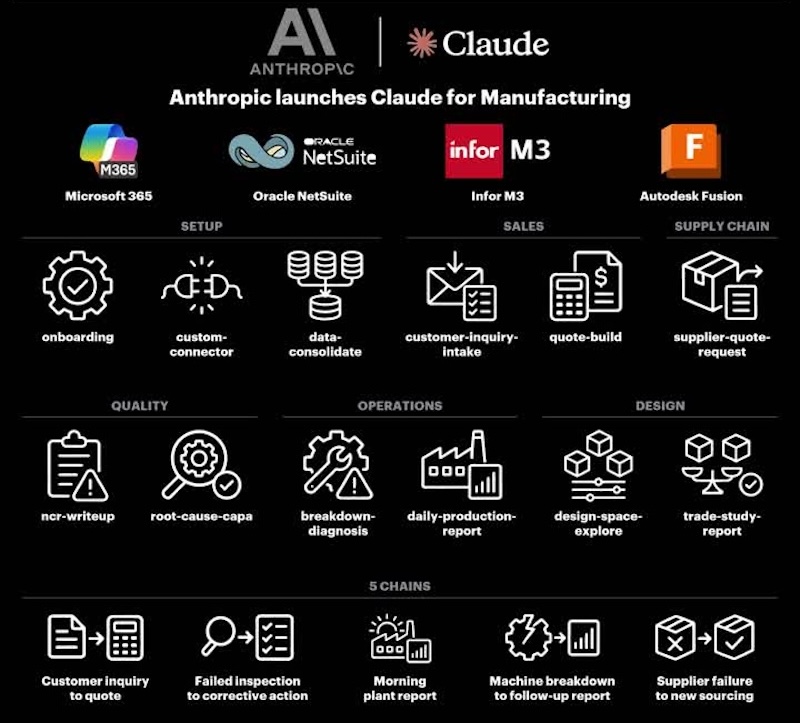
Announced on November 12, the offering combines 17 manufacturing-specific skills with four software connectors, enabling Claude to work with information stored in systems already used by industrial companies.
The connectors support Autodesk Fusion, Infor, Microsoft 365 and Oracle NetSuite, bringing together engineering, operational, financial and administrative information.
Anthropic says the system is intended to reduce the time manufacturing professionals spend collecting and organizing information, while leaving important decisions and approvals to employees.
The company cites a 2025 Manufacturing Leadership Council survey in which 79 percent of manufacturers reported entering data manually.
AI assistance across manufacturing operations
Claude for Manufacturing includes skills covering sales, quality management, operations, supply chains, engineering design and equipment setup.
The software can carry out individual tasks or coordinate several stages of a process before presenting its findings for human review.
For example, when a manufacturer receives a request for quotation, an estimator can ask Claude to examine the customer’s requirements, identify missing information, compare costs from previous jobs and prepare a draft quotation.
Quality engineers can use the system to investigate failed inspections by reviewing previous reports, identifying possible causes and preparing corrective action documentation.
Maintenance technicians can provide sensor data, repair records, photographs and equipment manuals to help Claude identify potential causes of a breakdown.
The system can then rank possible explanations for the technician to investigate.
Other applications include preparing supplier requests, comparing quotations, generating engineering design variations and compiling production performance reports.
For plant managers, Claude can combine production figures into reports showing output against targets, equipment downtime and the financial consequences of lost production.
Connecting AI with existing manufacturing software
A central feature of the offering is its ability to retrieve information from established manufacturing and business software.
Through Autodesk Fusion, engineers can use Claude to generate variations of existing designs, compare them against specified requirements and prepare recommendations.
The Microsoft 365 connector provides access to relevant documents, emails, procedures and reports, while Oracle NetSuite enables estimators to incorporate information about inventory, production costs and previous orders.
Infor integration allows buyers and planners to retrieve purchasing and inventory information.
Anthropic says manufacturers can also work with systems that do not have dedicated connectors by exporting their data into Microsoft 365, where Claude can access the resulting files.
The company plans to expand the available manufacturing skills over time, while allowing organizations to adapt existing skills to their own operations.
Infor partnership extends AI into business transactions
Alongside Anthropic’s announcement, enterprise software company Infor has introduced Infor Industry AI for Claude, a separate plugin designed to support actions within Infor’s manufacturing software.
While the connector included in Claude for Manufacturing allows users to retrieve records, Infor’s plugin also enables approved changes to business systems.
For example, if a steel shipment is delayed, a purchasing manager could ask Claude to identify affected customer orders, check inventory at other facilities and find alternative suppliers.
Following human approval, the system could issue a replacement purchase order and reschedule production through Infor.
The integration maintains existing Infor user permissions, meaning employees can access and modify only the information and functions authorized for their roles.
The approach illustrates how AI assistants are moving beyond answering questions and generating documents toward coordinating business processes across enterprise software.
Human oversight remains central
Anthropic emphasizes that Claude for Manufacturing is designed to support employees rather than make final operational decisions independently.
The system’s workflows are structured around review and approval, with estimators responsible for releasing quotations and quality engineers responsible for verifying corrective actions.
Claude can also link figures and findings to the underlying records and documents, allowing users to check the information supporting its recommendations.
Importantly, the new offering does not directly control manufacturing equipment.
Anthropic is separately developing a Model Hardware Standard, currently described as a research preview, intended to provide a standardized way for programmable equipment to communicate measurements, operating settings and safety limits.
That distinction separates the company’s immediate focus on manufacturing information and workflows from the more demanding task of connecting AI systems directly to industrial machinery.
Availability and industrial applications
Claude for Manufacturing is available as a plugin for organizations using Claude Team or Enterprise plans.
After installation, the software can help users identify their existing systems, test the available connectors and determine which manufacturing skills can operate with the information currently accessible.
The introduction reflects growing interest in applying generative AI to industrial operations beyond conventional chatbots and document generation.
Manufacturers already rely on numerous software systems for engineering, purchasing, production planning, quality management and maintenance. Connecting information across those systems can require considerable manual work.
Anthropic’s approach is to use AI to gather relevant information, prepare documentation and coordinate routine processes, while employees retain responsibility for technical judgments and business decisions.
Whether the technology delivers substantial productivity improvements will depend on the quality of manufacturers’ existing data, the reliability of the integrations and how effectively the software fits established workflows.
