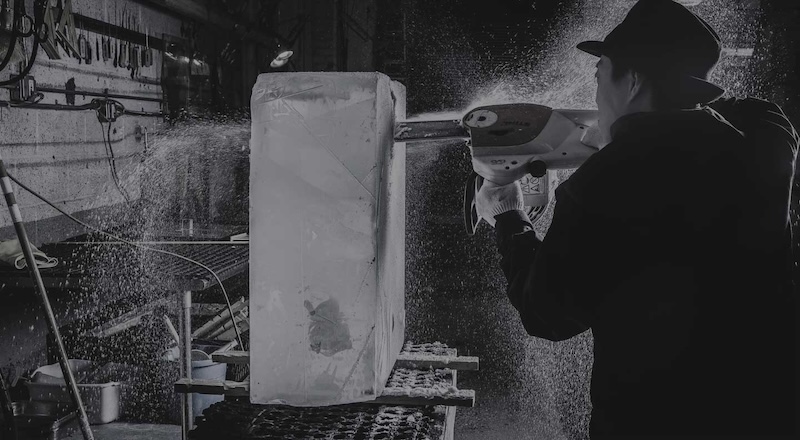
Ice rarely comes up when people talk about industrial automation. It sits far from robotic arms, warehouse vision systems and predictive analytics in the popular imagination.
Yet commercial ice production is going through the same quiet transformation as the rest of the manufacturing floor, driven by the same pressures: rising labor costs, tighter consistency requirements, and the need to do more with less water and energy.
The stakes are higher than they look. Hotels, restaurant groups, event caterers, seafood processors and cold chain operators all depend on a steady supply of ice that meets a defined standard.
Modern ice makers have been automated at a basic level for decades, but the latest generation of equipment goes much further. Below are six shifts manufacturers are making, followed by a look at some of the companies active in the category.
1. Automated Freezing Cycles Replace Manual Timing
Producing clear ice blocks relies on directional freezing, a slow process that pushes air and impurities away from the freezing front so the finished block is dense and transparent. Done by hand, it depends on an operator watching temperatures, timing the cycle and judging when a block is ready.
Modern equipment hands those decisions to controllers that manage the whole sequence, from filling and freezing through to harvest.
The practical result is repeatability: two blocks produced a week apart look and behave the same, which matters to any operation that sells or serves ice at volume and cannot afford a bad batch.
2. Sensors and Real-Time Monitoring
Temperature probes, water level sensors and pressure readings used to be checked occasionally by a technician walking past the machine. Increasingly they feed continuous data into control systems that track the health of the equipment.
Operators can see when a compressor is working harder than normal or when incoming water quality drifts, and respond before a minor issue becomes downtime.
For a business that needs ice at every service, avoiding unplanned stops is worth more than almost any single feature on a specification sheet, which is why monitoring has moved from an optional add-on to a core part of how equipment is designed.
3. Smarter Water Handling
Water quality largely determines ice quality. Dissolved minerals and trapped air are the main causes of cloudy ice, so manufacturers are automating the stages around the freezer itself: filtration, circulation and the management of impurities that concentrate during freezing.
Automated handling reduces the variation that comes from different operators, different water sources and different seasons. It also reduces waste, because fewer batches are rejected for visible defects, and every rejected block represents water, energy and hours of production that cannot be recovered.
4. Energy and Load Optimization
Refrigeration is energy-intensive, and ice production runs for long stretches. Automation allows manufacturers to build systems that schedule production around demand, run at more efficient load points and avoid unnecessary compressor cycling.
Some operators now produce during off-peak hours and build up storage ahead of busy service windows, smoothing both energy costs and workload.
As electricity prices and sustainability reporting become part of procurement decisions, efficiency has shifted from a pleasant extra to a standard question that buyers put to suppliers before they place an order.
5. Consistent Quality Control and Testing
In a manual workflow, quality control depends on someone noticing a problem. In an automated one, standard checks are built into the process, and equipment is typically tested before it leaves the factory.
Buyers have responded by asking for documentation, such as certifications and testing records, instead of relying on a manufacturer’s description of its own product.
This is part of a broader change in attitude: ice machines are increasingly treated as industrial equipment with traceable quality, rather than as appliances chosen mainly on price and appearance.
6. Modular, Scalable Production Lines
Ice demand is rarely flat. A hospitality group opening new venues, or a caterer taking on larger events, needs capacity that can grow with the business.
Manufacturers are responding with modular designs that let operators add units in stages and connect production with storage, cutting and handling equipment.
Automation is what makes this practical, because controllers can coordinate several machines as one system instead of leaving each as a standalone unit that someone has to manage separately.
Manufacturers to Know in Commercial and Industrial Ice Equipment
The category includes long-established brands and specialists focused on specific types of ice. The list below is not a ranking. It is a starting point for operators and engineers researching equipment.
- BF Technology is a manufacturer specializing in clear ice block machines built around directional freezing, supplying equipment to hospitality businesses, event operators and ice production companies in international markets.
- Scotsman Ice Systems is a long-established commercial ice machine manufacturer, known for a wide range of cube and nugget equipment used across hospitality and healthcare settings.
- Kold-Draft is recognized for large, dense ice cubes aimed at cocktail-focused bar programs.
- Ice-O-Matic is a commercial ice machine manufacturer serving restaurants, hotels and institutional kitchens with a broad equipment lineup.
- Clinebell Equipment Company is a specialist in large-format clear ice block production, often used for ice carving and premium presentation.
Each takes a different approach, some focused on general-purpose commercial ice, others built around clear ice or large blocks, so the right fit depends on the volume, the type of ice and the level of control a given operation needs.
What Comes Next
The direction of travel is clear. Ice production is moving from a manually supervised process toward a monitored, controlled and documented one, in line with the rest of industrial manufacturing.
For buyers, that changes the questions worth asking: not only how much ice a machine produces, but how consistently it produces it, how its performance can be monitored, how much energy and water it uses, and what testing and certification stand behind it.
Manufacturers that can answer those questions with data rather than slogans will be better placed as hospitality, food processing and cold chain operators continue to raise their expectations.
For everyone else in the supply chain, the lesson is the same one automation has taught in other industries: the unglamorous parts of the operation deserve the same engineering attention as the visible ones.
