
Walk the floor of any active facility today and you see the same stress points. The machines are faster. The placement heads are more precise. But getting a product from a schematic to a boxed unit on a pallet is harder than it was ten years ago.
We are dealing with parts that look like specks of dust, supply chains that break if someone sneezes in the wrong time zone, and clients who expect prototypes turned around in days. The physics of putting copper and silicon on a fiberglass board haven’t changed.
The business of doing it profitably has entirely shifted. You have to fight for margin on every single unit while maintaining quality standards that leave zero room for error.
Sourcing Parts Without Losing Your Mind
We all know the hangover from recent global shortages is still kicking around. You design a board around a specific microcontroller. By the time you get approval to run a thousand units, that chip is out of stock for fifty weeks.
Sourcing is no longer just a back office procurement job. It’s a core engineering problem. You have to design for availability right out of the gate.
This means building in alternates for passive components and picking active components with footprint compatible backups. Sometimes you even have to design two versions of the board simultaneously just to hedge your bets against supplier lead times.
When you hand off your bill of materials, your relationship with your PCB Assembly Manufacturer makes or breaks the project. A good partner will flag parts that are going to end of life before they load the reels on the pick and place machine.
They monitor global stock levels and buy ahead when they see a shortage coming. A bad one will just wait for the line to stop and ask you what you want to do about it. You need vendors who act like extensions of your own team.
Dialing in the Real Cost of Assembly
Everybody wants to know the unit cost on day one. Raw component cost is only half the math. The real money is made or lost in setup time, testing, and material handling. If you have a board with parts on both sides, you’re running it through the oven twice.
If you have heavy components that need wave soldering or manual placement, your labor costs jump immediately. Hand soldering a few connectors sounds cheap until you multiply it by ten thousand units.
Plugging your numbers into a Production Line Calculator early in the design phase is the only way to get a realistic picture of throughput.
It forces you to look at required production rate and figure out exactly where the bottleneck will be. Maybe the choke point is the automated optical inspection.
Maybe it’s the functional test jig or the conformal coating station. Once you know the slow step, you can tweak the design or add capacity to speed things up. Efficiency is found in seconds and cents.
Making Everything Fit Together
Boards are getting smaller but the real world still needs physical connections. You can shrink a logic board down to the size of a postage stamp. You still have to get power into it and high speed signals out of it.
Managing the physical routing inside an enclosure is a massive headache for mechanical and electrical teams alike. Standard cables rarely do exactly what you need them to do without leaving a nest of wires that catches on the casing or blocks airflow.
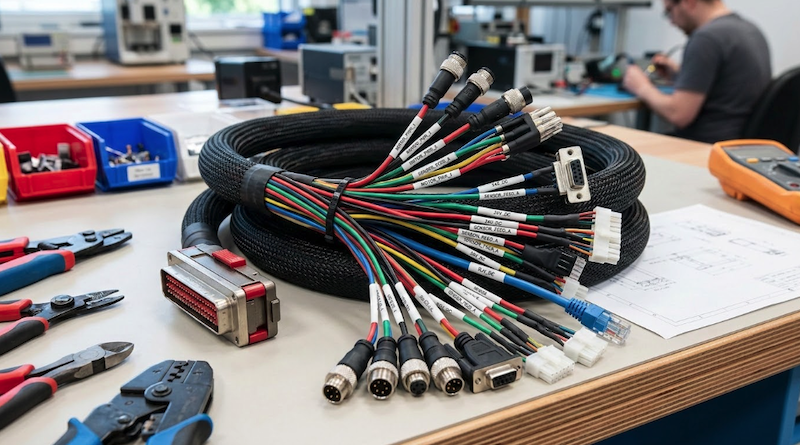
This is where a Custom wiring harness becomes mandatory. When you have high vibration environments or you just need to pass EMI testing without failing by two decibels, routing matters. You need the exact length, the right shielding, and connectors that actually click and hold.
Trying to jam generic cables into a tight form factor usually results in pinched wires, poor grounding, and eventual field failures that are miserable to diagnose.
Test Strategy and False Failures
Testing takes time. Not testing takes money. That is the basic math of quality control. We put a lot of faith in flying probe tests and bed of nails fixtures. Setting up those test environments takes serious engineering hours. You have to define exactly what constitutes a pass.
If your tolerance windows are too tight, you end up throwing perfectly good boards in the rework bin. If they’re too loose, dead units end up in the hands of customers.
Functional testing is even worse from a setup standpoint. You’re essentially building a product to test your product. That means writing custom firmware just to exercise the memory, flash the LEDs, verify the communication ports, and check power draw under load.
It’s tedious work. It also has to be done perfectly if you want to scale up volume without drowning in returns. You can’t test quality into a product at the end of the line, but you certainly need a net to catch the inevitable manufacturing defects.
Environmental Reality Checks
Things work great on a lab bench at 72 degrees. They tend to fail when strapped to an engine block in the winter or baked inside a sealed metal box in the summer. Thermal management is entirely unforgiving.
We push more current through smaller traces now, and all that heat has to go somewhere. If your thermal vias are insufficient or your copper pours are too thin, the board literally cooks itself over time.
The same goes for the external connections that leave the housing. A standard connector might handle the voltage but it will shake loose on a tractor or a piece of heavy industrial machinery.
Upgrading to a Custom Cable Assembly designed with proper strain relief and ingress protection is how you keep the elements out.
It costs a bit more upfront but it absolutely beats paying for warranty replacements, field technician travel, and angry phone calls from facility managers.
The Burden of Revision Control
Hardware is not software. You can’t push an over the air update to fix a backward polarized capacitor. The moment a physical change is made to a board layout, every single piece of documentation has to follow suit.
Schematics, assembly drawings, pick and place files, and test procedures all need to sync simultaneously. If one file is out of date, the whole batch is ruined.
I’ve seen massive delays happen just because a contract manufacturer built revision C of a board while the test engineering team was using revision D of the test jig.
Keeping the whole chain aligned takes rigorous discipline and strict change management processes. It’s boring administrative work. There’s no glory in it. But it keeps the factory floor running and prevents dumpsters full of expensive scrap.
Managing Client Expectations
Most people outside the industry don’t understand why a minor layout tweak adds two weeks to a timeline. They assume modern factories are magic. They think you just hit print and the machines spit out new boards the next morning.
Explaining the reality of tooling charges, stencil creation, solder paste curing profiles, and machine setup time is just part of the job now. You have to set the operational boundaries early and clearly.
We’re dealing with physics and chemistry on a daily basis. Things take the time they take. Good manufacturing is about removing the variables you can control so you have the bandwidth and resources to deal with the ones you cannot.
You build processes that are repeatable, you trust your supply chain, and you measure everything.
