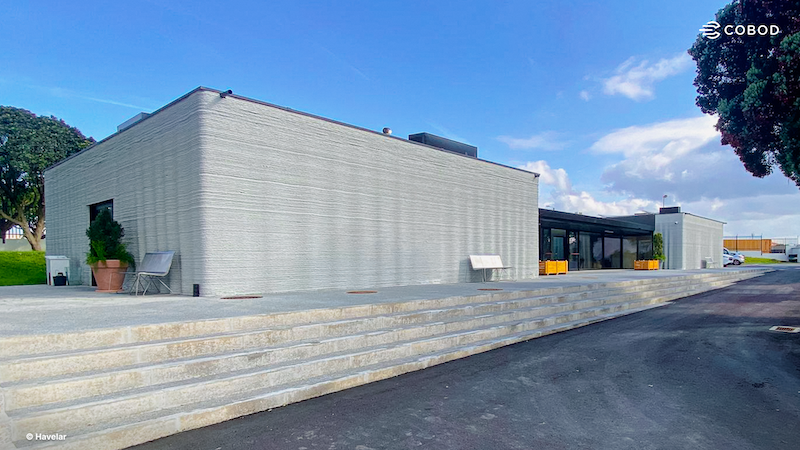
Portuguese construction 3D printing company Havelar has delivered a public building for the municipality of Matosinhos using construction 3D printing technology.
The project, a 500 m² (5,400 ft²) recycling center office at the Ecocentro de Perafita in Porto, was printed in 9 days on budget using a COBOD BOD2 construction 3D printer operated by a four-person crew.
The project demonstrates the benefits of construction 3D printing for public sector applications. Public construction projects in Portugal have historically faced cost overruns, making the budget-accurate delivery of this project particularly notable.
The recycling center was completed exactly in line with its allocated budget, an outcome that the project partners described as uncommon for public works in the country.
The structure incorporates curved walls throughout – a feature that would add significant cost using conventional formwork, but which construction 3D printing produces directly from the digital model at no additional labor or material cost.
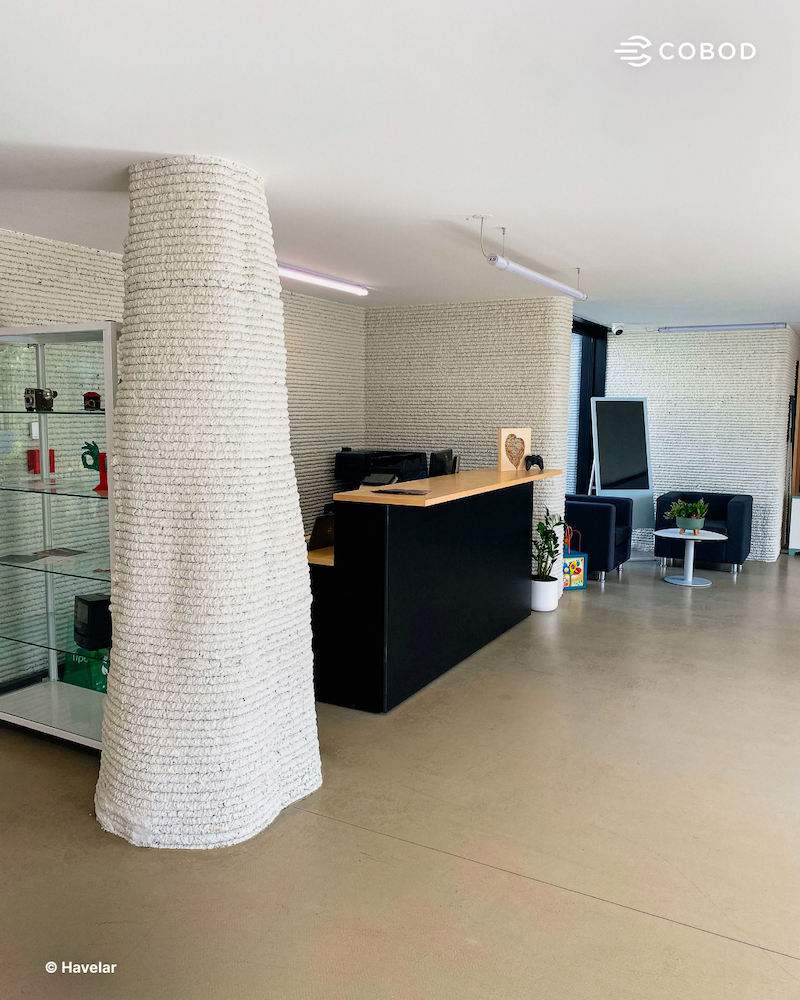
José Maria Ferreira, founder and CEO at Havelar, says: “The main advantage is time. In construction terms, it is a third: a third of the time, a third of the materials, and a third of the people. Here it is not just about the recycling aspect; it is also that we had a team of only four people to construct a building like this.”
Bárbara Rangel, researcher at the Faculty of Engineering of the University of Porto, says: “With 3D construction printing, trades can work in parallel; there is no waiting for walls or slabs to dry before the electrician, tiler, or carpenter comes in.
“The curved walls on the exterior also serve a structural purpose, and through the shade they generate, we are able to enhance solar gains through the interplay between shade and sun exposure.”
Havelar has continued to build on this project’s success. Since completing the recycling center, the company has printed 32 housing units in Porto, and a further 53 houses are scheduled for construction later in 2026, extending construction 3D printing to residential applications across different regions of the country.
Philip Lund-Nielsen, co-founder and CCO of COBOD International, says: “Havelar delivered a public building on budget with a four-person crew and beat the conventional construction timeline. Construction 3D printing isn’t an alternative method anymore. For projects like this, it’s clearly the superior option.”
This project adds to a growing body of evidence that construction 3D printing is capable of delivering public buildings faster, at comparable or lower cost, and with greater design freedom than traditional methods.
COBOD’s BOD2 printer, deployed by Havelar for this project, is part of a global fleet of COBOD machines that have been used to print residential, commercial, industrial, and public structures across Europe, the Americas, the Middle East, and Asia.
