
X Square Robot is showcasing its full portfolio of embodied AI technologies at the World Robot Conference 2026 in Beijing, presenting applications ranging from logistics automation and dexterous manipulation to household robotics and AI training-data collection.
The Shenzhen-based company is exhibiting at booth C107 during WRC, which runs from August 19 to 23, bringing together its WALL-B embodied AI foundation model, robotic hardware, manipulation technologies and data infrastructure.
The WRC appearance comes shortly after X Square Robot livestreamed an hour-long logistics demonstration in which its system processed 1,816 parcels with a reported accuracy of more than 98 percent.
At WRC, the company is expanding the focus beyond that logistics application to demonstrate how the same broader approach to embodied intelligence can be applied across different physical systems and environments.
Embodied AI across different applications
One of the central demonstrations at the X Square Robot booth is the logistics system featured in the recent livestream.
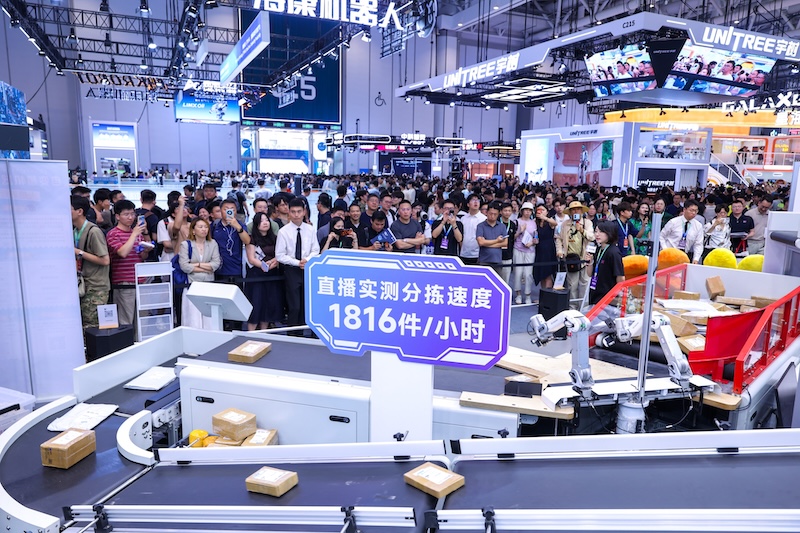
The system combines the company’s WALL-B foundation model with its self-developed high-performance six-axis robotic arms to handle parcels of different sizes, weights, shapes and materials.
But the company’s WRC presentation extends from industrial operations into much more complex manipulation tasks.
In a flower-arranging demonstration, a dual-arm robot is given natural-language instructions that require it to understand a customer’s preference for a particular color of rose, identify the appropriate flower and then complete a sequence involving a vase, additional flowers and foliage.
The robot must coordinate perception, language understanding and two-arm manipulation across the complete task.
Changes can also be introduced into the environment, including moving the vase or rearranging the flowers, testing whether the system can adapt its actions rather than simply replay a predetermined sequence of movements.
Fan disassembly with dexterous hands
The fan-handling demo is designed to test how a robot can use its embodied AI foundation model and dexterous hand to complete a long sequence of precise manipulation tasks.
The robot needs to open a cardboard box, retrieve a fan, place it on the table, turn on the switch, and verify that it is working. Along the way, it must handle deformable packaging, limited visibility, and an irregularly shaped object, while coordinating both arms and precisely controlling its five-finger dexterous hand.
Behind the demo is X Square Robot’s general-purpose skill generation platform for dexterous hands, which integrates data management, skill training, and real-robot evaluation.
It supports skills such as grasping, turning, opening and closing, and tool use, connecting the workflow from demonstration and data processing to model training, deployment, and evaluation.
By turning raw demonstrations into learnable and continuously improvable skill assets, the platform helps robots move beyond individual tasks toward building transferable, general-purpose manipulation capabilities.
Bringing embodied AI into the home
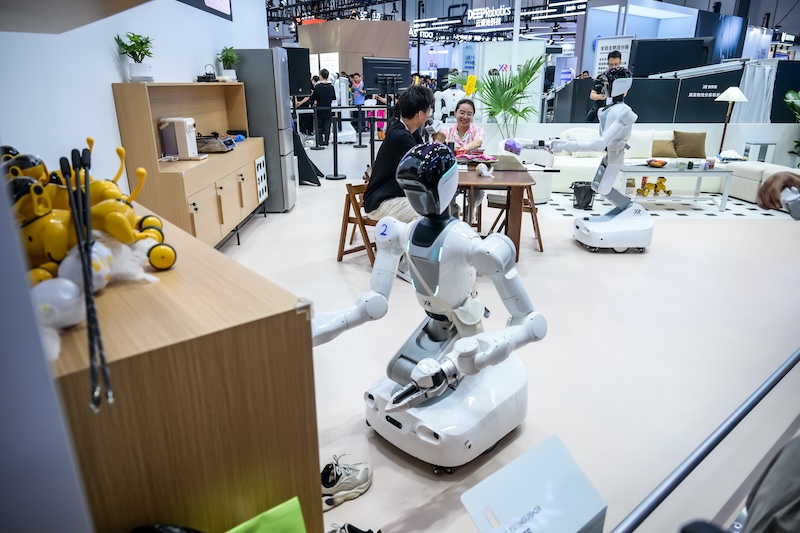
X Square Robot is also using WRC to demonstrate its “X Family Member Program” through a real-life home environment built around the concept of “a day at home”.
Rather than presenting individual robotic functions in isolation, the demonstration connects different everyday scenarios, including entertainment, family meals, leaving the home and remotely interacting with the home through an app.
The concept is intended to demonstrate how robotics, AI, connected devices and services could work together as people move between different activities during the day.
It also presents a substantially different challenge for embodied AI from the relatively controlled conditions of an industrial workstation.
Homes contain changing arrangements of objects, people and activities, making perception and adaptability particularly important if robots are eventually to operate autonomously in domestic environments.
Building the data behind embodied AI
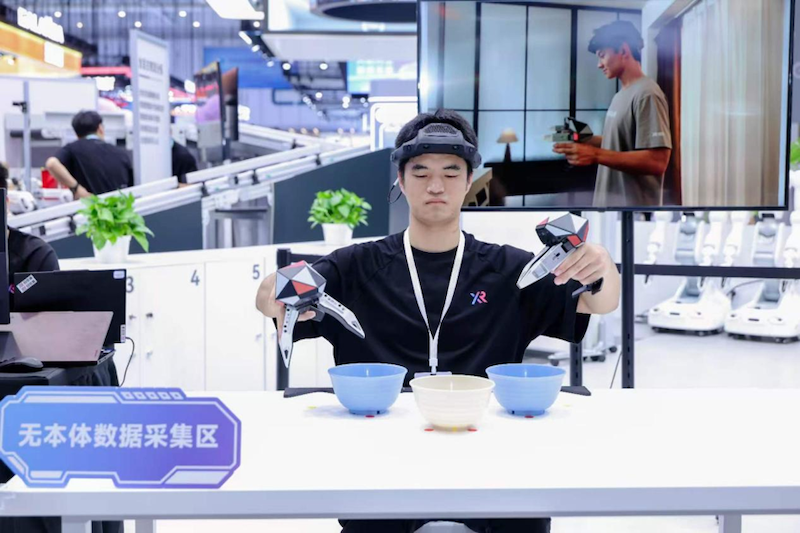
Underlying those applications is another major part of X Square Robot’s WRC portfolio: the QUANXTA Zero series, a hardware-and-software platform for generating embodied AI training data.
The product family includes different combinations of head-mounted equipment, wearable hardware and handheld grippers designed to capture human movements without requiring the operator to be physically connected to a robot.
According to X Square Robot, the system synchronizes multiple sensor streams to within 1 millisecond and can capture vision, touch and audio alongside millimeter-level positioning information.
The company says its testing indicates that 1,000 body-free data samples combined with 100 samples collected from real robots can provide training results comparable to approximately 1,000 real-robot samples.
X Square Robot also claims its approach can make data collection 2.33 times more efficient than conventional remote-control methods.
On the software side, QUANXTA Zero covers the workflow from collection and cleaning through quality control, annotation, model training, simulation, evaluation and model iteration.
The aim is to turn collected demonstrations into structured, reusable training assets that can support the continuing development of embodied AI models.
Taken together, the WRC demonstrations present the different layers of X Square Robot’s strategy: data collection and model development at one end, and physical robots performing industrial, dexterous and domestic tasks at the other.
Logistics provides a real-world test
The logistics demonstration conducted immediately before WRC provides a more production-oriented example of how those technologies can be applied.
Parcel induction is a particularly demanding automation problem because packages arriving from unloading operations are not necessarily presented in predictable positions.
Boxes overlap, soft packages deform, labels can face in the wrong direction and the available grasping surface changes every time a parcel is removed.
X Square Robot’s approach uses WALL-B to interpret those changing conditions and determine how its six-axis arms should approach and manipulate individual parcels.
The arms can pick, flip and reposition packages before feeding them into a downstream conveyor. They can also flatten labels on flexible packaging and adjust the orientation of boxes to improve subsequent barcode scanning.
During the livestream, the system also demonstrated exception handling when an arm intervened to recover a parcel moving toward the wrong routing area.
Wang Qian, founder and CEO of X Square Robot, says: “The question in logistics automation is not whether a robot can make one clean pick. It is whether it keeps making good decisions as the pile changes, recovers when something goes wrong, and keeps the rest of the operation moving. We designed the automation around the work itself, not around an idealized environment.”
That adaptability attracted attention from automation specialists following the demonstration.
Katy Lin, an automation engineering manager in the automotive industry, says: “Speed gets the headline, but handling real-world variability at that speed is what makes this impressive.”
Purpose-built robots and the humanoid question
The livestream also attracted attention because X Square Robot processed 1,816 parcels in the hour after setting itself a target of 1,248 parcels per hour – a figure comparable to the sustained hourly average achieved during Figure AI’s much longer 200-hour humanoid logistics demonstration.
X Square Robot exceeded that target by approximately 45 percent.
The demonstrations are not directly equivalent. Figure used a complete humanoid robot and demonstrated endurance over a much longer period, whereas X Square Robot’s system uses stationary robotic arms optimized for a parcel-induction workflow.
But the comparison raises a broader question that is particularly relevant to X Square Robot’s WRC portfolio: whether embodied intelligence needs to be associated with one universal robot form.
Scarlett Lu, a China technology and supply chain analyst, says: “This is the comparison I’d like to see much more often. Not ‘robot vs human’, but one robot architecture vs another for the same job.”
She adds: “Sometimes the winning robot may simply be the one designed around the work, not around the human form.”
Throughput alone will not determine which architecture ultimately makes commercial sense.
Damijan Zorko, a specialist in gear transmissions and tribology, says: “1,816 vs. 1,248 parcels per hour is interesting, but what does each system cost to purchase, operate and maintain?”
He adds: “Ultimately, the business case will.”
Tim Schmiedl, co-founder and CIO of fruitcore robotics, summarizes the wider argument: “The form factor is secondary – what matters is whether the system has the right physical capabilities and the intelligence to orchestrate them reliably.”
That observation also brings the various technologies X Square Robot is showing at WRC together.
Six-axis logistics arms, dexterous hands and robots operating in homes represent very different physical systems and applications. X Square Robot’s proposition is that foundation models, scalable data infrastructure and appropriate robotic hardware can be combined according to the environment and task.
Its WRC 2026 showcase provides an opportunity to demonstrate that proposition across the company’s portfolio – with the recent logistics livestream offering one example of what happens when the technology is applied to a demanding real-world workflow.
