They say “Necessity is the mother of invention”, but that seems to be one of the only times in popular imagination that a female is associated with engineering, which is what invention almost always entails.
The truth is women engineers are few and far between, no matter which country we are talking about – throughout history and even today.
At present, they make up approximately 16 percent of UK engineers. In other words, the overwhelming majority of engineers in the UK – 84 per cent – are male.
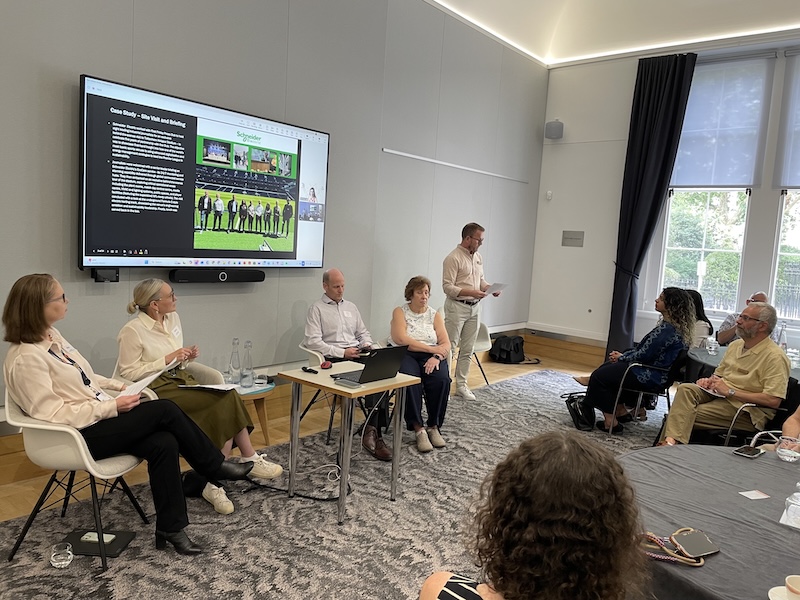
That may or may not surprise some people, but it’s not something that sits well with the Royal Academy of Engineering, which hosted a panel discussion about the subject and debated what can be done to redress the imbalance.
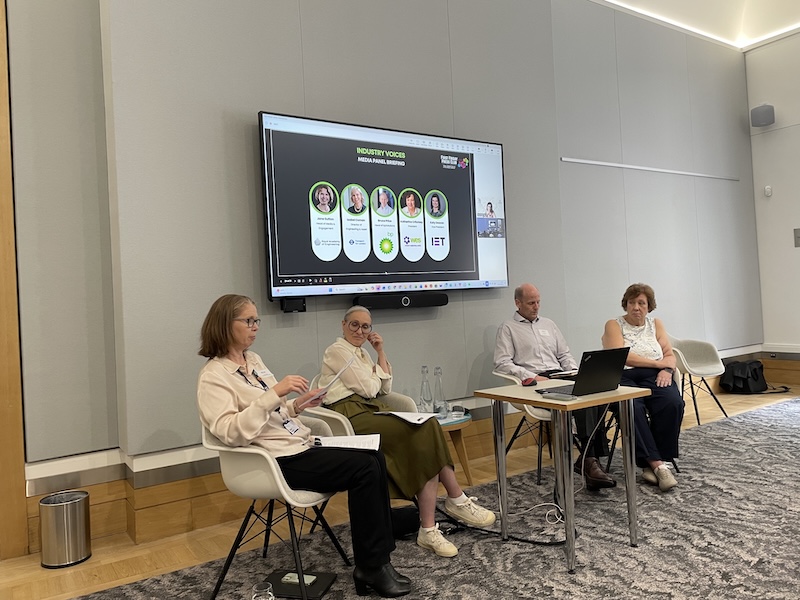
The high-powered panel included:
- Jane Sutton, head of media and engagement, Royal Academy of Engineering
- Katy Deacon, vice chair, Institute of Engineering and Technology
- Katherine Critchley, president, Women’s Engineering Society
- Isabel Coman, director of engineering and asset strategy, Transport for London
- Bruce Price, head of bpSolutions, bp
The event was organised by the Cadence Team, through its First Friday Editors’ Briefings.
Making up the numbers
According to the independent nonprofit organisation EngineeringUK, there are 6.4 million people working in the engineering sector, with more than 4 million of that figure being described as “core” engineers.
The sector is described as “a vital pillar of the UK economy” by the RAE, generating up to an estimated £747 billion (more than $1 trillion) in direct gross value added annually, which accounts for over 33 per cent of the total UK economic output.
In other words, one-third of the UK economy is dependent on engineering. So, maintaining and if possible expanding the sector in general, while making it appeal more to women, is arguably critical to the country’s future as a global power.
The UK is still within or at least around most lists of the top 10 manufacturing countries in the world. Its manufacturing output is just under £280 billion. But the direction of travel has not been good for decades.
As the global manufacturing base moved to Asia, especially China, the UK – which arguably started the first industrial revolution through its engineering prowess – has been losing its place in the top 10s since the 1970s and ’80s.
The financial sector – perhaps euphemistically called the “services sector” – shored up the UK economy in the intervening decades, but that too is losing its power because an increasing number of financial companies are moving from London to European countries which are part of the European Union.
The psychological root of the problem
Some people feel a sense of dread when confronted with maths problems they have to solve, even if it’s simple arithmetic. Both male and female students probably have the same dislike for maths, and perhaps females dislike it even more.
I put this to Katherine Critchley, president of Women’s Engineering Society, but she said: “I don’t agree. Maths can be interesting.”
Having worked at Jaguar in the early days of her career, and gone on to become one of the relatively few women engineers in the UK at the time, Critchley is perhaps less inclined than most to accept the idea that engineering is inherently intimidating.
As president of WES, Critchley is running various campaigns aimed at increasing the number of women in engineering. “Our target is to increase that 16 per cent proportion to 30 per cent by 2030,” she said.
“That’s an over-ambitious target, isn’t it?” I asked.
“People said that when the figure was at 5 per cent,” she said. “Yes, it sounds like an ambitious target, but it’s not impossible.”
I remained unsure – seems too ambitious to me.
Anyway, I suggested that perhaps the problem runs deeper than recruitment campaigns or a lack of role models. I wondered whether engineering suffers from a perception problem that discourages many young women before they even consider it as a career.
My theory was that STEM subjects are often viewed as unusually difficult and unforgiving. Success frequently depends on solving complex technical problems, and I wondered whether fear of failure plays a larger role than many people are willing to acknowledge.
In other words, was engineering struggling to attract more women because of barriers within the profession, or because many potential candidates had already decided it was not for them?
Critchley turned away but briefly came back to point out that the number of female dentists in the UK actually outnumbers the number of male dentists. And becoming a dentist takes five to six years beyond your normal school education, and is regarded as a STEM-heavy path.
I checked out her claim afterwards and it turns out that there are approximately 24,000 female dentists in the UK, and 21,000 male dentists.
I was still of the opinion that fear played a larger role than many people were willing to acknowledge. Not fear in the sense of cowardice, but fear of failure, fear of getting things wrong, and fear of entering a field widely perceived as technically demanding.
I wondered whether engineering suffered not because women lacked the ability to succeed, but because too many capable women ruled themselves out before they even began.
“Humanities subjects are not easy or fun,” said Critchley. “I never had to do a 20,000 word dissertation on some subject or other when I studied engineering. Nothing is easy in life.”
Where angels fear to tread
I still had the conviction that fear was at the psychological root of women not choosing STEM subjects or careers. And I felt somewhat vindicated by the comments of Jane Sutton, head of media and engagement at the Royal Academy of Engineering.
“Feel the fear and do it anyway,” said Sutton, who explained to me afterwards that although she didn’t invent the phrase, she felt it was appropriate to use during the discussion.
Sutton was responding to comments being made by Katy Deacon, vice chair of the Institute of Engineering and Technology, who was talking about how women need to be confident enough to accept senior roles as that is one the most effective ways to improve opportunities for women.
Echoing and adding to Deacon’s perspective, Isabel Coman, director of engineering and asset strategy, Transport for London, said that often “Women don’t value themselves and their skills accurately enough – they don’t know how good they are.”
Coman added that large and complex organisations like TfL – which has almost 30,000 employees and is responsible for London Underground trains as well as the above-ground trams and buses – need more people who think differently.
She suggested that women who do have opportunities to try for senior roles need to bear in mind that: “No person is perfect.”
Deacon said there needs to be more diversity and inclusion in engineering design. She explained how difficult it is to find a suitable hotel in London if you are disabled, which she is. More than 95 per cent of buildings of all types “not designed with disabled people in mind”.
Bruce Price, head of bpSolutions, bp, which is one of the world’s largest energy companies, said something which could perhaps be considered an encouraging statistic to end on. He said: “One-third of all chief engineers at bp are women.”
He underlined what Coman said about women needing to try for and accept senior roles. “Role models are important – builds confidence.”
