
Wiz is one of the fastest-growing security companies in history. Its agentless cloud scanning, Security Graph visualization, and ability to surface cross-cloud attack paths changed how the market thinks about cloud-native application protection (CNAPP).
But 2026 has introduced new reasons to reconsider:
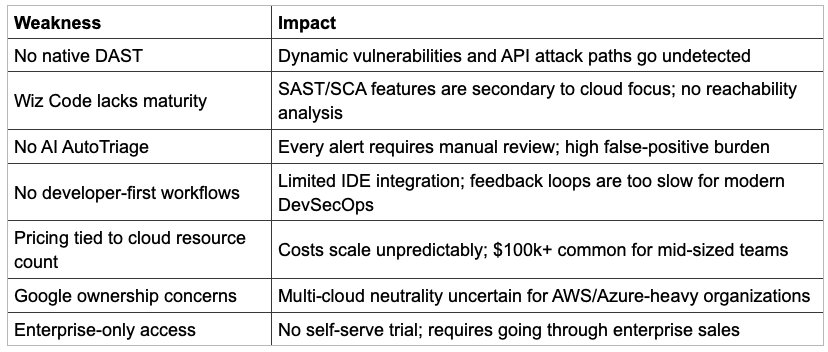
- The Google Acquisition Changes the Equation. In March 2025, Google completed the acquisition of Wiz for approximately $32 billion – the largest cybersecurity acquisition in history. For many security teams, this raises a straightforward question: will a Google-owned Wiz continue investing equally in AWS and Azure coverage, or will GCP gradually receive preferential treatment? For multi-cloud organizations, that uncertainty alone is enough to start evaluating alternatives.
- Pricing is Designed for Enterprises – and Scales Unpredictably. Wiz pricing is based on cloud resource count, not developer seats. For mid-sized companies, this typically means annual spend exceeding $100,000. As your cloud infrastructure grows, costs scale in ways that are difficult to forecast. There are no self-serve trials; every engagement starts with an enterprise sales cycle.
- Wiz Code Still Lags Dedicated AppSec Tools. Wiz launched Wiz Code in 2024 to add code scanning to its cloud-first platform. While it covers SAST, SCA, IaC scanning, secrets, and containers, the code security capabilities remain secondary to Wiz’s infrastructure focus. Teams report limited DAST coverage, no AI AutoTriage, no reachability analysis, and an AutoFix feature that is constrained to the main branch rather than fitting natively into PR workflows. For organizations that want to genuinely shift security left – into developer IDEs, CI/CD pipelines, and pull requests – Wiz Code still requires significant supplementation.
- Alert Fatigue is a Real Problem. Security teams using Wiz regularly report that the volume of raw findings, without intelligent prioritization or context, creates more noise than signal. According to Aikido Security’s 2026 State of AI Security report, two-thirds of development teams bypass, dismiss, or delay security findings because tool noise overwhelms their workflows.
- No Native DAST, Limited Runtime AppSec Wiz’s agentless model is excellent for cloud posture management. But agentless scanning by definition cannot detect active exploitation, runtime threats in running application code, or dynamic vulnerabilities that only surface during execution. Teams that need DAST, API security testing, or in-app runtime protection must source those capabilities elsewhere.
What Wiz Does Well – and Where it Falls Short
Wiz’s Core Strengths
- Agentless deployment: No agents to manage. Wiz connects to cloud accounts via read-only APIs and delivers first findings within hours.
- Security Graph: Wiz’s defining feature. It connects misconfigurations, vulnerabilities, exposed secrets, and identity risks into prioritized attack paths showing actual exploitability – not alert-by-alert noise.
- Broad cloud coverage: AWS, Azure, GCP, OCI, Kubernetes, and containers in a single platform.
- CSPM + CIEM + CWPP in one: Cloud Security Posture Management, Cloud Infrastructure Entitlement Management, and Cloud Workload Protection under one roof.
- Market validation: Wiz is the CNAPP market leader, with the $32B Google acquisition confirming that status.
Wiz’s Key Weaknesses
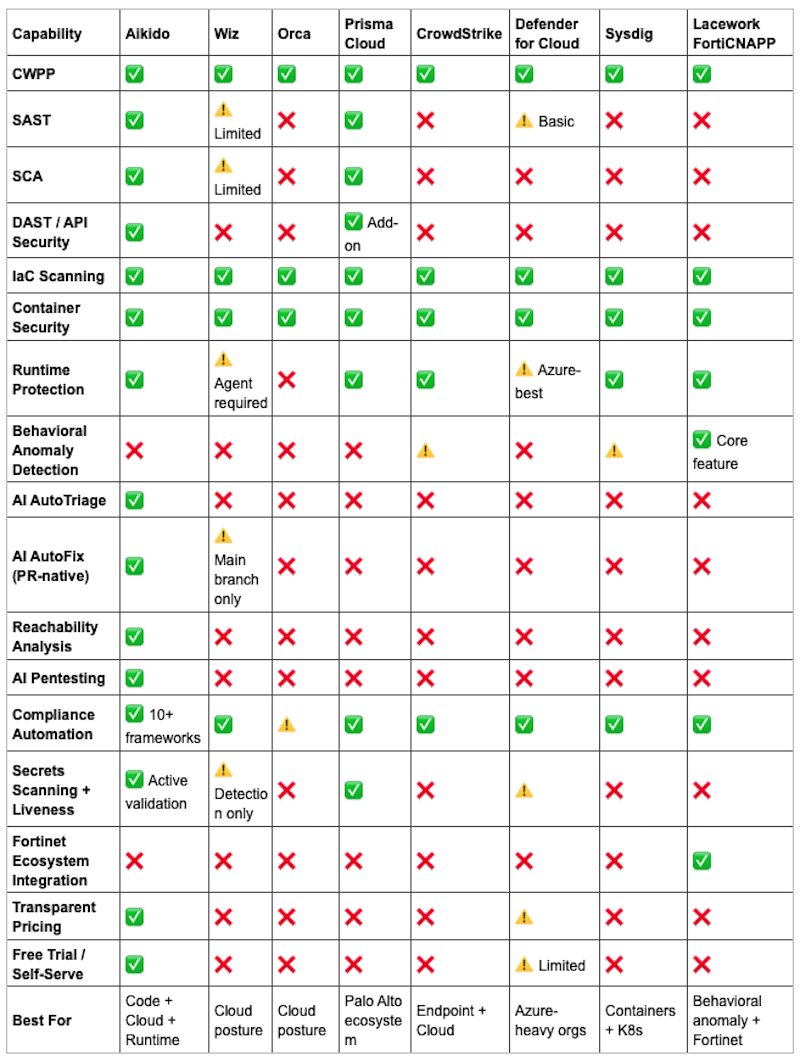
Wiz Alternatives Compared at a Glance
1. Aikido Security – Best Overall Wiz Alternative
Best for: Developer-first teams, startups to enterprise, anyone who needs code + cloud + runtime security in one platform
Aikido Security is the most complete Wiz alternative available in 2026. While every other tool on this list covers one segment of the security landscape – cloud posture, code scanning, or runtime protection – Aikido unifies all three in a single developer-first platform.
It is also the only alternative that is genuinely accessible to non-enterprise teams, with transparent pricing, a free tier, and a setup time of under 10 minutes.
Why Aikido Beats Wiz for Most Teams
Code + Cloud + Runtime in One Platform, Built for Developers
Wiz was built for security teams and CISOs. Aikido was built for the people who actually write and ship code. The difference shows up everywhere: IDE integrations so developers find issues without leaving their editor, pre-commit hooks that block secrets before they ever touch Git history, PR-native AutoFix that generates ready-to-merge pull requests rather than just flagging problems, and CI/CD pipeline integration that makes security a natural part of the build process rather than a separate gate.
Aikido covers the full surface: SAST, SCA, DAST, IaC, container scanning, CSPM, secrets detection, malware detection in dependencies, license risk (SBOM), and runtime protection – all without agents.
AI AutoTriage: 85% Fewer False Positives
Where Wiz surfaces raw findings and leaves triage to the team, Aikido’s AI AutoTriage engine actively filters non-exploitable CVEs before they reach developers.
Combined with function-level reachability analysis – which confirms whether vulnerable code paths are actually callable in your application – Aikido cuts alert volume by 85% compared to tools that report every theoretical vulnerability.
The practical result: developers receive a short, accurate list of issues that actually need fixing, rather than a queue of hundreds of findings they’ll learn to ignore.
AI AutoFix That Works in Real Developer Workflows
Aikido’s AI AutoFix generates pull requests with the code changes already written. For SAST issues, IaC misconfigurations, and container vulnerabilities, Aikido analyzes potential breaking changes before suggesting an upgrade – so the PRs it creates are safe to merge, not just technically correct.
This works across the entire codebase and across PR workflows, not just on the main branch like Wiz Code’s constrained AutoFix.
Native DAST and API Security Testing
Wiz has no DAST. Aikido includes native Dynamic Application Security Testing with authenticated scanning, REST and GraphQL API fuzzing, and attack surface monitoring. This catches vulnerabilities – injections, broken authentication, business logic flaws – that static analysis cannot detect by definition.
For teams working toward SOC 2 or PCI compliance, DAST coverage is often a requirement, and Aikido delivers it natively without requiring a separate vendor.
Secrets Scanning That Goes Beyond Detection
Wiz Code detects secrets. Aikido goes further: it checks whether detected secrets are still active, maps the permissions those credentials have been granted, and supports auto-downgrade of exposed credentials.
Pre-commit hooks prevent secrets from ever entering the repository history in the first place. If a secret is leaked, Aikido tells you exactly what an attacker could do with it – Wiz tells you it exists.
AI Pentesting – A Category Wiz Doesn’t Compete in
Aikido’s AI Pentesting delivers continuous automated penetration testing at a fraction of the cost of manual engagements. The platform simulates multi-step attack chains and business logic exploitation – the kinds of vulnerabilities that static analysis and misconfiguration scanners cannot find. No other CNAPP alternative on this list offers anything equivalent.
Transparent Pricing That Scales With Teams, Not Cloud Spend
Wiz pricing is tied to cloud infrastructure size, which means costs scale unpredictably as your environment grows. Aikido Pro costs approximately $15,000 annually for 20 users – pricing that is publicly available without speaking to sales. For startups, Aikido offers a free tier.
For enterprises, pricing scales per seat, not per cloud resource count. Organizations that have replaced Wiz with Aikido consistently report significant cost savings alongside improved coverage.
Compliance Automation Built in
Aikido includes pre-configured compliance mapping for ISO 27001, SOC 2, NIST, PCI DSS, HIPAA, DORA, and NIS2, with direct integrations to Vanta, Drata, and Secureframe. Wiz requires a separate GRC platform for compliance workflow automation.
Aikido Security Feature Highlights
- SAST with cross-file taint tracking (not just single-file analysis)
- SCA with reachability analysis and breaking-change assessment before dependency upgrades
- DAST with authenticated scanning and API security (REST + GraphQL)
- Secrets scanning with liveness checks, permission mapping, and pre-commit protection
- IaC scanning (Terraform, CloudFormation, Kubernetes, Pulumi)
- Container and Kubernetes security
- CSPM for AWS, Azure, GCP
- Malware detection in uploaded files and dependencies
- Runtime protection via Zen (in-app firewall, blocks 0-days)
- AI AutoTriage is reducing false positives by 85%
- AI AutoFix with PR-native, ready-to-merge code changes
- Continuous AI pentesting
- Compliance automation for 10+ frameworks
- IDE integrations (VS Code, JetBrains, and more)
- SOC 2 Type II and ISO 27001 certified
- FedRAMP authorization in progress
- Trusted by 100,000+ teams from startups to enterprise
Aikido vs. Wiz: Side-by-Side
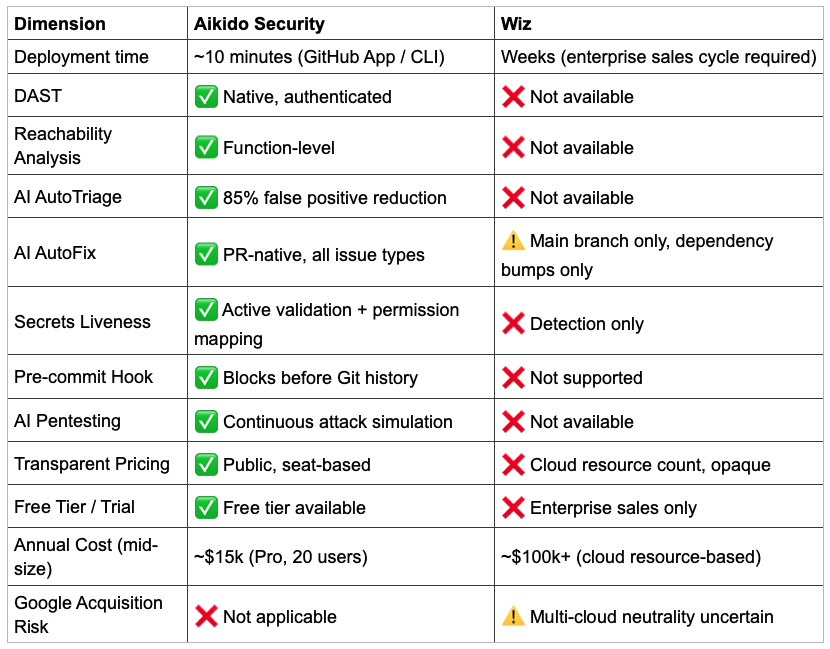
Who should choose Aikido over Wiz: Teams that want to shift security left into the developer workflow, organizations that need DAST alongside cloud security, companies that don’t want pricing tied to their cloud resource count, and any team that has experienced alert fatigue from tools without intelligent triage.
2. Orca Security – Best Direct CNAPP Competitor
Best for: Teams seeking an agentless CNAPP as a direct Wiz substitute
Orca Security is the most direct like-for-like Wiz alternative in the CNAPP market. Both tools use agentless scanning via cloud APIs, both provide security graph visualization, and both compete directly in enterprise CNAPP deals. Orca’s proprietary SideScanning technology connects to cloud accounts through read-only APIs and cloud snapshots rather than deploying agents.
Orca covers cloud misconfigurations, vulnerabilities in workloads, exposed sensitive data (DSPM), and identity risks (CIEM) across AWS, Azure, and GCP. It regularly appears in Gartner Peer Insights and G2 comparisons as the primary price-competitive alternative to Wiz.
Where Orca wins: Often positioned as a more affordable CNAPP option vs. Wiz, with a similar agentless architecture but without the Google acquisition overhead. Strong data security posture management (DSPM) capabilities.
Where Orca falls short: Like Wiz, Orca is cloud-first and does not offer code security (SAST/SCA) or DAST. It also lacks AI AutoTriage and developer-facing workflows. Teams that need code-to-cloud coverage will still require additional tooling.
Top Features
- Agentless cloud scanning via SideScanning technology
- Security graph with attack path analysis
- CSPM, CWPP, CIEM in one platform
- DSPM for sensitive data exposure
- Compliance reporting for major frameworks
- AWS, Azure, GCP, and OCI coverage
3. Prisma Cloud – Best for Palo Alto Networks Ecosystems
Best for: Large enterprises already invested in Palo Alto Networks infrastructure
Prisma Cloud from Palo Alto Networks is the broadest CNAPP platform in the market by feature scope. It spans code security (IaC scanning, SCA, secrets), CSPM, workload runtime protection, network security, and identity threat detection. No single vendor covers as many CNAPP subcategories in one product license.
Prisma Cloud’s strength comes from its acquisition history: Bridgecrew brought IaC and developer-facing security, Twistlock brought runtime container protection, Cider brought CI/CD pipeline security, and the original RedLock provided CSPM. For Palo Alto Networks customers, the integration story is compelling – Prisma Cloud connects to XSOAR (SOAR), Cortex XDR (EDR), and the broader PANW ecosystem.
The key tradeoff: Breadth comes with complexity. Prisma Cloud is not a tool you deploy and get value from in an afternoon. Customers report months of configuration and onboarding before the platform fully delivers. The UI reflects its acquisition history – it still shows seams between components, and the developer experience lags behind purpose-built tools like Aikido.
Where Prisma wins: Broadest CNAPP feature set in the market; unbeatable traceability from runtime findings back to source code for Palo Alto-committed enterprises; strong compliance and governance tooling.
Where Prisma falls short: Complexity is high; pricing is opaque; developer experience is security-analyst-oriented rather than developer-first; AI-driven triage and remediation capabilities are limited compared to Aikido.
Top Features
- Broadest CNAPP feature set: code, cloud, workload, network, identity
- IaC security via Bridgecrew (Terraform, CloudFormation, Kubernetes)
- Runtime container protection
- CSPM across 7+ cloud providers
- CIEM and DSPM
- Deep Palo Alto Networks ecosystem integration
4. CrowdStrike Falcon Cloud Security – Best for Endpoint + Cloud Consolidation
Best for: Enterprises already running CrowdStrike Falcon for endpoint protection
CrowdStrike extends its endpoint security expertise into the cloud with Falcon Cloud Security. The platform uses the same Falcon agent deployed for endpoint protection to provide runtime visibility and protection in cloud workloads – a natural consolidation play for security teams already managing CrowdStrike across their environment.
Falcon Cloud Security delivers agentless CSPM for cloud posture alongside agent-based runtime protection for containers and Kubernetes.
CrowdStrike’s threat intelligence capabilities are among the strongest in the industry, and Falcon’s unified platform means cloud findings appear alongside endpoint detections in a single console.
Where CrowdStrike wins: Best threat intelligence integration in CNAPP; strong runtime protection; natural fit for the large install base of Falcon endpoint customers; unified detection and response across endpoint and cloud.
Where CrowdStrike falls short: Code security (SAST/SCA/DAST) is not a CrowdStrike capability; developer-first workflows are absent; pricing is module-based and can accumulate quickly for organizations activating multiple capabilities.
Top Features
- Agentless CSPM for cloud posture
- Agent-based runtime protection for containers and Kubernetes
- Unified Falcon platform with endpoint and identity
- Best-in-class threat intelligence
- Attack path analysis and risk prioritization
- AWS, Azure, GCP coverage
5. Microsoft Defender for Cloud – Best for Azure-Centric Organizations
Best for: Organizations heavily invested in Microsoft Azure and the Microsoft Security stack
Microsoft Defender for Cloud is the best Wiz alternative for Azure-centric organizations and offers the strongest free tier in the CNAPP category.
Basic CSPM is available at no additional cost for Azure subscriptions – making it an easy first step for teams just getting started with cloud security posture management.
Defender CSPM adds attack path analysis comparable to Wiz’s Security Graph for Azure environments. The integration with Microsoft Sentinel (SIEM), Entra ID (identity), Defender XDR (extended detection and response), and Microsoft Copilot for Security creates a unified workflow that vendor-agnostic alternatives cannot match for Azure-heavy environments.
Where Defender wins: Native Azure integration creates depth no third-party tool can replicate; free basic CSPM tier; Microsoft Copilot for Security integration for AI-assisted analysis; best option for organizations consolidating on the Microsoft security stack.
Where Defender falls short: Non-Azure cloud coverage (AWS, GCP) provides roughly 60% of Azure-equivalent checks — a significant gap for multi-cloud organizations. No code security (SAST/SCA/DAST). Developer-first workflows are absent. For organizations primarily on AWS or GCP, Defender’s value diminishes sharply.
Top Features
- Native Azure CSPM with free basic tier
- Attack path analysis for Azure environments
- Integration with Sentinel, Entra, Defender XDR, and Copilot for Security
- Multi-cloud coverage for AWS and GCP (at lower depth than Azure)
- Regulatory compliance dashboards
- Container and Kubernetes security
6. Sysdig Secure – Best for Container and Kubernetes Security
Best for: Teams running complex container and Kubernetes workloads that need deep runtime visibility
Sysdig Secure is a CNAPP with a specialized focus on container and Kubernetes security, built on its open-source Falco runtime security engine.
Where Wiz and Orca are agentless-first, Sysdig deploys lightweight agents that provide deep runtime visibility into container workloads – capturing system calls in real time to detect threats that agentless scanning cannot see.
Sysdig covers the full container lifecycle: image scanning in registries, configuration auditing in Kubernetes clusters, and runtime threat detection and response. Its Falco integration means security policies are codified and version-controlled alongside application infrastructure.
Where Sysdig wins: Deepest container and Kubernetes runtime visibility in the market; real-time threat detection for active attack; Falco-based policy as code; strong for regulated industries requiring runtime protection evidence.
Where Sysdig falls short: Cloud posture management is functional but not as mature as Wiz or Orca; no SAST, SCA, or DAST; developer-first workflows are absent; agents add operational overhead that agentless platforms avoid.
Top Features
- Container and Kubernetes runtime security via Falco
- Image scanning across registries and CI/CD pipelines
- Kubernetes Security Posture Management (KSPM)
- Cloud posture management (CSPM) for AWS, Azure, GCP
- Drift control to prevent unauthorized container changes
- Compliance reporting for CIS, NIST, PCI, SOC 2
7. Lacework FortiCNAPP – Best for Behavioral Anomaly Detection
Best for: Teams that need to detect cloud threats based on behavioral patterns rather than known signatures
Lacework FortiCNAPP takes a fundamentally different approach to cloud security than Wiz’s posture-focused model. Where Wiz shows you what your cloud environment looks like at a point in time, Lacework FortiCNAPP monitors how it behaves over time.
Its machine learning engine builds a baseline of normal activity for each environment – API calls, user behaviors, network flows, process execution patterns – and surfaces anomalies that deviate from that baseline.
This behavioral approach catches configuration drift and unusual runtime behavior that signature-based tools miss. For organizations that want to detect zero-day threats and insider activity rather than known misconfiguration patterns, Lacework FortiCNAPP offers capabilities that Wiz simply doesn’t have.
Where Lacework FortiCNAPP wins: Behavioral ML for anomaly detection is genuinely differentiated; it detects threats that no-signature-based tool would flag; it has strong cloud threat detection and incident response capabilities.
Where Lacework FortiCNAPP falls short: No SAST, SCA, or DAST; posture management (CSPM) is less mature than Wiz or Orca; Lacework was acquired by Fortinet, which introduces its own integration and roadmap questions; developer-first workflows are absent.
Top Features
- Behavioral ML for cloud anomaly detection
- Continuous cloud activity monitoring
- Container and Kubernetes threat detection
- CSPM with automated policy enforcement
- Vulnerability management for cloud workloads
- AWS, Azure, GCP coverage
How to Choose the Right Wiz Alternative
The right alternative depends on what problem you’re primarily trying to solve:
If you need code + cloud + runtime security with a developer-first experience → Aikido Security The only platform that covers SAST, SCA, DAST, IaC, CSPM, containers, secrets, runtime, and AI pentesting in one place – with AI AutoTriage that eliminates noise and transparent pricing that doesn’t require a sales call.
If you need a direct cloud-posture (CNAPP) Wiz replacement → Orca Security is the most architecturally similar alternative to Wiz. Agentless, security-graph-based, and cloud-posture-focused – often at a more competitive price point.
If you’re in the Palo Alto Networks ecosystem → Prisma Cloud The broadest CNAPP feature set in the market, with deep Palo Alto integrations. Plan for a long deployment and significant operational investment.
If you’re already running CrowdStrike for endpoint → CrowdStrike Falcon Cloud Security Natural consolidation play. Extend Falcon’s threat intelligence to cloud workloads without adding a new vendor.
If you’re Azure-heavy → Microsoft Defender for Cloud has the best native integration, a free basic tier, and a natural fit with Microsoft Sentinel and Copilot for Security.
If containers and Kubernetes runtime are your primary concern → Sysdig Secure Deepest Kubernetes runtime visibility in the market, built on Falco.
If behavioral anomaly detection matters more than posture → Lacework’s machine learning baseline approach catches cloud threats that signature-based tools miss.
Frequently Asked Questions
What is the best alternative to Wiz in 2026?
Aikido Security is the best overall Wiz alternative for teams that need code + cloud + runtime security in a single developer-first platform.
It covers SAST, SCA, DAST, IaC, CSPM, containers, secrets, malware, API security, and AI pentesting – with transparent seat-based pricing starting around $15,000 per year for 20 users, compared to Wiz’s typical $100,000+ for mid-sized deployments. For teams that only need cloud posture management (CSPM/CWPP/CIEM), Orca Security is the most direct CNAPP alternative.
Did Google’s acquisition of Wiz change anything?
Yes. Google announced the Wiz acquisition for approximately $32 billion in March 2025 – the largest cybersecurity acquisition in history.
For multi-cloud organizations, the primary concern is whether Wiz will maintain parity of coverage and investment across AWS and Azure as Google’s incentives increasingly favor Google Cloud. This uncertainty is one of the key reasons organizations are actively evaluating alternatives in 2026.
Does Wiz include DAST?
No. Wiz does not offer native DAST (Dynamic Application Security Testing) or comprehensive API security testing. Organizations that need runtime vulnerability detection or API fuzzing must integrate third-party tools.
Of the major Wiz alternatives, Aikido Security and Prisma Cloud (as an add-on module) are the primary options with native DAST capabilities.
Is there a cheaper alternative to Wiz?
Yes. Wiz pricing is typically $100,000+ annually for mid-sized deployments, with costs tied to cloud resource count. Aikido Security offers transparent, seat-based pricing at approximately $15,000 per year for a team of 20 users, with a free tier for getting started.
Microsoft Defender for Cloud offers free basic CSPM for Azure. Most Wiz alternatives have more predictable pricing than Wiz’s infrastructure-based model.
Can Aikido Security replace Wiz completely?
For the majority of teams, yes. Aikido covers CSPM (cloud posture management), CWPP (workload protection), IaC scanning, container security, SAST, SCA, DAST, secrets scanning, malware detection, runtime protection, and AI pentesting in a single platform.
The one capability unique to Wiz is its Security Graph – a visualization engine that traces attack paths specifically across cloud infrastructure.
For organizations where that cloud graph visualization is a core workflow, Wiz may remain valuable for cloud posture alongside Aikido for code and developer security.
What is a CNAPP?
A Cloud-Native Application Protection Platform (CNAPP) unifies cloud security across code, configuration, identity, workloads, and runtime into a single platform.
It combines CSPM (Cloud Security Posture Management), CWPP (Cloud Workload Protection Platform), CIEM (Cloud Infrastructure Entitlement Management), and increasingly ASPM (Application Security Posture Management) to eliminate tool sprawl and provide end-to-end visibility from development to production.
How long does it take to deploy Wiz alternatives?
It depends significantly on the tool. Aikido Security deploys in approximately 10 minutes via GitHub App or CLI, with no agents required. Orca Security’s agentless setup typically takes hours to days.
Prisma Cloud’s full deployment takes weeks to months. CrowdStrike Falcon and Sysdig require agents, adding 2-8 weeks for full rollout. Microsoft Defender for Cloud is instant for Azure subscriptions, but takes more time for multi-cloud setup.
