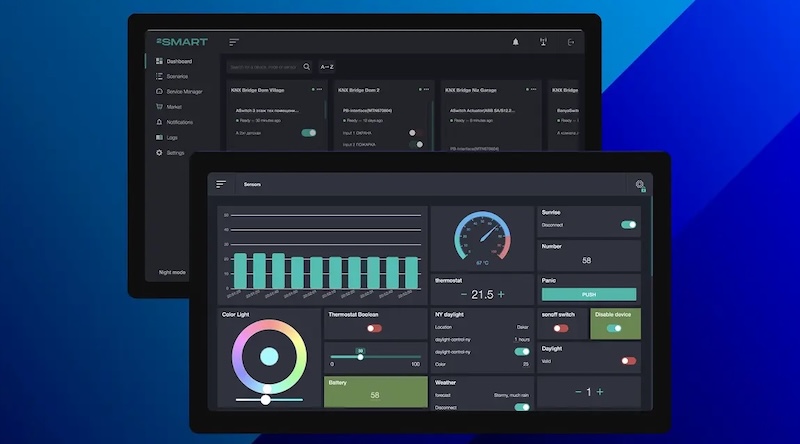
A predictive maintenance system can flag rising vibration, unusual temperature patterns, or a combination of signals that suggests a component is likely to fail. That may be technically impressive, but it does not reduce downtime by itself.
Someone still has to decide whether the signal matters, how urgent it is, what action should follow, and whether the equipment can keep operating safely in the meantime.
The harder part often starts after the model has raised the flag. The analytics layer is only one part of the system.
The real operational value comes from what happens after a risk is detected: how the event is interpreted, who receives it, how a maintenance task is created, what the technician sees, and whether the outcome is fed back into future decisions.
Predictive maintenance has an execution problem, not just a model problem
Most discussions around predictive maintenance focus on model accuracy, anomaly detection, sensor coverage, and the quality of historical data.
They all matter, but a highly accurate model can still create very little value if its output ends up in a dashboard that nobody consistently acts on.
In practice, this is often where an impressive predictive maintenance demo stops looking quite so impressive. Detecting a developing fault is only useful if the system can translate that finding into the next operational step.
A risk signal may need to trigger an inspection by a technician, generate a service ticket, notify a customer, change an operating mode, or simply be watched for another few hours. Those are very different responses, and the prediction alone usually cannot determine which one is appropriate.
The maintenance process therefore has to answer several questions that sit outside the model itself. What exactly happened? How serious is it in the context of this asset? Who owns the response? What should happen next, and how quickly?
Without those answers, predictive maintenance can easily become another source of alerts rather than a way to improve maintenance operations.
A slightly less sophisticated model that is properly connected to service workflows may be more useful in the field than a better model whose results remain isolated from the people and systems responsible for acting on them.
Context determines whether an alert deserves action
The same sensor reading does not always mean the same thing. A vibration level that looks abnormal during steady operation may be entirely expected during startup.
Temperature can rise because a component is deteriorating, but it can also reflect a heavier workload or different ambient conditions.
Maintenance history matters as well: a reading taken two hours after a repair should not necessarily be interpreted in the same way as the same reading on a machine that has been running untouched for six months.
In the field, anomaly detection alone is rarely enough to decide whether somebody should intervene. A useful maintenance decision needs context around the signal: machine state, workload, environment, previous faults, recent configuration changes, and the criticality of the asset itself.
Consider two similar pumps showing the same increase in vibration. One is running on a production line where an unexpected stop would halt an entire process.
The other is one of two redundant pumps and can be taken offline without disrupting the process. The technical signal may be almost identical, but the operational priority is clearly not.
False positives make this distinction especially important. If every deviation becomes an urgent service ticket, technicians quickly spend their time investigating conditions that never required intervention.
More importantly, they start losing confidence in the alerts themselves. Once that happens, genuinely important warnings can get treated with the same skepticism.
Not every anomaly should turn into action. Some need an immediate response, some should be watched, and some will turn out to be noise. Making that distinction depends on much more than the model score.
From prediction to action: the missing service layer
Once an event is serious enough to act on, the next question is more mundane: where does it go?
For a low-risk condition, that may mean watching the asset more closely and waiting for a few more telemetry samples. A more serious event might create a maintenance task, notify a service manager, or request a remote diagnostic check.
In other cases, the safest response could be to change operating parameters, restrict a particular mode, or escalate the issue for an on-site inspection.
At that point, the prediction has to enter an operational chain. The event has to be tied to the right asset, location, customer, and service context.
The responsible person or system needs enough information to understand why it was raised. And the next action has to be explicit rather than left sitting in another dashboard for someone to notice.
Predictive maintenance becomes useful only when the result can move beyond analytics and into day-to-day service operations.
Effective remote monitoring for connected equipment should connect device telemetry with maintenance workflows, service automation, and the people responsible for acting on an emerging problem.
The platform layer therefore has to manage not only what the equipment reports, but what should happen next when a threshold, anomaly, or predicted failure requires intervention.
None of this requires rebuilding the supporting platform layer for every deployment. Device connectivity, telemetry collection, monitoring, alerts, roles and access control, automation mechanisms, and integrations are common requirements across many connected-equipment deployments.
The parts that usually differ are closer to the operation itself. One manufacturer may need a particular escalation path for critical machines. Another may route service work through an existing ERP or field-service system.
A unit under a premium maintenance contract may trigger a different response from an otherwise identical unit sold without one.
There may also be customer-specific rules, partner responsibilities, or operating limits that determine whether an alert becomes a notification, a ticket, or an immediate intervention.
Standard IoT mechanics can stay in a reusable core, while maintenance rules, escalation logic, service workflows, and equipment-specific business logic are adapted to the way the operation actually works.
Rollout discipline matters across a distributed equipment fleet
A maintenance rule that works well on ten test machines can still cause trouble when it is pushed to several thousand assets operating under different conditions. Predictive maintenance changes are not limited to models either.
Thresholds, alert logic, firmware parameters, device configurations, and automation rules can all affect how the fleet behaves and how often service teams are called into action.
Pushing a new rule straight from validation to the entire installed base is usually a bad bet. A representative group of assets gives you a chance to see how it behaves under real workloads before expanding further.
The test group also needs to reflect the fleet itself. Different hardware revisions, firmware versions, operating environments, and usage patterns can turn what looked like a small configuration change into very different outcomes.
I would be particularly cautious with fleet-wide changes that appear harmless in a lab. A threshold that is slightly too sensitive may only generate a few unnecessary alerts during testing. Applied across thousands of machines, the same mistake can flood a service operation with tickets in a matter of hours.
At fleet scale, you need to know which rules, configurations, or model versions are running where. Just as importantly, there has to be a practical way to stop a rollout or roll back the change when the operational effects look wrong.
A rollout can be technically clean and still make maintenance worse. What I would watch is whether the new logic actually improves the decisions people make around the equipment.
Did it identify meaningful problems earlier? Did false positives increase? Did technicians start receiving more work without finding more faults?
The problem gets harder as the fleet becomes larger and less uniform. A rule that has passed validation still needs to earn its way across the installed base.
Service workflows must fit the operation that already exists
Most maintenance organizations already have systems for assigning work, tracking service history, managing customers, and coordinating technicians. Introducing predictive maintenance should not require them to build a parallel operating process around another dashboard.
It usually makes more sense to bring equipment events into the tools and routines people already use.
A maintenance team may work in a CMMS or field-service platform, while customer information and contracts live in CRM or ERP systems. In that environment, an anomaly should carry enough context to become part of an existing workflow.
A service ticket can be created automatically, but it still needs the correct asset, priority, location, fault history, and diagnostic information attached to it.
The same event also looks very different depending on who has to deal with it. An operator may only need to know whether the machine can continue running. A technician needs telemetry, recent alerts, configuration data, and maintenance history.
A service manager cares about severity, assignment, and SLA. A customer may need to know that maintenance has been scheduled, without seeing the internal diagnostic detail behind that decision.
A fair amount of that coordination can be automated. An event can create the appropriate work item, route it to the correct team, attach recent device data, and update the customer-facing status without somebody copying information between systems.
There is a limit to how far that automation should go. A low-risk diagnostic workflow can often run automatically, while a change that could interrupt production or alter machine behavior may reasonably require human approval.
The right boundary depends on the equipment, the consequences of a wrong decision, and the organization’s operating procedures.
In a well-connected operation, the workflow can look almost boring: the platform identifies a developing problem, a service task appears in the system the technician already uses, the technician opens it with the relevant telemetry and service history attached, and the customer sees that the asset is under investigation.
Nobody should have to reconstruct the event manually from several disconnected tools before maintenance can begin.
That repeatability also changes what equipment providers can sell. Remote monitoring, proactive maintenance, or uptime-oriented support can be packaged as ongoing services across customers and fleets.
But that only works if the workflow is dependable; predictive maintenance is difficult to productize if every alert still requires someone to decide manually where the information should go.
Closing the loop after maintenance
The maintenance task itself should not be the end of the process. Once a technician has inspected or repaired the equipment, the system needs to know what was actually found.
Was the predicted fault confirmed? Was there no fault at all? Did the equipment have a real problem, but for a different reason than the system suggested? Those are three very different results, and they should not disappear into the same “ticket closed” status.
For me, “no fault found” is not empty data. If technicians repeatedly investigate the same type of alert and find nothing wrong, that is evidence that the threshold, context rules, or prioritization logic may need adjustment.
The same is true when the system correctly identifies that something is wrong but consistently points teams toward the wrong component or failure mode.
Closing the ticket is not enough. The useful record is what the technician actually found, what work was done, which components were replaced, the root cause, if known, and whether the abnormal telemetry disappeared afterwards.
Over time, those records show where thresholds need tuning, where maintenance procedures need changing, and when a model update is actually justified. They also make it easier to see whether predictive maintenance is improving outcomes or merely generating more work.
Without that feedback, the system knows what it predicted, but not whether the prediction led to the right maintenance decision.
The useful prediction is the one somebody can act on
Predictive maintenance is often discussed as an analytics problem because the model is the most visible part of the technology. In real operations, however, model quality is only one part of what determines whether downtime is reduced.
A good signal can still be useless without context or a clear owner. New rules have to survive real fleet conditions, maintenance events have to reach the systems people already work in, and somebody needs to record what was actually found after the intervention.
A useful prediction is not merely accurate. It reaches the right person or system, triggers an appropriate response, and leaves enough evidence to tell whether that response actually worked.
