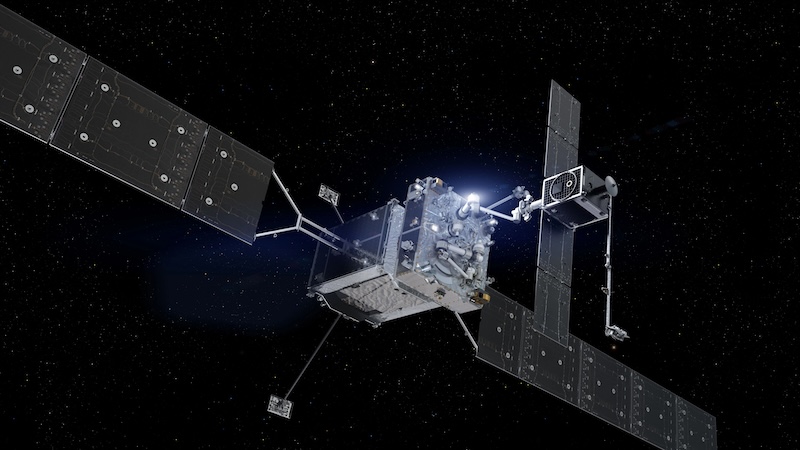
Northrop Grumman has launched a sophisticated robotic spacecraft designed to service satellites in orbit, potentially allowing expensive space assets to be repaired, upgraded, moved and kept operational long after their original fuel supplies have been depleted.
The company’s Mission Robotic Vehicle, or MRV, launched from Cape Canaveral Space Force Station aboard a SpaceX Falcon 9 rocket on July 21 alongside three smaller Mission Extension Pods.
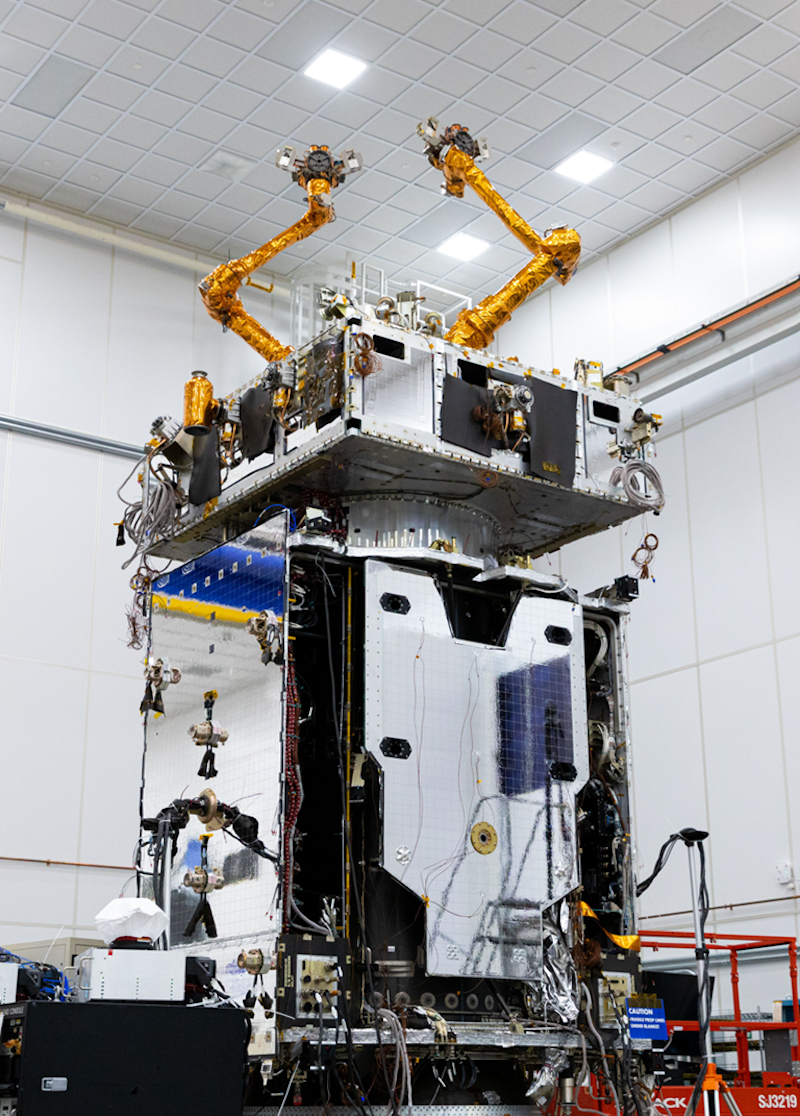
Equipped with two fully articulated robotic arms, the MRV is essentially a mobile robot mechanic for satellites operating thousands of miles above Earth.
Northrop Grumman says the spacecraft will be capable of satellite inspection, relocation, repair, upgrades, debris removal and even robotic assembly in space.
Ryan Tintner, vice president and general manager, space superiority at Northrop Grumman, says: “The MRV is a whole new class of advanced autonomous space robotics that will learn and evolve to support novel missions for our nation.
“These are not demonstrations. Our world-leading investments in these capabilities are finally providing options in space that are only limited by our imagination.”
Giving old satellites a new lease of life
One of the MRV’s first jobs will demonstrate a potentially important new model for extending the working lives of satellites.
The three Mission Extension Pods, or MEPs, launched alongside the spacecraft are effectively small propulsion modules that can be permanently attached to existing satellites.
Many large communications satellites remain technically functional when they reach the end of their planned lives but run short of the propellant required to maintain their correct position and orientation.
Instead of replacing the entire satellite, an MEP can provide additional propulsion.
The MRV’s robotic arms allow it to transport and install these modules on satellites already in orbit. Once the installation is complete, the MRV can leave and service another spacecraft.
Northrop describes the MEPs as “jetpacks” for satellites.
The robotic arms themselves originated through the Defense Advanced Research Projects Agency’s Robotic Servicing of Geosynchronous Satellites program and were developed by the US Naval Research Laboratory.
Each arm has seven degrees of freedom and can manipulate specialized tools while the MRV conducts servicing operations.
From towing satellites to actually working on them
Northrop Grumman already has considerable experience extending satellite life in orbit.
Its SpaceLogistics subsidiary operates two Mission Extension Vehicles, or MEVs, which represent the company’s first generation of commercial satellite servicing spacecraft.
Rather than repairing a satellite, an MEV docks with it and effectively takes over the propulsion and attitude-control functions required to keep it operating.
MEV-1 made history in February 2020 when it docked with Intelsat 901, becoming the first commercial spacecraft to dock with a satellite in geosynchronous orbit for life-extension services.
Northrop says its two MEVs have subsequently docked with three commercial communications satellites and provided more than 10 years of combined mission-extension services.
The MRV takes the concept significantly further.
Instead of permanently providing propulsion itself, the spacecraft can use its robotic arms to modify another satellite and then move on.
Northrop says the MRV will be able to install MEPs, relocate spacecraft and eventually perform inspection, repair and upgrades.
The company also envisages robotic replacement or enhancement of satellite components, debris removal and in-orbit assembly of large space structures.
A robot designed to keep working in space
Another important difference is that the MRV itself has been designed for a potentially extended operational life.
It carries Northrop Grumman’s Passive Refueling Module, a docking and refueling interface approved as a standard by the US Space Force. This is intended to allow the robotic spacecraft itself to be refueled while in orbit rather than becoming another disposable satellite when its propellant runs out.
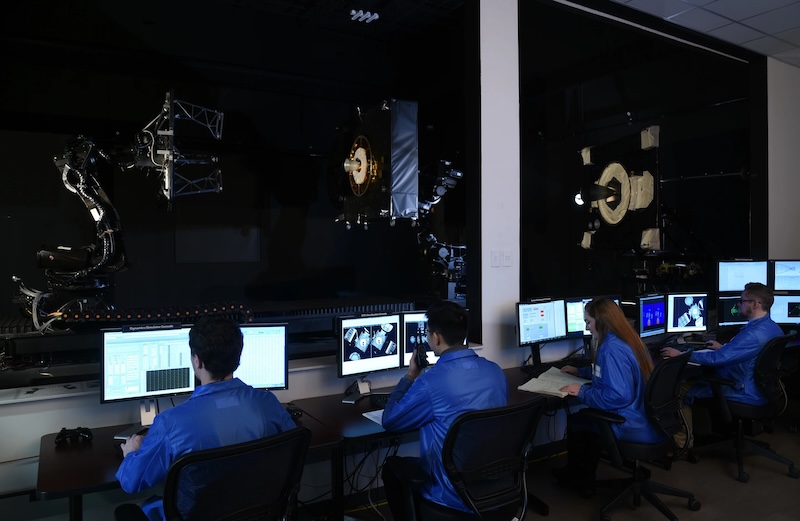
The MRV has also launched with computing hardware intended to support future AI-powered operations.
Northrop says it plans to use AI to improve reliability and mission assurance while reducing operating costs, with greater autonomy expected to become part of future MRV servicing operations.
The combination could eventually create something closer to a reusable service vehicle than a conventional satellite: a robotic spacecraft capable of moving between customers, carrying out physical work and replenishing its own fuel supply.
Northrop’s longer-term ambition is correspondingly large. SpaceLogistics says its goal is to establish a fleet of commercial servicing vehicles in geosynchronous orbit capable of addressing a wide range of servicing requirements.
If the model works, satellites may increasingly cease to be machines that are launched with a fixed configuration, operated until something fails or their fuel runs out, and then abandoned.
Instead, at least some of the largest and most expensive spacecraft could eventually be treated more like other major pieces of infrastructure – inspected, maintained, upgraded and repaired by robots throughout their working lives.
