Sony has filed a US patent application for a robotic hand featuring a human-like opposable thumb, providing another intriguing indication of the electronics giant’s continuing research into humanoid and embodied robotics.
The application, US 2026/0225261 A1, was published by the US Patent and Trademark Office on August 6 and describes a robot hand designed to reproduce some of the movements that make the human thumb so important for manipulating objects.
The filing was brought to the attention of Robotics & Automation News by patent intelligence publication Patentlyze, which has published an analysis of the application.
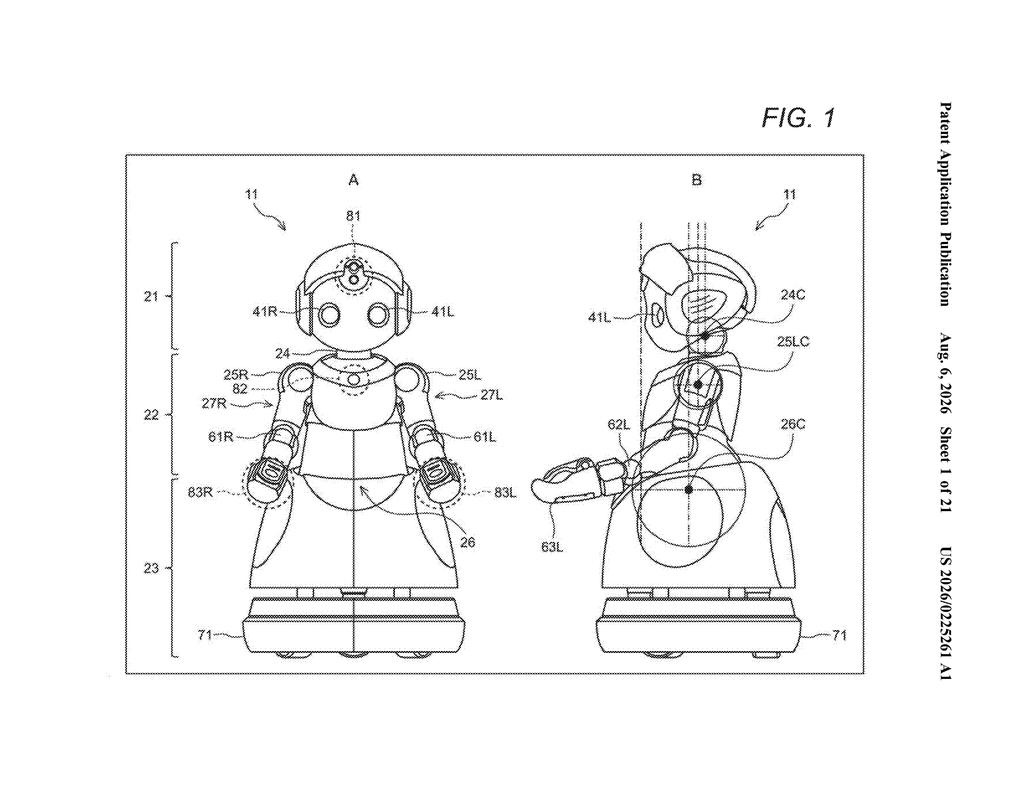
Although the patent focuses on the hand mechanism, drawings accompanying the application show considerably more than an isolated hand. One depicts two views of a complete robot with a head, torso, two articulated arms and a wheeled mobile base.
There is no indication at this stage that Sony intends to commercialize the robot depicted in the filing, and patent drawings should not be interpreted as product announcements. But the application is particularly interesting given Sony’s long – and sometimes overlooked – history in robotics.
Getting the thumb right
At the center of the patent is one of the hardest mechanical problems in robotic manipulation: reproducing the unusual range of motion of the human thumb.
Patentlyze describes Sony’s approach as a design that breaks the movement into three separate rotation points.
Two rotation shafts allow the finger section to flex, while a third provides the sideways movement that enables the thumb to move across the palm and oppose the fingers.
Patentlyze notes that when the hand is completely open, the three axes occupy the same plane, providing the mechanism with a clearly defined neutral position.
The publication describes the third joint as follows: “This specialized joint controls how the robotic thumb swivels and opposes the rest of the hand.”
The apparently small distinction matters. Many robotic grippers are extremely effective at repetitive industrial tasks but lack the adaptability of a human hand, which can move rapidly between pinching tiny objects, gripping tools and wrapping its fingers around irregular shapes.
A mechanically capable opposable thumb could therefore have applications well beyond humanoids, including service robots, remotely operated machines and other systems expected to use tools and objects designed for humans.
Sony has been here before
For anyone who remembers the early years of humanoid robotics, the sight of a Sony patent containing a humanoid-style machine may also look strangely familiar.
More than two decades ago, Sony developed QRIO, a small bipedal humanoid originally known as the Sony Dream Robot.
QRIO could walk, dance, interact with people and recognize voices and faces. In 2003, Sony demonstrated an upgraded version capable of running and jumping, which the company described at the time as the world’s first running autonomous humanoid robot with its control and power systems onboard.
Sony stopped developing QRIO amid a wider restructuring of its robotics businesses in the mid-2000s. The company says it has no plans to bring the robot itself back.
Its robotics research, however, never entirely disappeared.
Sony has said that its AI and robotics R&D continued through successive reorganizations even after it withdrew from the robotics business. The company subsequently returned to commercial robotics with a new generation of Aibo and has continued research into locomotion, manipulation, autonomous machines and AI.
More recently, Sony researchers have investigated autonomous mobile robots capable of combining wheeled and legged locomotion, while Sony Interactive Entertainment researchers have worked on teaching bipedal robots to move using human motion data.
And last month, Sony joined Honda, SoftBank, NEC and other Japanese organizations in a project developing a multimodal foundation model intended to support AI-enabled robots and physical AI.
Hands become the next battleground
That wider context makes the timing of Sony’s hand patent notable.
Humanoid robotics has advanced dramatically since the days of QRIO and Honda’s ASIMO. Simply getting a robot to remain upright and walk convincingly is no longer the defining technical achievement it once was.
Attention is increasingly shifting towards manipulation – giving robots the ability to perform useful work once they arrive at their destination.
That requires hands capable of reliably gripping thousands of objects with different sizes, weights, shapes and surface properties.
Patentlyze argues that Sony’s filing addresses that problem at the mechanical level rather than attempting to solve everything through AI and software, describing it as “a focused mechanical engineering patent, not a flashy AI filing”.
Whether the mechanism ultimately appears in a Sony robot remains unknown. Companies routinely patent technologies that never become commercial products, and the drawings provide no evidence that Sony is preparing a new QRIO successor.
But at a time when some of the world’s largest technology and automotive companies are once again investing heavily in humanoids and physical AI, the filing shows that Sony is still thinking about one of the field’s most difficult problems.
Twenty years after QRIO disappeared, Sony’s next humanoid may or may not be waiting in the wings. Its engineers, however, clearly haven’t stopped thinking about how robots should move – right down to the thumb.
