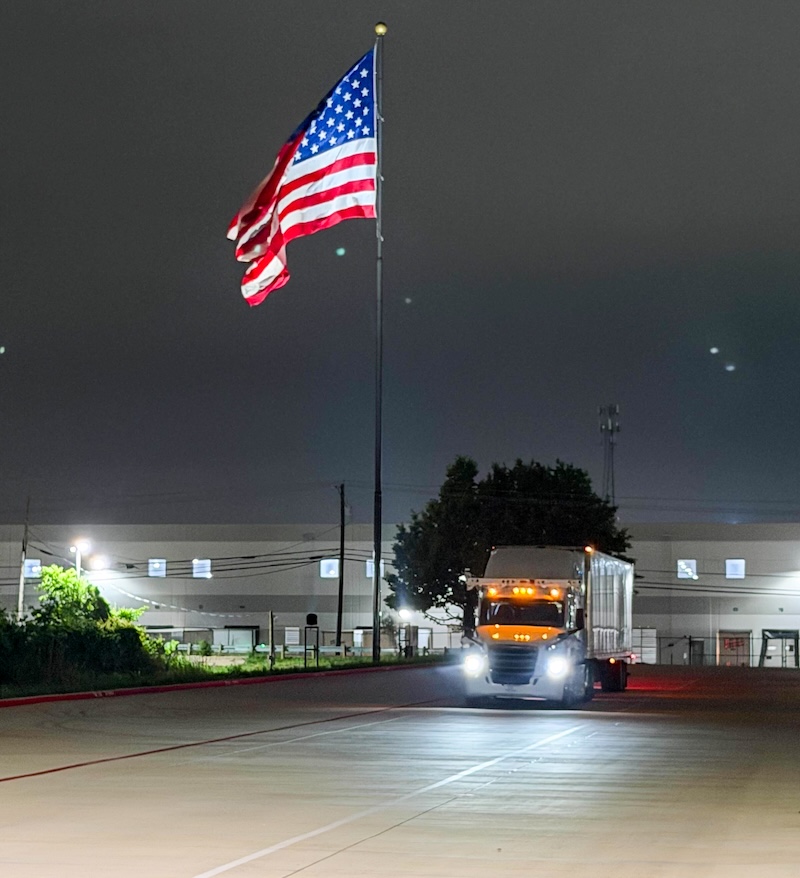
Autonomous trucking company Bot Auto says it has completed what it describes as the first fully humanless commercial over-the-road truckload delivery in the United States, moving freight between Houston and Dallas without a driver, in-cab observer, or remote operator controlling the vehicle.
The Houston-based company said the autonomous truck completed a 230-mile overnight route from Riggy’s Truck Parking in northeast Houston to Safe Stop in Hutchins, south of Dallas, delivering a commercial shipment booked through logistics provider Ryan Transportation.
According to Bot Auto, the run was conducted without a safety driver onboard and without “low-latency remote human feedback”, which the company says differentiates the operation from earlier autonomous trucking demonstrations and pilot programs.
The route is significant because it took place on a live commercial freight lane rather than a controlled test environment, reflecting growing competition among autonomous trucking companies seeking to commercialize driverless freight operations in Texas and the wider US logistics market.
Bot Auto says the shipment was selected specifically to support a customer requiring reliable overnight delivery within a tight time window – a segment where trucking companies often face challenges related to driver availability, scheduling constraints, and hours-of-service regulations.
Jeff Henderson, senior vice president at Ryan Transportation, said: “At Ryan Transportation, we’re constantly evaluating new solutions that enhance service, safety and reliability for our shipper partners.
“Forming this partnership is a strategic decision based on Bot Auto’s proven technology and the role autonomous trucking will play long-term in logistics. It will strengthen our ability to provide dependable, high-frequency capacity on time-sensitive freight while maintaining the operational standards our customers expect.”
The company emphasized that the run was not conducted as a technology demonstration but as a commercial freight movement operating within an existing logistics workflow.
Autonomous vehicle analyst Grayson Brulte observed the operation from pickup through delivery, according to Bot Auto, with footage expected to be released through The Road to Autonomy in the coming weeks.
Brulte said “what I saw on the roads in Texas was not a test. It was an autonomous commercial operation designed to scale and reduce downtime. Bot Auto is not doing a pilot, they are building a commercial trucking business powered by autonomy, free from the inconsistencies that are all too common in traditional trucking.”
The autonomous trucking sector has attracted significant investment over the past decade, although several companies have faced delays in moving from testing programs toward large-scale commercial deployment. Texas has emerged as one of the industry’s preferred operating regions because of its extensive freight corridors and relatively supportive regulatory environment.
Bot Auto founder and CEO Xiaodi Hou described the delivery as a milestone for the commercial viability of autonomous freight transportation.
Hou said: “People told me autonomous trucking commercialization still had a long way to go. This load is my answer. We did not build a demonstration, we built a business: commercial freight, on public roads, with no human in the cab or remote driving, operating between third-party logistics hubs, and most importantly, making money on every mile.
“That was my commercial vision for this revolutionary technology a decade ago. Now we intend to set that as the standard in America, with no asterisks and no caveats. Houston to Dallas is mile one.”
Bot Auto says it plans to expand its autonomous freight operations beyond the Houston-to-Dallas corridor while continuing to develop its partnership with Ryan Transportation.
The company argues that the economics of humanless trucking – particularly lower cost per mile and increased vehicle utilization – could eventually reshape long-haul freight transportation if autonomous systems prove capable of scaling reliably under real operating conditions.
