The robotic lawn mower industry is entering a new phase of technological maturity. Over the past decade, systems relying on boundary wires have dominated the mainstream market due to their stability and reliability.
However, as user demand for “zero-maintenance” and “plug-and-play” experiences continues to grow, boundary-free robotic lawn mowers are rapidly becoming the industry’s future direction.
This shift represents not only a product upgrade but also a transformation of the industry from “rule-based automation” to “spatially intelligent autonomous systems”.
For example, some leading robotic lawn mower manufacturer are integrating AI vision, RTK positioning, and autonomous decision-making technologies to accelerate this industry transformation.
Why Traditional Boundary-Line Lawn Mower Systems Are Gradually Being Phased Out
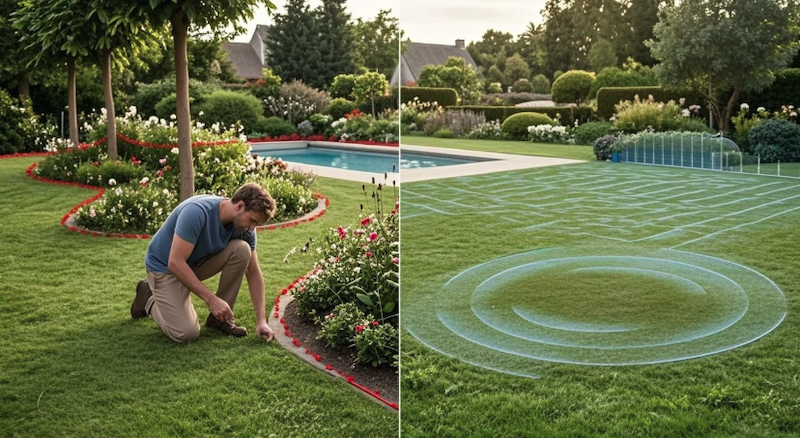
In the early days of the robotic lawn mower market, boundary-line systems were the mainstream solution for defining work areas and preventing the mower from straying outside them. However, as demand for smarter technology has grown, their limitations have become increasingly apparent.
Complex Installation and High Entry Barriers
Boundary wires require manual laying or burial, making installation time-consuming and costly, especially in large or complex gardens. In contrast, boundary-free solutions can automatically identify areas using AI vision, RTK, or SLAM, significantly reducing deployment complexity.
Lack of Flexibility
When garden layouts change (e.g., adding flower beds or pools), traditional solutions typically require rewiring, resulting in high adjustment costs and low efficiency.
High Maintenance Costs
Boundary lines are susceptible to damage from weather, construction, or external forces, which can cause equipment malfunctions and increase maintenance and after-sales support burdens.
Not Suitable for Large-Scale Scenarios
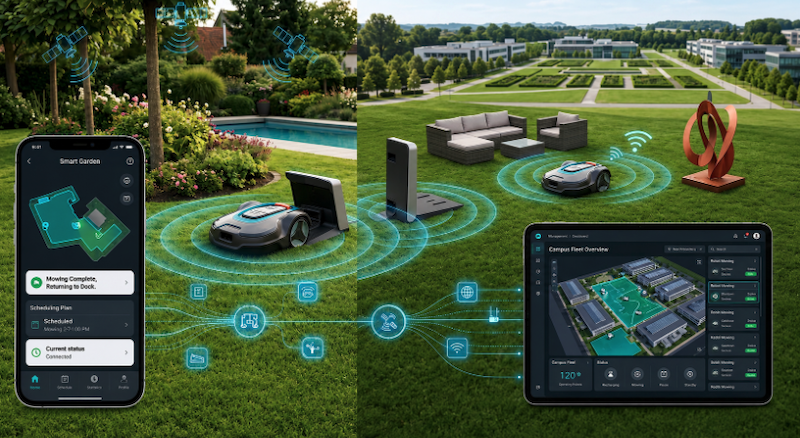
In large-scale applications such as campus or commercial landscaping, the complexity of wiring and maintenance increases significantly, limiting scalability.
Consequently, an increasing number of manufacturers are shifting toward boundary-free navigation solutions to enhance intelligence levels and the overall user experience.
The Core Drivers Behind the Development of Boundary-Free Technology
As the robotic lawn mower industry evolves toward greater intelligence and automation, traditional boundary-line solutions are no longer sufficient to meet the demands of high-precision navigation, convenient deployment, and adaptation to complex environments.
Consequently, the new generation of boundary-free robotic lawn mowers is increasingly adopting a variety of advanced perception and navigation technologies.
Currently, the core technologies driving industry development primarily include:
RTK High-Precision Positioning System
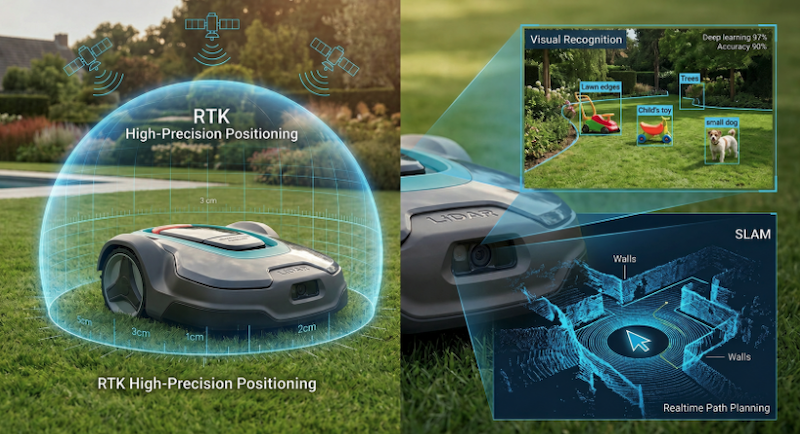
RTK technology provides centimeter-level positioning accuracy. Compared to traditional GPS, it is more stable and precise, enabling more accurate path planning and reducing issues such as repeated mowing and missed spots. It is suitable for large gardens and commercial settings.
AI Visual Recognition Technology
Through cameras and deep learning algorithms, AI vision systems can identify dynamic targets such as lawn boundaries, obstacles, pedestrians, and pets, enhancing safety and adaptability in complex environments.
SLAM Spatial Mapping and Localization Technology
SLAM technology builds real-time environmental maps and continuously optimizes navigation paths. Widely used in AMR and service robotics, it has also become a core technology in high-end robotic lawn mowers, especially for multi-zone and complex terrains.
Multi-Sensor Fusion System
Modern systems integrate cameras, ultrasonic sensors, IMUs, RTK, LiDAR, and collision sensors to achieve multi-dimensional perception. This improves stability in weak signal, complex weather, or obstructed environments.
The Technological Upgrade from “Relying on Boundaries” to “Understanding the Environment”
The evolution of boundary-free robotic lawn mowers is not just about removing physical wires. More importantly, it represents a shift from fixed-rule operation to environmental understanding and autonomous decision-making.
Through RTK, AI vision, SLAM, and multi-sensor fusion, robots can now understand their surroundings, plan paths dynamically, avoid obstacles, and manage mowing zones intelligently. This also shows that robotic lawn mowers are gradually evolving into true intelligent mobile robots.
Why Boundary-Free Robotic Lawn Mowers Are Becoming the Industry Standard
With the rapid development of the smart garden equipment market, boundary-free robotic lawn mowers are gradually replacing traditional systems and becoming a key industry direction. This shift is driven not only by navigation technology, but also by changes in user expectations, product experience, and business models.
For manufacturers, OEM/ODM brands, and end users, boundary-free systems deliver higher efficiency, lower maintenance costs, and significantly improved usability.
A Plug-and-Play User Experience
Traditional systems require boundary wire installation and calibration, making setup complex and time-consuming.
In contrast, boundary-free systems can quickly map environments using RTK, AI vision, or SLAM. For example, modern solutions such as the robot lawn mower without perimeter wire demonstrate how plug-and-play deployment is becoming a reality.
Better Adaptation to Dynamic Garden Environments
Modern gardens are increasingly complex, with seasonal layouts, temporary structures, and evolving landscapes. Traditional systems require rewiring, while boundary-free systems automatically adapt through real-time perception and path replanning.
Better Alignment with Smart Device Trends
Smart home devices are shifting from manual control to autonomous operation. Users now expect automatic planning, obstacle avoidance, self-correction, and minimal maintenance.
Boundary-free robotic lawn mowers meet these expectations through AI-driven decision systems and multi-sensor fusion.
Improved Efficiency in Commercial Applications
In landscaping, campuses, and property management, boundary-free systems reduce costs and improve scalability:
- Lower installation labor costs
- Faster deployment cycles
- Reduced maintenance workload
- Better multi-site management efficiency
- Scalable operations for large areas
Technical Challenges Still Facing Boundary-Free Robotic Lawn Mowers
Although rapidly advancing, boundary-free robotic lawn mowers still face several technical challenges that affect large-scale commercialization.
Positioning Stability in Complex Environments
RTK systems can be affected by trees, walls, reflections, or extreme weather. This may cause drift or path deviation. Multi-sensor fusion (RTK + SLAM + AI vision + IMU) is being used to improve stability.
Limited Recognition of Irregular Obstacles
While AI vision handles common obstacles well, real-world gardens contain irregular objects such as toys, tools, pets, and shadows, which remain challenging.
Product Cost Optimization
High-end systems integrate multiple sensors, AI chips, and RTK modules, increasing cost. However, supply chain maturity and algorithm optimization are expected to reduce costs over time.
Fragmented Industry Standards
Differences in navigation systems, communication protocols, and app ecosystems create compatibility issues and higher switching costs. Standardization is becoming increasingly important.
Overall, these challenges are being gradually addressed as the technology continues to evolve.
The Maturity of Boundary-Free Technology Is Driving Industry Upgrades
Despite existing challenges, continuous improvements in AI, positioning systems, and sensor fusion are rapidly enhancing system stability and intelligence.
Boundary-free navigation has clearly become a key direction in robotic lawn mower development and is expected to drive long-term growth in the smart garden equipment industry.
Conclusion
Boundary-free robotic lawn mowers are redefining the entire industry. From complex installation to plug-and-play operation, and from rule-based systems to environmental intelligence, the transformation is accelerating rapidly.
As technology continues to mature, robotic lawn mower manufacturers are leading the industry toward a new era – one defined by fully intelligent, boundary-free, and autonomous garden robotics.
