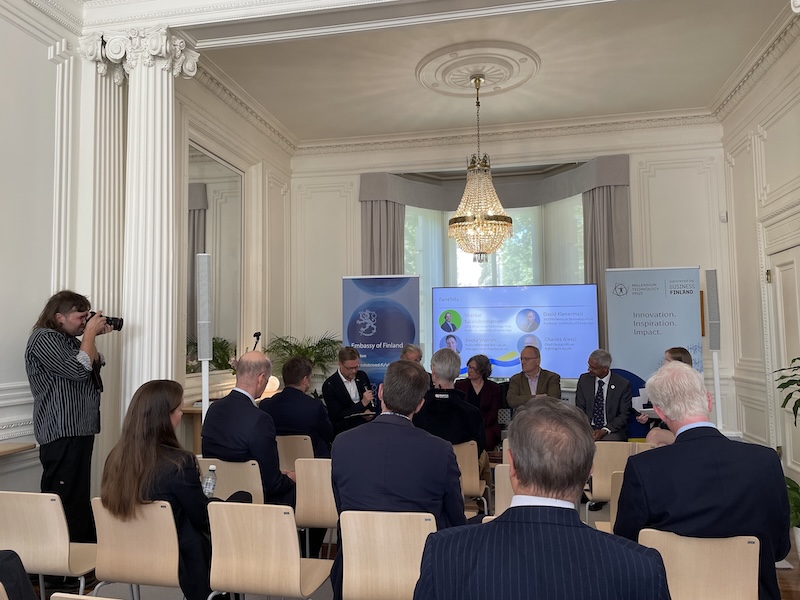
Being invited to the Embassy of Finland in the uppest of upscale neighbourhoods in London, England is a treat Robotics & Automation News was never going to pass up.
Quite apart from the importance of the 2027 Millennium Technology Prize which was the reason for the invitation, the opportunity to experience the ambiance of the area where it seems every grand house you walk past is an embassy – and the entrance to the street is guarded by police – was not one we wanted to miss.
Things didn’t start off on the right foot as I actually entered the street through the larger gate meant for cars. I was immediately told firmly to go back out and use the smaller gate meant for humans.
Along the street, about halfway to the Finnish embassy, a group of police officers were standing around a man who was on the pavement. From a distance, I thought it was a drunk or homeless person, the type of person who can be found in any big city, pretty much anywhere in the world.
This one happened to be lying on his side, face away from my view as I walked past. I noticed that he had handcuffs on. I wanted to ask what had happened, but knowing the police would not give me any information, I walked past and went to the Finnish embassy, where a small group of journalists and influential people mainly from the world of science, technology and medicine were gathering for a panel discussion.
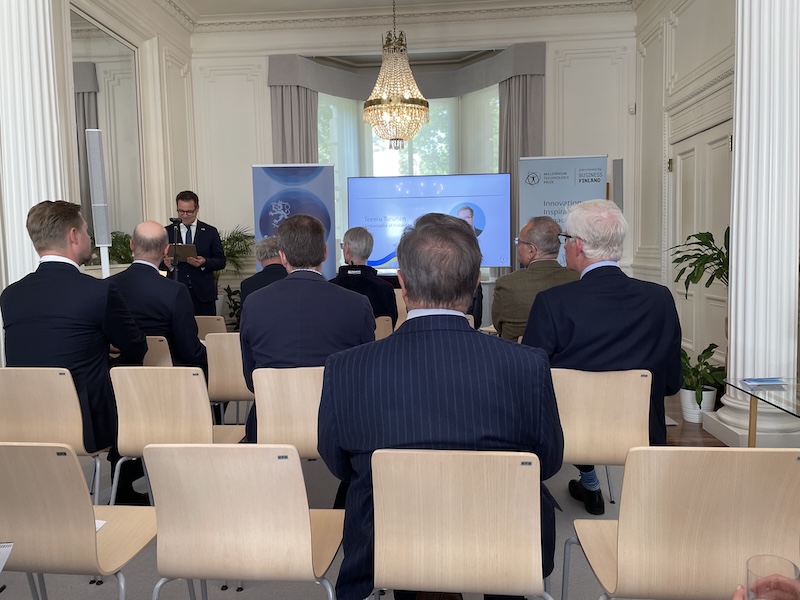
The title of the panel discussion was “Creating breakthroughs – How to build an appealing atmosphere for scalable innovations”, and featured four expert panelists and two hosts, all of whom were preceded by the ambassador, Teemu Turunen, who spoke to Robotics & Automation News afterwards and gave some background about the 2027 Millennium Technology Prize.
Turunen praised the previous winners who were part of the panel, David Klenerman and Shankar Balasubramanian, who had been awarded the 2020 Millennium Technology Prize for inventing a technology which reduced the cost and time for sequencing a human genome from millions of dollars and years to less than $1,000 and a single day.
The technology was said to be “vital” for Covid-19 tracking, cancer research, and personalised medicine.
I managed to get a word with Balasubramanian after the panel discussion ended and asked him what he thinks of the current advancements in artificial intelligence and robotics and their contribution to drug discovery and lab automation.
Balasubramanian was not as enthusiastic as I expected, saying that while AI and robotics had “potential”, the reality is that the human ingenuity of scientists and entrepreneurs are the things that really count more than anything.
His comments aligned with the opinions of Sally Roberts, who works at a government agency called Catapult, as business development manager for start-ups and SMEs.
Roberts is of the view that AI is not good enough to take human jobs and can’t really do basic tasks as well as humans can. “They might be superficially impressive, but you gradually start noticing that there is a qualitative difference between work produced by AI and work produced by a human – the human work is always better.”
She wouldn’t be drawn on my suggestion that AI has only just started to enter the world of work in a serious way, and it’s possible that in less than five years it would better than humans at most if not all knowledge-based tasks.
“No, I don’t think so,” was Roberts’ conclusion.
I detected a general sense of antipathy towards AI from most of the people I spoke to at the event, perhaps also a little nervousness at what AI has in store for us in the future.
But one panelist – Becky Warnes, public affairs and NHS liaison manager at a company called Orion Pharma – who I spoke to afterwards was much more positive, acknowledging that lab automation and AI were “important to our company’s activities”.
Her colleague, Charles De Wet, head of medical for UK and Ireland, said Orion had many medicines that were available across the medical sector, many of which would have been developed using AI and robotic technologies.
Many of the audience were interested in finding out how they can turn their ideas into businesses. One professor from a university gave the impression that she has numerous innovations that she could commercialise, perhaps currently being incubated at her university, and asked the panel for advice about how to go about it.
In fact, the presenters asked the panel at the start what they thought was the “single most important” thing in developing, commercialising and succeeding in an enterprise.
Each panelist suggested one aspect, starting with Balasubramanian, who said, “There’s more than one, but if I had to choose one, it would be ‘ideas’ or an idea – you have to have a good idea, which is obvious, but it’s the most important thing.”
The next panelist, Charles Alessi, chief clinical officer at Nightingale Health, echoed and emphasised Balasubramanian’s suggestion of ideas, and added to that “persistence”. Without persistence and determination, even good ideas can fail to reach the market and the success they deserve, he said.
Warnes added to the two previous suggestions her own choice of “collaboration”. It’s important to find people who you can work with and can help you develop your ideas and find ways of commercialising them, she said.
And the last person on the panel, Klenerman, said “culture” is an important factor in success. You have to find the right culture for yourself and your idea to flourish, he said.
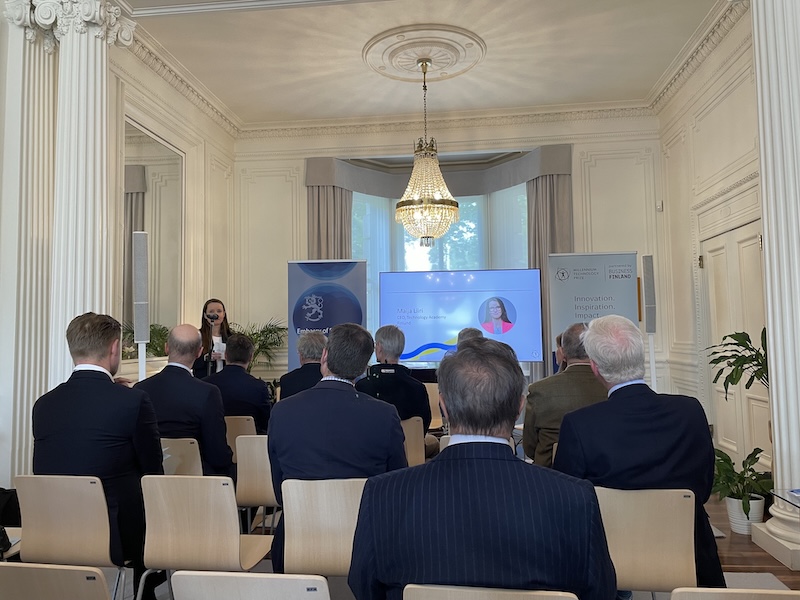
In her presentation at the start of the event, Maija Liiri, CEO of the Technology Academy of Finland, the organisation behind the Millennium Technology Prize, said it was the “world’s leading technology prize”.
Liiri said: “Finland can play a unique role in recognising important innovations. The Millennium Technology Prize does exactly that.”
