• Skip to primary navigation
  • Skip to main content
  • Skip to primary sidebar
  • Skip to secondary sidebar
  • About
    • Contact
    • Privacy
    • Terms of use
  • Shop
    • Cart
    • Checkout
    • My Account
  • Advertise
    • Advertising
      • Buy ad space
    • Case studies
    • Design
    • Email marketing
    • Features list
    • Lead generation
    • Magazine
    • Press releases
    • Publishing
    • Sponsor an article
    • Webcasting
    • Webinars
    • White papers
    • Writing
  • Subscribe to Newsletter

Robotics & Automation News

Where Innovation Meets Imagination

  • Home
  • News
  • Features
  • Editorial Sections A-Z
    • Agriculture
    • Aircraft
    • Artificial Intelligence
    • Automation
    • Autonomous Vehicles
    • Business
    • Computing
    • Construction
    • Culture
    • Design
    • Drones
    • Economy
    • Energy
    • Engineering
    • Environment
    • Health
    • Humanoids
    • Industrial robots
    • Industry
    • Infrastructure
    • Investments
    • Logistics
    • Manufacturing
    • Marine
    • Material handling
    • Materials
    • Mining
    • Promoted
    • Research
    • Robotics
    • Science
    • Sensors
    • Service robots
    • Software
    • Space
    • Technology
    • Transportation
    • Warehouse robots
    • Wearables
  • Press releases
  • Events

Greenpeace robot stages deepest-ever seabed protest

May 27, 2026 by Sam Francis

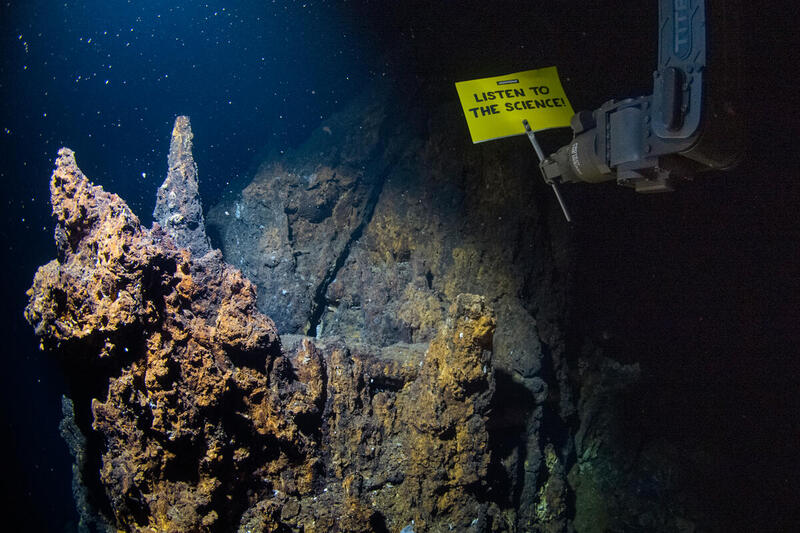
While conducting a scientific survey of vulnerable and unexplored deep-sea ecosystems along the Arctic Mid-Ocean Ridge, environmental campaign group Greenpeace deployed an underwater robot from 2,300 meters below the surface, in the deepest banner protest ever made from the seabed.

The words demanding global leaders do something were: “LISTEN TO THE SCIENCE!”

Dr Sandra Schöttner, chief scientist for the Deep Arctic Expedition, Greenpeace International, said: “This marks the deepest banner protest in history, to speak for ecosystems that have no voice of their own.

“World leaders have already promised to protect 30 percent of the oceans, now they must listen to the science and actually do it.

“We cannot meet our global goals if we also allow industrial exploitation of unexplored and vulnerable ecosystems in the deep sea. It is high time that leaders keep their promises and give the oceans a chance to recover.”

The banner was brought down to 2315 metres below sea level by the expedition’s remotely operated vehicle – ROV Holly – and held up in front of the hydrothermal vent field called “Loki’s Castle”, a unique volcanic ecosystem where black smokers are emitting 300-320 °C fluid from deep within the ocean crust.

Scientists believe our own distant ancestors may have looked just like the microbes living on structures like these, making Loki’s Castle a “cradle” of complex life that could hold the key to how life on Earth once started.

The Arctic is one of the most rapidly changing regions on Earth due to climate change, and as the industrial frontier expands toward the deep sea, through threats like deep-sea mining, Greenpeace warns that these unique “biodiversity hotspots” are at risk of irreversible disruption.

Dr Sandra Schöttner said: “It is not too late to act. Science clearly predicts the limits of what our planet can endure, but human action determines our survival.

“By safeguarding these deep-sea ecosystems within a global network of ocean sanctuaries and establishing a moratorium on deep sea mining, we can create a resilient safety net for marine life, and protect the health of our global oceans for generations to come.”

The Deep Arctic Expedition brings together world-leading scientists to explore Arctic seamounts and hydrothermal vent fields – all while livestreaming the science from the Arctic seabed on Greenpeace International’s youtube channel.

The area of the expedition was opened for deep sea mining by the Norwegian government in 2024, but the plans were halted last year after protests from environmental organisations, fishermen, scientists and the green opposition parties in Norway.

Deep sea mining would, according to many scientists, cause irreversible damage to vulnerable deep-sea ecosystems, including the destruction of habitats, and possibly species extinction.

Greenpeace is calling on world leaders to honor global climate targets, implement the UN Ocean Treaty to protect 30 percent of the global ocean by 2030, and establish an immediate moratorium on deep-sea mining.

Print Friendly, PDF & Email

Share this:

  • Print (Opens in new window) Print
  • Share on Facebook (Opens in new window) Facebook
  • Share on LinkedIn (Opens in new window) LinkedIn
  • Share on Reddit (Opens in new window) Reddit
  • Share on X (Opens in new window) X
  • Share on Tumblr (Opens in new window) Tumblr
  • Share on Pinterest (Opens in new window) Pinterest
  • Share on WhatsApp (Opens in new window) WhatsApp
  • Share on Telegram (Opens in new window) Telegram

Related stories you might also like…

Filed Under: Environment, News Tagged With: Arctic Ocean, automation news, autonomous underwater vehicles, climate change, deep sea mining, deep-sea exploration, environmental robotics, Greenpeace, Loki’s Castle, marine science, ocean conservation, ocean robotics, remotely operated vehicle, robotics and automation, robotics and automation news, robotics news, rov, scientific expedition, subsea robotics, underwater robot

Primary Sidebar

Search this website

Latest articles

  • The Hardware Powering the Hybrid Industrial Workforce
  • How to Choose a Robot Vacuum and Mop That Actually Fits Your Home
  • How Modern Software Helps Construction Companies in Qatar Work Smarter and Safer
  • Antivirus vs malware: Why antivirus alone is no longer enough
  • X Square Robot builds a full-stack approach to embodied AI and general-purpose robotics
  • AGIBOT debuts A3 humanoid robot in Europe and launches UK Robot-as-a-Service model
  • What Are the Biggest Challenges in Modern Electronics Manufacturing?
  • What Are the Best AI Tools for Creating Content Faster in 2026?
  • Why Does Quality Wiring Matter More Than Ever in Modern Electronic Devices?
  • Why Are Custom Harness Solutions Essential for Next Generation Technology?

Secondary Sidebar

Latest news

  • The Hardware Powering the Hybrid Industrial Workforce
  • How to Choose a Robot Vacuum and Mop That Actually Fits Your Home
  • How Modern Software Helps Construction Companies in Qatar Work Smarter and Safer
  • Antivirus vs malware: Why antivirus alone is no longer enough
  • X Square Robot builds a full-stack approach to embodied AI and general-purpose robotics
  • AGIBOT debuts A3 humanoid robot in Europe and launches UK Robot-as-a-Service model
  • What Are the Biggest Challenges in Modern Electronics Manufacturing?
  • What Are the Best AI Tools for Creating Content Faster in 2026?
  • Why Does Quality Wiring Matter More Than Ever in Modern Electronic Devices?
  • Why Are Custom Harness Solutions Essential for Next Generation Technology?

Copyright © 2026 · News Pro on Genesis Framework · WordPress · Log in

We use cookies on our website to give you the most relevant experience by remembering your preferences and repeat visits. By clicking “Accept”, you consent to the use of ALL the cookies.
Do not sell my personal information.
Cookie SettingsAccept
Manage consent

Privacy Overview

This website uses cookies to improve your experience while you navigate through the website. Out of these, the cookies that are categorized as necessary are stored on your browser as they are essential for the working of basic functionalities of the website. We also use third-party cookies that help us analyze and understand how you use this website. These cookies will be stored in your browser only with your consent. You also have the option to opt-out of these cookies. But opting out of some of these cookies may affect your browsing experience.
Necessary
Always Enabled
Necessary cookies are absolutely essential for the website to function properly. These cookies ensure basic functionalities and security features of the website, anonymously.
CookieDurationDescription
cookielawinfo-checkbox-analytics11 monthsThis cookie is set by GDPR Cookie Consent plugin. The cookie is used to store the user consent for the cookies in the category "Analytics".
cookielawinfo-checkbox-functional11 monthsThe cookie is set by GDPR cookie consent to record the user consent for the cookies in the category "Functional".
cookielawinfo-checkbox-necessary11 monthsThis cookie is set by GDPR Cookie Consent plugin. The cookies is used to store the user consent for the cookies in the category "Necessary".
cookielawinfo-checkbox-others11 monthsThis cookie is set by GDPR Cookie Consent plugin. The cookie is used to store the user consent for the cookies in the category "Other.
cookielawinfo-checkbox-performance11 monthsThis cookie is set by GDPR Cookie Consent plugin. The cookie is used to store the user consent for the cookies in the category "Performance".
viewed_cookie_policy11 monthsThe cookie is set by the GDPR Cookie Consent plugin and is used to store whether or not user has consented to the use of cookies. It does not store any personal data.
Functional
Functional cookies help to perform certain functionalities like sharing the content of the website on social media platforms, collect feedbacks, and other third-party features.
Performance
Performance cookies are used to understand and analyze the key performance indexes of the website which helps in delivering a better user experience for the visitors.
Analytics
Analytical cookies are used to understand how visitors interact with the website. These cookies help provide information on metrics the number of visitors, bounce rate, traffic source, etc.
Advertisement
Advertisement cookies are used to provide visitors with relevant ads and marketing campaigns. These cookies track visitors across websites and collect information to provide customized ads.
Others
Other uncategorized cookies are those that are being analyzed and have not been classified into a category as yet.
SAVE & ACCEPT