Humanoid robotics companies have spent years producing carefully choreographed demonstrations and highly controlled prototypes. The real challenge, however, has always been manufacturing scale.
Building one impressive humanoid robot is difficult. Building hundreds reliably, repeatedly, and economically is something else entirely.
Figure AI now claims to be crossing that threshold.
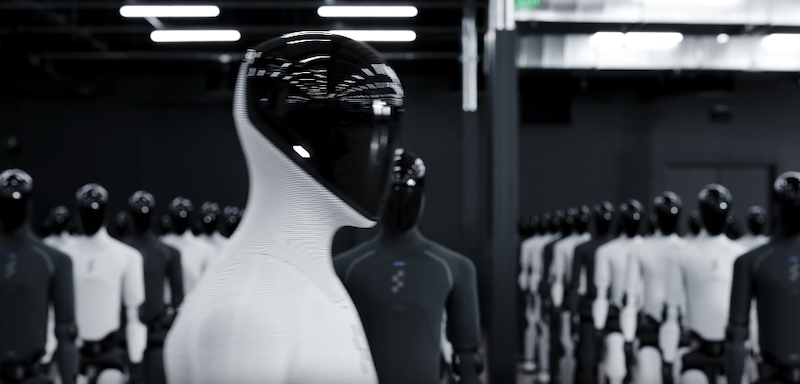
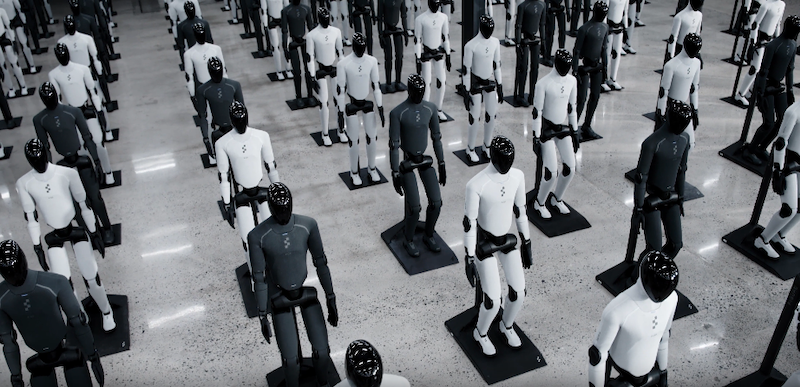
In a recent update, the company revealed that its BotQ manufacturing facility has increased production output of its Figure 03 humanoid robot from one unit per day to one unit per hour – a 24-fold increase in throughput achieved in less than 120 days.
The company says it has already produced more than 350 third-generation humanoid robots and manufactured over 9,000 actuators across more than 10 different SKUs.
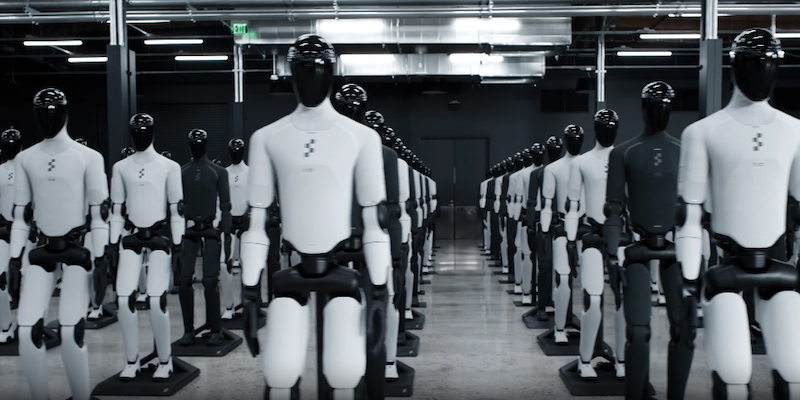
While production figures remain small compared with the automotive industry, they are significant within the still-emerging humanoid robotics sector, where most companies remain focused primarily on R&D and limited pilot deployments.
More importantly, Figure’s update offers insight into how the economics and technical priorities of humanoid robotics may be changing.
Manufacturing scale becomes the new battleground
Much of the public attention surrounding humanoid robotics has focused on movement demonstrations – robots dancing, running, or carrying objects.
But increasingly, industry competition appears to be shifting toward:
- manufacturing scale;
- reliability;
- fleet operations;
- AI data collection; and
- commercial deployment.
Figure itself framed the production ramp not simply as a manufacturing milestone, but as a data and development milestone.
The company stated: “This 24x increase represents more than just manufacturing efficiency – it is a fundamental shift in our development velocity.”
That observation highlights a broader shift taking place across robotics and AI.
Modern humanoid systems are increasingly viewed not merely as machines, but as data-generation platforms. Every deployed robot generates operational data that can be used to improve AI models, fault tolerance, motion planning, and real-world autonomy.
The larger the fleet becomes, the faster those systems can theoretically improve.
This creates a feedback loop similar to those seen in autonomous vehicles and large-scale AI systems:
- more robots generate more data;
- more data improves the AI;
- improved AI enables broader deployment; and
- broader deployment generates even more data.
In this sense, manufacturing scale itself becomes a strategic AI advantage.
Building a humanoid production system
According to Figure, scaling production required the development of custom manufacturing execution software operating across more than 150 networked workstations.
The company said one of its largest challenges involved improving yield rates and supplier quality.
Figure claims it implemented:
- more than 50 in-process inspection points;
- over 80 end-of-line functional verification tests;
- battery testing systems; and
- extensive “burn-in” exercises designed to eliminate early hardware failures.
These stress tests reportedly include robots performing repeated squats, jogging, and shoulder press motions over thousands of cycles to simulate long-term real-world use.
The company says its battery production line has achieved a 99.3 percent first-pass yield, while overall robot first-pass yield rates now exceed 80 percent and continue improving weekly.
Although the figures cannot be independently verified, they illustrate the growing industrialization of humanoid robot manufacturing.
Humanoid robots become fleet-managed systems
Another important aspect of Figure’s update concerns operational infrastructure.
The company says it has developed:
- internal fleet management systems;
- over-the-air software update infrastructure;
- field service management tools;
- failure diagnostics systems; and
- “fallback ladders” that allow robots to recover gracefully from non-critical faults.
This may prove just as important as the robots themselves.
Historically, industrial robots operated inside highly structured factory cells with relatively predictable tasks and environments.
Humanoid robots, by contrast, are expected to operate in dynamic human spaces:
- warehouses;
- factories;
- offices;
- retail environments; and
- eventually homes.
Managing large fleets of semi-autonomous humanoids therefore begins to resemble cloud infrastructure management as much as traditional robotics engineering.
The robotics industry increasingly appears to be converging with enterprise software, AI infrastructure, and distributed computing.
Figure’s broader AI ambitions
Alongside manufacturing updates, Figure also revealed new developments involving Helix, the company’s humanoid AI system.
According to Figure, its “System 0” whole-body controller now integrates visual perception data from onboard cameras with proprioceptive state information, enabling robots to navigate stairs and uneven terrain more autonomously.
The company says the system is trained end-to-end using reinforcement learning in simulation before being transferred directly to physical robots without real-world fine-tuning.
This “sim-to-real” transfer problem has long been considered one of the central technical bottlenecks in robotics.
If companies can reliably train complex behaviors in simulation and deploy them directly onto physical machines, development speed could accelerate dramatically.
Figure claims the same architecture used for stair traversal may eventually support a much broader class of real-world behaviors.
The bigger shift in humanoid robotics
The significance of Figure’s announcement may extend beyond production numbers alone.
The humanoid robotics sector appears to be entering a new phase where competitive advantage is no longer defined solely by mechanical design or impressive demonstrations.
Instead, leadership may increasingly depend on:
- manufacturing scale;
- operational reliability;
- AI infrastructure;
- data acquisition;
- simulation capability; and
- fleet orchestration.
This mirrors earlier transformations in industries such as cloud computing, autonomous driving, and consumer AI.
The companies that ultimately dominate humanoid robotics may not necessarily be those with the most visually impressive prototypes, but those capable of scaling production, maintaining reliability, and continuously improving AI systems through large-scale deployment.
Figure appears determined to position itself as one of those companies.
Whether the broader humanoid robotics industry can transition from experimental systems to economically viable large-scale deployment remains uncertain.
But the conversation is increasingly shifting away from whether humanoid robots can walk – and toward whether companies can manufacture, manage, and commercially operate them at scale.
