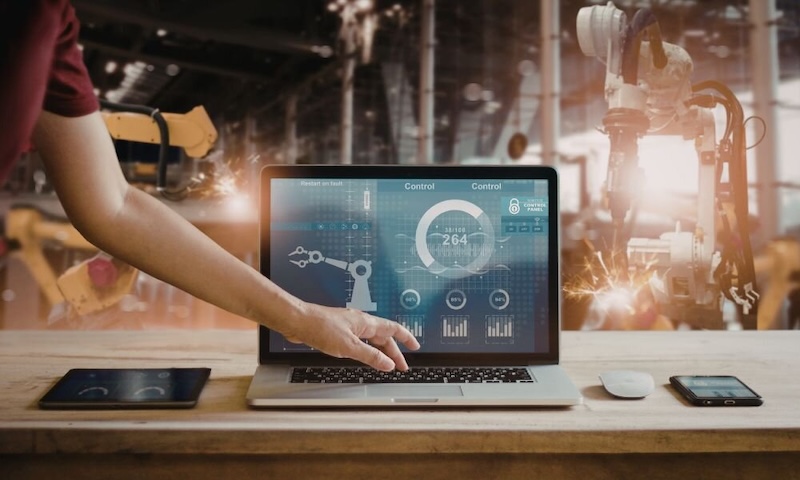
The International Federation of Robotics projects 575,000 industrial robot installations globally were achieved in 2025, which would mark the highest annual total on record.
The automotive sector runs the densest robot fleet of any manufacturing industry – more robots per 10,000 employees than any other sector in Germany, Japan, the United States and South Korea.
With robots concentrations that high, automotive plants have more to gain from getting condition monitoring right – small improvements in uptime translate directly into outsized gains in productivity and cost efficiency.
What the existing approach misses
The maintenance programs in most automotive plants were built for static equipment. A pump, a conveyor motor, a stamping press – these assets generate consistent vibration signatures at a fixed location under repeatable load conditions. Threshold-based monitoring works for them because there is a stable baseline to measure against.
However, industrial robots do not work that way. A six-axis arm moving through a welding path looks completely different from the same arm picking a light component near the home position.
The vibration signature changes with every pose, every payload, every speed. A threshold set for one condition fires false alarms in another and misses real wear in a third. Most maintenance teams learn this quickly and stop trusting the alerts.
Additionally, the failures that actually take robots down make this worse. Gearboxes wear gradually from millions of repeated movements. Motor bearings fatigue from constantly reversing direction. Cables crack from bending through the same path thousands of times per shift.
The result is that standard condition monitoring generates noise on healthy robots and misses real degradation on failing ones. Most plants fall back to scheduled maintenance and run to failure in between. That cycle is why predictive maintenance in automotive keeps delivering despite the sensors already being on the floor.
How AI changes condition monitoring
Robot controllers already record everything happening inside the machine on every cycle – force, speed, position. Most plants never use this data.
However, AI condition monitoring reads it continuously and learns what normal looks like for each robot on each specific job. A welding robot running the same body-in-white cycle 400 times per shift generates an enormous amount of consistent data.
AI treats that consistency as the baseline. When something starts going wrong, the pattern changes before anything visible happens. The signs are subtle and gradual, which is exactly why standard monitoring misses them, and AI does not.
The difference from traditional monitoring is that AI does not need a fixed threshold set by an engineer in advance. It compares today’s behavior against that specific robot’s own history, which means it gets more accurate over time and adapts when the job changes.
The practical starting point is connecting the controller data that already exists to a system that can read it. Most automotive plants have not made that connection yet – the robot collects data on the shop floor and it stays there.
Fixing that is less about AI and more about data architecture. Once it is in place, optimizing automotive data operations through real-time sync stops being the bottleneck and condition monitoring starts working the way it was supposed to.
Where this leaves most plants
The robots already on the line are generating the data needed to predict their own failures. The technology to read that data and act on it exists today.
For most automotive plants, the immediate step is not evaluating new AI tools, it is auditing whether controller data is actually flowing anywhere useful.
That audit typically surfaces quick wins: robots that have been logging anomalies for months with no one watching, maintenance intervals that could be extended on assets showing no signs of wear, and a handful of high-risk assets that need attention before the next scheduled window.
The investment required to get there is smaller than most teams expect, and the baseline is already running on every robot on the floor.
