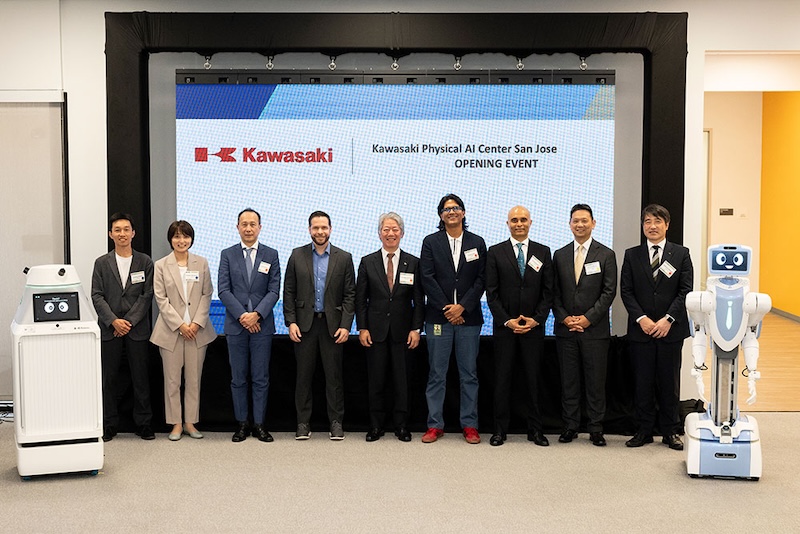
Kawasaki Heavy Industries has launched a new physical AI development center in Silicon Valley as part of a broader push to accelerate collaboration between Japanese and American companies in artificial intelligence, semiconductors, and robotics.
Called the Kawasaki Physical AI Center San Jose, the facility will focus on developing real-world applications for physical AI systems through partnerships with major technology companies including Nvidia, Analog Devices, Microsoft, and Fujitsu.
The company says the center will initially prioritize healthcare and elder care applications, areas increasingly affected by labor shortages and aging populations in many countries.
At the opening ceremony held on May 21, Yasuhiko Hashimoto, president and CEO of Kawasaki Heavy Industries, outlined the company’s ambitions for the new center.
“At the Kawasaki Physical AI Center, we will first focus on healthcare and elder care, where aging societies and labor shortages are global challenges,” said Hashimoto.
“We will establish ‘hospital one-stop solution’ that covers the entire in-hospital experience from arrival, examination, diagnosis, and treatment, to surgery and post-care – through the integration of Physical AI and robotics.”
Hashimoto added: “What we aim for is NOT to replace people, but to deliver Physical AI that supports human judgment and action – safely and efficiently.”
Kawasaki defines physical AI as artificial intelligence capable of autonomously perceiving, reasoning, and acting within real-world environments through machines and robotic systems. The company argues that advancing these systems requires large amounts of operational “real world” data gathered from industrial environments.
The company plans to combine physical AI technologies with several of its existing robotic systems, including the Nyokkey autonomous service robot, the Forro indoor delivery robot, the hinotori surgical robot system, and the Corleo robotic multi-legged vehicle.
Under the collaboration agreements, Nvidia will work with Kawasaki on AI and robotics integration, while Analog Devices will contribute sensing and voice-recognition technologies. Microsoft will support cloud and AI platform infrastructure, and Fujitsu will focus on integrating AI with healthcare business and robotic systems.
The move reflects growing interest among industrial and robotics companies in positioning physical AI as the next major phase of automation, extending beyond traditional industrial robotics into healthcare, mobility, logistics, and service applications.
Kawasaki says the San Jose center will also collaborate with its development operations in Japan and Europe to accelerate the practical deployment of physical AI systems across multiple industries.
