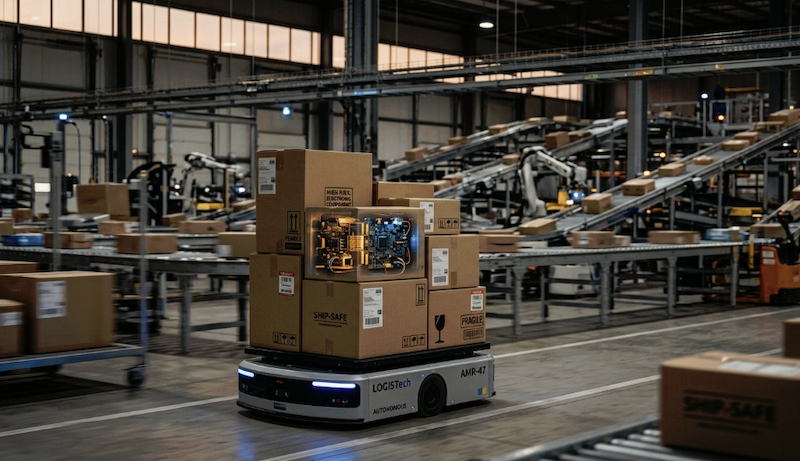
To stop automated fulfillment lines, which will account for 85% of all warehousing nationally by 2030, from shredding your margins, you have to look at the physics of the floor.
Damage in a robotized environment isn’t usually about a single “drop” incident; it is a cumulative result of high-velocity vibration, G-force shifts during AMR acceleration, and rigid sorting hardware that lacks a human touch.
Calibrating for Kinetic Force
There are thousands of parcel impacts every day in high-volume automated hubs that could be avoided by simply adjusting sensor thresholds.
When Autonomous Mobile Robots (AMRs) zip across a warehouse floor, the lateral force of a sudden stop can shift internal contents even if the box remains upright.
You need to establish “soft-stop” zones where robots decelerate gradually before entering a turn or a lift. These zones allow the product’s inertia to dissipate without slamming against the corrugated packaging walls.
If your vision systems aren’t flagging parcels that look skewed on a conveyor, you are essentially letting a ticking time bomb head toward the shipping dock.
Optimizing Packaging Specs for Sorters
Standard shipping boxes were designed for human hands, but high-speed sorters require different structural integrity. High-speed belt transitions can catch the flap of a poorly taped box, leading to a jam that crushes the following three parcels.
Moving to data-driven packaging means choosing materials that meet updated ISTA standards specifically for robotic handling rather than general manual labor.
You should consider the thickness of your corrugate and the friction coefficient of the outer finish to ensure parcels don’t slide or stack dangerously.
Effective damage control in automated systems relies on three specific physical interventions:
- Specialized cushioned totes for AS/RS systems to absorb shuttle vibration
- Automated friction-testing for all new secondary packaging materials
- Variable speed conveyor controllers that adjust based on parcel weight
Implementing these hardware tweaks reduces the physical stress on every item that passes through your facility. The importance of material strength is well established, but even the best packaging has its limits.
Managing Residual Risk with Third-Party Protection
Even with perfect sensor calibration and reinforced boxes, the reality of logistics is that some percentage of parcels will always suffer.
Technical controls can mitigate 90% of the damage, but the final 10% requires a financial safety net to protect your bottom line.
Using Secursus third party shipping protection allows you to bypass the bureaucratic nightmare of carrier claims when automation goes wrong.
Since most carriers have strict “adequacy of packaging” clauses that they use to deny claims in automated environments, having an independent layer of coverage ensures you aren’t left eating the cost of a robotic mishap.
Establishing Chain of Custody Documentation
You cannot fix what you cannot prove, which is why vision systems are the most underutilized tool in damage reduction.
By placing high-resolution cameras at every transition point – where a box moves from a shelf to a bot, or a bot to a conveyor – you create a digital paper trail.
If a parcel arrives at the customer’s door crushed, you can scrub back through the footage to see exactly where the failure occurred.
This allows operations leaders to identify a specific “hard-drop” zone or a miscalibrated diverter arm that is consistently causing issues.
Hardening Your Automated Pipeline
The transition to a fully touchless warehouse is a game of millimeters and milliseconds. By focusing on the structural requirements of automated sorters and the kinetic habits of your AMR fleet, you turn your warehouse into a precision instrument rather than a blender for your inventory.
Check our blog for more deep dives into warehouse tech and risk management, as well as insights into all sorts of other automation-related topics.
