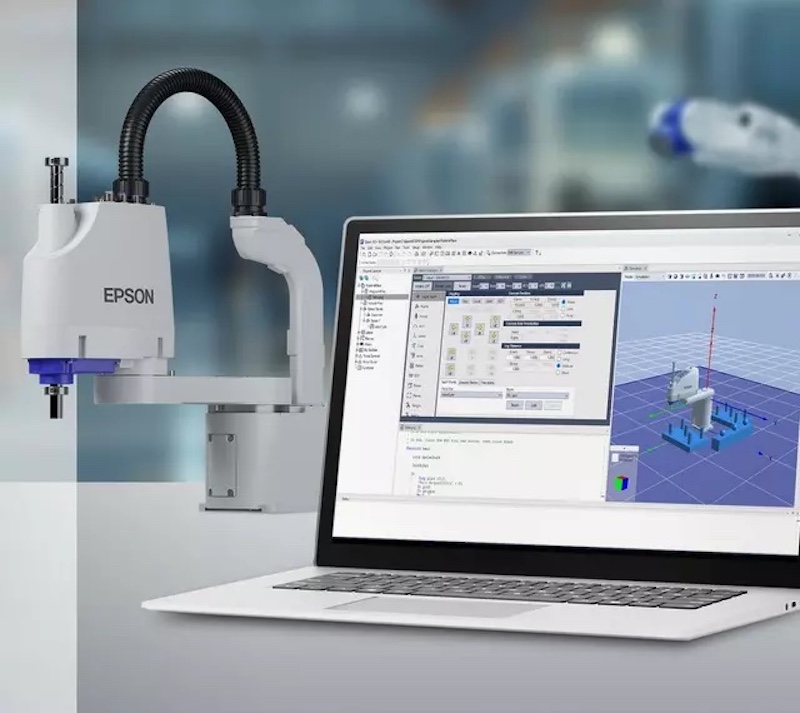
Epson Robots has been a quiet but influential force in industrial robotics for decades, particularly in high-precision automation.
The company’s history in robotics dates back to its internal efforts to automate watch assembly, which pushed it toward small-parts handling, speed, and accuracy rather than heavy-payload industrial automation. That heritage still shapes its strategy.
Today, Epson is best known for its strong market position in the SCARA robot segment – where it has held a prominent position globally for many years – and for supplying compact six-axis systems, vision tools, force-sensing technology, and integrated software environments designed to reduce deployment time and complexity.
Its customer base spans electronics manufacturing, medical and diagnostics production, consumer goods, lab automation, and light industrial assembly, with many deployments in environments that demand consistency and repeatability rather than brute strength.
The market context is shifting. Labor shortages have persisted since the pandemic. Reshoring and regionalisation efforts are accelerating. Small and mid-sized manufacturers are seeking automation that does not require large specialist teams to deploy or maintain.
At the same time, high-mix production and increasing product variation are making flexibility and fast changeovers essential.
These trends are driving demand for compact, integrated automation solutions, including SCARA robots with built-in vision and part-feeding capabilities, and easy-to-program six-axis robots that can handle machine tending, test and inspection, and material handling tasks in tight spaces.
Against this backdrop, Robotics & Automation News spoke with Scott Marsic, group product manager at Epson Robots. Marsic oversees product strategy and works closely with customers adopting automation for the first time as well as those scaling established systems.
In this Q&A, he discusses current demand for SCARA and six-axis robots, the continued impact of labor shortages, approaches to simplifying deployment, and the broader trends shaping adoption in 2025 and beyond.
Interview with Scott Marsic
Robotics & Automation News: Epson is often cited as the world’s largest producer of delta robots. How do you see demand evolving for delta, SCARA, and 6-axis robots, and what applications are driving that growth?

Scott Marsic: Epson is best known for SCARA – the segment where we’ve led for years. Across our customer base we continue to see strong growth in SCARA for high-throughput, small-parts applications that demand speed, precision, and repeatability (electronics, consumer devices, medical/diagnostics, and lab automation).
At the same time, 6-axis adoption is rising where reach, articulation, or access around fixtures is critical – think machine tending, test/inspection, and flexible material handling.
The common thread is customers asking for faster time-to-value: integrated vision and feeding, simpler programming, and compact / high performance automation packages that lower total cost of ownership.
R&AN: Labor shortages continue to be a major driver for automation. From Epson’s perspective, which industries or tasks are adopting robotics most aggressively to fill those gaps?
SM: Labor shortages are indeed a real challenge for manufacturers. This began to really accelerate during and after Covid, and it’s not getting a whole lot better.
We’re seeing sharpest impact within SMB and mid-market manufacturers that can’t hire fast enough but still need Tier-1 performance – particularly in electronics and component assembly, medical device and diagnostics, packaging, and general industrial.
Robotic automation absolutely is the answer to augment these challenges, as well as helping companies enhance business performance, time to market, supply to demand management, and so on.
What accelerates robotic adoption is lowering the skills barrier: our all-in-one robots help to minimize integration steps, while RC+ helps both first-time users and seasoned automation professionals build out their workflow and get to production quickly.
R&AN: Accessibility and ease of use are increasingly important in robotics. How is Epson making its systems simpler to integrate and operate for companies that may not have deep in-house robotics expertise?
SM: Epson makes it simple for teams with a wide range of experience to deploy robots. Epson RC+ streamlines text-based programming within a familiar Windows interface.
Complete with a built-in 3D simulator, users can run feasibility and cycle-time studies for quick evaluation of potential projects.
Unified peripheral management also exists for key solutions such as for vision, flexible parts feeding, force guidance, as well as other peripherals.
For new users, RC+ Express provides guided, icon-driven programming and reusable templates so first projects move from concept to production fast – no advanced coding required.
R&AN: Many manufacturers are looking for flexible automation that can adapt to changing production demands. How is Epson addressing the need for modularity or quick reconfiguration in its robot lines?
SM: In high-mix environments like packaging, the pace of change makes flexibility essential. Ease of use remains critical for plant-floor success, and improved diagnostics will keep expanding as manufacturers look to optimize workflows and reduce service time and cost.
Epson addresses this with unique small-footprint form factors, parts flexibility and changeover with IntelliFlex, profile-based Force Guidance, and software that treats vision, feeding, and motion as one system – so teams can reconfigure in hours, not weeks.
R&AN: Trade shows like The Assembly Show highlight new solutions. Beyond what you’re showcasing there, what broader trends do you think will define robotics adoption in 2025 and beyond?
SM: Robotics adoption is becoming essential for survival and growth in modern manufacturing. Labor shortages, reshoring and technological advancements are driving small and mid-sized manufacturers to seek solutions that are easy to use, deliver quick results, and don’t require specialized expertise.
As technology advances and manufacturers face increasing production demands, solutions that are easy to implement and deliver measurable ROI will define the next phase of robotics growth.
There are several key trends occurring in the market today, but here are three of the more prominent ones.
- Do-more-with-less operations – persistent labor gaps and reshoring push demand for automation that’s easy to learn and fast to deploy.
- High-mix, low-volume – SKU volatility favors platforms with rapid changeover and integrated vision/feeding to keep line OEE high.
- Data-backed decisions – simulation and cycle-time studies up front, with diagnostics and remote support at scale.
Epson’s roadmap aligns directly with those needs: compact, all-in-one SCARA and 6-axis systems that combine speed and precision with approachable software, plus tightly integrated solutions to reduce deployment time and improve automation outcomes.
We expect more manufacturers across electronics, medical/diagnostics, consumer goods, and general industrial to adopt this model as they scale intelligently without adding complexity.
R&AN: Epson has a strong global presence. Where do you see the biggest geographic opportunities for growth in robotics adoption, and how is the company positioning itself to meet them?
SM: We see strong momentum across the Americas as manufacturers reshore and expand regional capacity, and continued growth in Asia for electronics, medical, and component manufacturing.
Our focus is removing adoption barriers – affordable all-in-one robots, streamlined deployment with RC+ / RC+ Express, and a deep ecosystem of vision, feeding, and force options that ship and support quickly.
That combination helps new adopters and experienced teams alike standardize on Epson to scale faster with lower risk.
