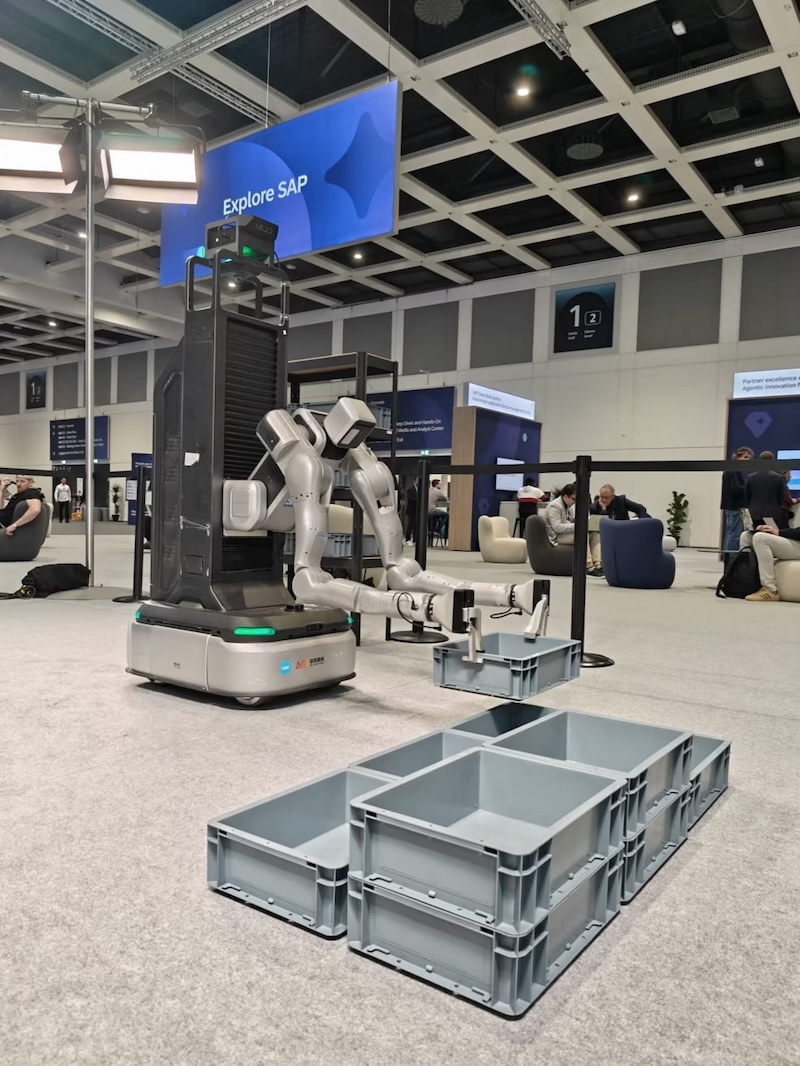
Intel and SAP have collaborated on a proof-of-concept system that connects enterprise software with autonomous mobile robots, allowing warehouse tasks to be initiated, carried out and monitored through a single workflow.
The companies announced the project on October 27, demonstrating how physical AI could connect business management systems with robots performing material-handling operations.
The system integrates SAP Extended Warehouse Management (SAP EWM) with Intel’s edge AI hardware and robotics software.
Warehouse transport requests are generated through SAP EWM and transmitted to autonomous robots, which move materials and report their progress and completion back to the enterprise system.
According to Intel, the demonstration showed improvements including shorter transport distances and reduced repetitive manual handling.
Connecting business systems with physical operations
The collaboration aims to bridge the gap between information technology (IT) and operational technology (OT), allowing business decisions to translate directly into physical actions.
John Healy, vice president and general manager, industrial and robotics at Intel, says: “Organizations want to connect AI directly to physical operations. By combining SAP’s enterprise context and orchestration with Intel’s edge AI and robotics technologies, we can help customers move Physical AI from business decision to real-world execution.”
Intel provides the computing infrastructure for local AI processing, including perception, navigation and real-time control.
Its technology combines CPUs, GPUs and neural processing units with software including OpenVINO Physical AI, Physical AI Studio and Robotics AI Suite.
SAP supplies the business workflows, operational rules and management systems that coordinate robot activities.
The companies say the architecture is designed to work across different robot manufacturers, AI models and computing environments, reducing dependence on individual technology suppliers.
Although currently demonstrated as a proof of concept, Intel and SAP intend to develop the approach into a repeatable framework for integrating autonomous robots with enterprise systems across multiple facilities and industrial applications.
