For a company that made its name manufacturing intelligent electric vehicles, the prospect of producing a humanoid robot every two and a half minutes represents a remarkable evolution of its industrial ambitions. And that is precisely what Chinese technology company XPeng is working towards.
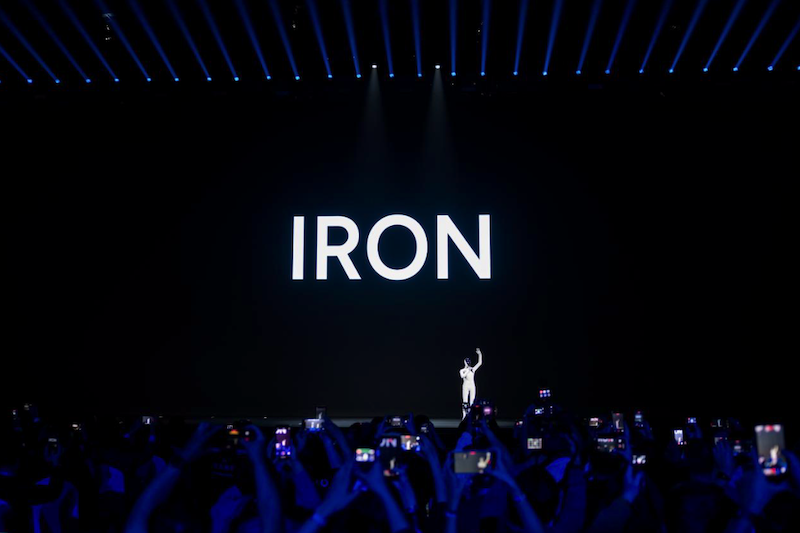
At its AI Day 2026 event in Guangzhou, XPeng unveiled the latest generation of its general-purpose humanoid robot, Iron, outlining a strategy that brings together artificial intelligence, automotive manufacturing expertise and a new commercial ecosystem for robotics.
Mass production is scheduled to begin in January 2027, marking an important transition from technology development to commercial operations.
He Xiaopeng, chairman and CEO of XPeng, says: “Humanoid robotics is reaching the point where the industry must move beyond demonstrations and prove that robots can create value in the real world.
“That requires more than capable hardware or intelligent models. It requires reliable products, high-quality data, scalable manufacturing and continuous learning through deployment. XPeng Iron brings these capabilities together as we prepare for commercial deployment and mass production is scheduled to begin in January 2027.”
Developing the brain and body together
Central to XPeng’s approach is the simultaneous development of the robot’s intelligence and physical capabilities.
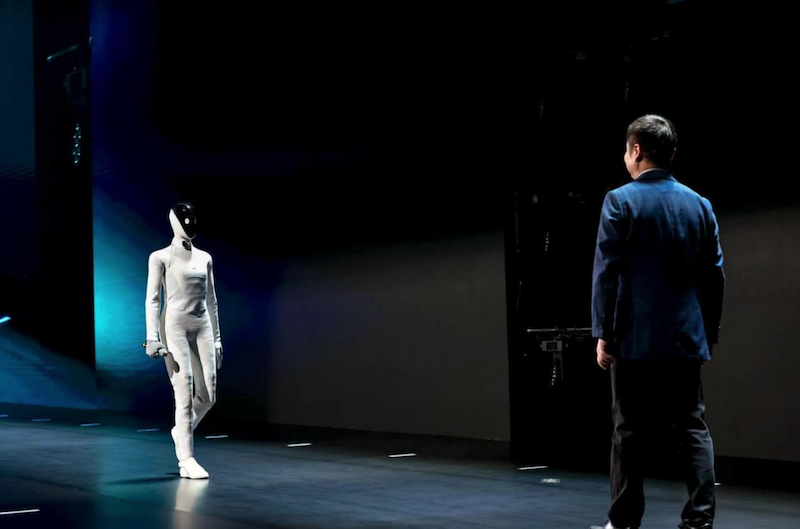
Its Turing physical AI architecture incorporates three interconnected systems responsible for higher-level reasoning and task planning, real-time decision-making and the direct control of physical movements.
The latest generation of Iron features 76 degrees of freedom, including a dexterous hand with 21 degrees of freedom, more than 1,500 tactile sensing points, 3D vision and 360-degree environmental perception.
Three proprietary Turing AI chips provide a combined 2,250 trillion operations per second of effective computing power.
The robot is designed to recognize people, retain conversational context, navigate autonomously, monitor its operational health and recharge itself before returning to work.
XPeng has also incorporated five layers of safety protection, including collision detection, torque limits and emergency-stop mechanisms.
Applying automotive manufacturing expertise
Perhaps one of XPeng’s greatest potential advantages in the emerging humanoid robotics market is the industrial infrastructure and manufacturing knowledge it has accumulated through its automotive business.
The company has established a 50,000 sq m Robot Data Factory covering more than 250 scenarios and 15 job categories, enabling robots to be trained and evaluated across a range of practical tasks.
Its dedicated automated humanoid production line incorporates more than 600 AI-powered holographic quality inspection checkpoints and over 1,000 vehicle-grade tests.
At full capacity, the line is designed to produce one Iron humanoid robot every 2.5 minutes.
A robot with a job to do
Interestingly, XPeng’s humanoid robots are initially destined not for its automotive factories, but for its retail stores.
Iron is scheduled to begin training as a store assistant in the first quarter of 2027, welcoming customers, providing product guidance and undertaking other retail service activities.
Further potential applications include reception services, education, exhibition guidance and industrial operations.
XPeng is developing a commercial model that combines hardware sales, software subscriptions and an open robotics ecosystem through which developers and businesses can create and introduce new robotic skills.
For XPeng, the ambition extends beyond manufacturing and selling humanoid robots. The company is seeking to establish a platform through which those machines can continue acquiring commercially useful capabilities throughout their operational lives.
It is an ambition that could ultimately make software and robotic skills as important to the humanoid robotics business as the machines themselves.
