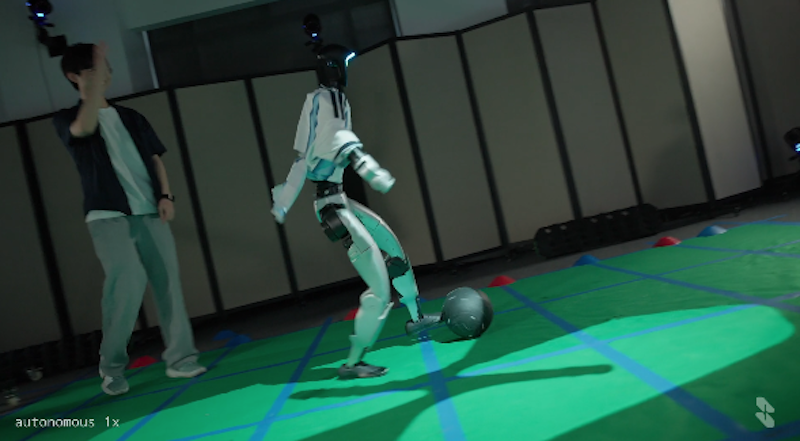
Skild AI has demonstrated a new self-play training approach that enables robots to develop physical skills without relying on human demonstrations, using its S1 robotics foundation model to learn soccer through more than 140 years of simulated play.
The company says the technique could eventually allow robots to acquire increasingly complex skills in factories, construction sites, homes and other physical environments without people having to demonstrate every action.
Skild used Nvidia Isaac Sim to create the simulated environment, giving the model a single objective: score a goal.
Rather than specifying individual behaviors such as dribbling, tackling or recovering after a fall, the researchers allowed the policy to compete against progressively more capable versions of itself.
Skild says: “The policy then learned to score by playing against recent versions of itself. As it improved, its opponents improved alongside it – turning every gain in capability into an increasingly difficult opponent.”
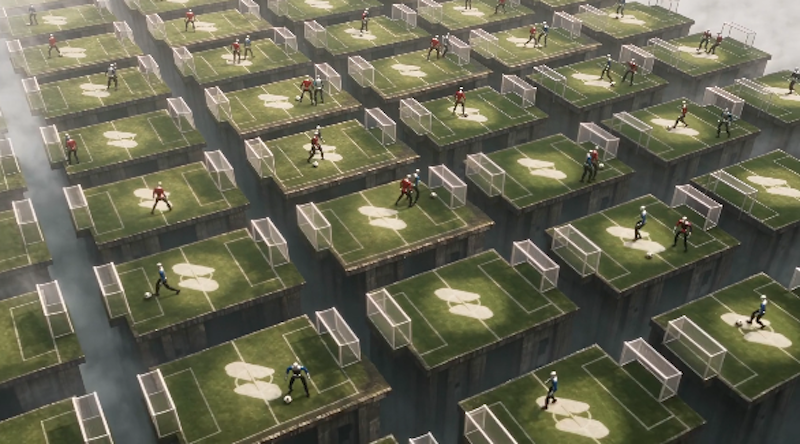
During its first few simulated months, the robot could barely walk. As training continued, it learned to recover after falling and subsequently developed behaviors including dribbling around defenders, shielding the ball and tackling opponents.
According to Skild, those capabilities emerged from the objective of scoring rather than from individually engineered rewards for each behavior.
After more than 140 years of simulated play, Skild transferred the resulting policy from simulation to a physical humanoid robot and demonstrated it playing soccer.
The company says: “We see the successful transfer from simulation to humanoid, along with the sheer complexity of the task, as a bright green flag for self-play on the road to physical AGI.”
The work represents a post-training extension of S1, Skild’s robotics foundation model, which the company introduced in August.
S1 is pre-trained using data including human videos, glove data, simulation and teleoperation, and is designed to learn tasks from in-context demonstrations.
Skild argues, however, that training primarily from human-generated data ultimately constrains models to the capabilities represented in that data.
The company says: “However, because S1-class models are pre-trained on human data, they are capped at human capability. We believe physical self-play will enable robots to far exceed human capability.”
Self-play has previously produced significant advances in software-based AI systems.
DeepMind used the approach extensively in its AlphaGo systems, while self-play subsequently contributed to systems capable of playing multiplayer games including StarCraft II and Dota 2.
Skild is attempting to extend the same principle into physical AI, where robots must learn not only strategies but also the physical movements required to execute them in the real world.
Soccer provides a demanding test because it combines locomotion, manipulation, recovery from physical disturbances and strategic interaction with opponents.
The company says the approach is not limited to sport and is already being extended to everyday robotics tasks.
Skild is also experimenting with larger groups of agents. Early four-agent soccer experiments have begun to produce behaviors including passing and coordination, according to the company.
Future work is expected to explore collaborative manipulation and navigation as the number of interacting robots increases.
Skild says: “This simulation ran for over a century with a trivial goal. What happens when we run it for orders of magnitude longer, on a virtual construction site, factory, or home?”
The research points toward an alternative way of scaling robot learning: using human data and demonstrations to establish broad foundational capabilities, then allowing robots to improve those capabilities autonomously through large amounts of simulated experience.
If the approach transfers successfully to practical tasks, it could reduce one of the major bottlenecks facing physical AI – the amount of human-generated data required to teach robots increasingly complex behaviors.
