Renewables made up 85.6% of all new power capacity added worldwide in 2025, according to the International Renewable Energy Agency’s Renewable Capacity Statistics 2026.
Each new solar park, wind farm, and battery site adds another stream of operational data. Energy companies turn those streams into value through data platforms built for different jobs.
The hard part starts before the first vendor call. Without a clear list of sources, owners, and constraints, vendors fill the gaps with assumptions, and proposals for one project arrive with different scopes and prices.
This article reviews the best firms providing energy data platform development services and the work each one has delivered. You will also find what to prepare before you brief a vendor, from a data source inventory to security limits, and how to test your chosen vendor through a pilot before a full build.
Key Takeaways
- A vendor brief works best with 6 inputs ready: a data source inventory, named owners, sample exports, security and hosting limits, systems to connect, and success metrics.
- Relevant Software, EPAM, Lemberg Solutions, STX Next, and Codibly publish energy work that ranges from ETRM and grid data platforms to device telemetry and demand-response connectivity.
- A pilot limited to 1 use case and a few data sources tests a vendor on real data before a full contract.
- Success metrics agreed before the pilot starts turn the go or no-go decision into a check against numbers.
What to Prepare Before You Brief a Data Platform Development Vendor
A vendor can only price and plan what you describe. Here are the 6 inputs that give every shortlisted firm the same starting point and make their proposals comparable:
Source Inventory
List every system that produces data the platform will use: SCADA historians, meter head-ends, IoT gateways, asset registers, weather services, and market feeds.
For each source, note the format, how often it updates, the time zone it logs in, and roughly how much data it produces a day.
Vendors size ingestion and storage from this list, so a missing source shows up later as a change request. A spreadsheet with one row per source is enough to start your brief.
Owners and Access
Every source needs a named owner who can approve access and answer questions about the data. Write down who that person is, which team they sit in, and how a vendor would get read access, whether through an API, a database replica, or file exports.
Access requests for control systems can take weeks, so starting them before the brief keeps your project schedule intact.
Sample Exports
A week of real data from each main source shows a vendor what written descriptions miss. Anonymize customer details if needed, but keep the original timestamps, units, and gaps. Vendors use these samples to spot quality problems early and to estimate the cleaning work in your proposal.
Security and Hosting Limits
State where the data may live: a specific cloud, your own data center, or a hybrid setup. Add the standards your security team applies, such as ISO 27001 or NERC CIP, and any rule that keeps control-system networks closed to inbound traffic.
These limits rule out unsuitable architectures early and spare your team from reviewing proposals that could never pass an audit.
Systems to Connect or Replace
Name every system the platform must exchange data with, such as billing, ERP, asset management, GIS, or trading tools, and mark which ones it will replace.
Include the vendor and version of each, since integration effort depends on both. A short diagram of how data moves today helps a vendor see where your platform fits.
Goals and Success Metrics
Describe the business result the platform must deliver, such as fewer manual reports, earlier fault detection, or more accurate forecasts.
Attach a number and the current baseline to each goal, so progress has a reference point. The same metrics later decide whether a pilot passes, which ties your brief directly to the go or no-go call.
Shortlist of Top Companies Providing Energy Data Platform Development Services
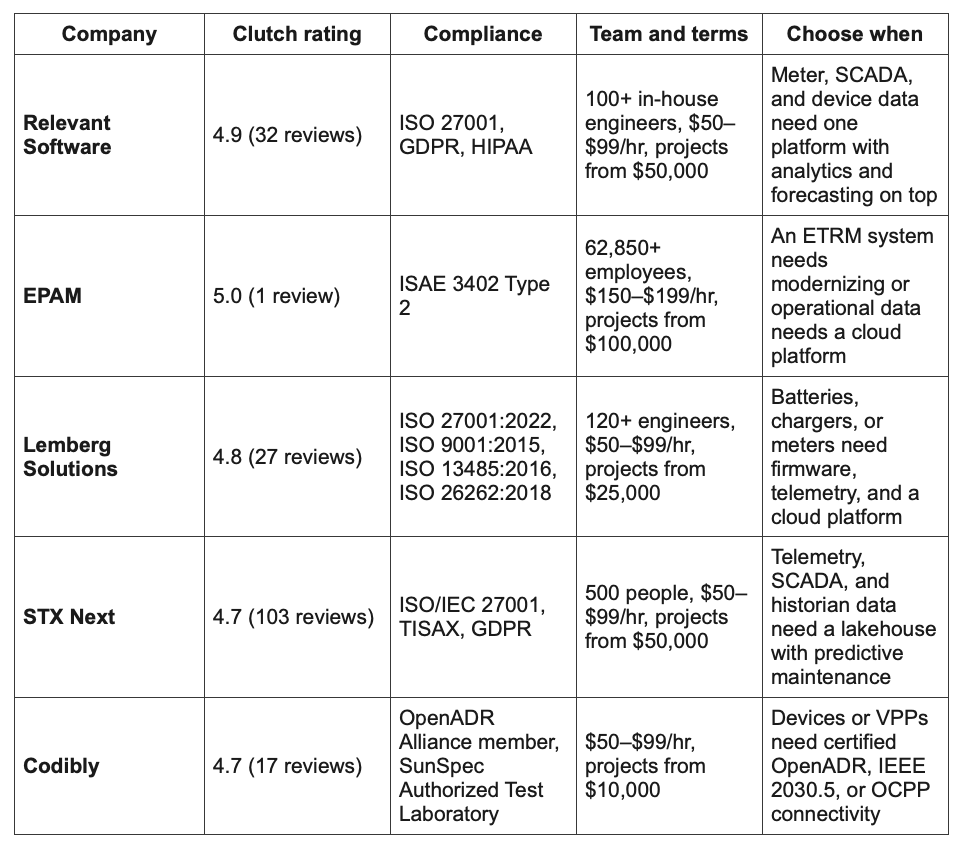
The 5 companies line up side by side in the table below, from Clutch ratings to compliance and working terms. The last column helps you to understand the situation each firm fits, based on the energy work each one has published.
Relevant Software
- Typical starting point: an energy business that needs meter, SCADA, and device data in one platform with analytics and forecasting on top
- Team and terms: 100+ in-house engineers, $50–$99/hr, projects from $50,000
- Compliance: ISO 27001, GDPR, HIPAA
- Energy case results: +20% solar forecast accuracy; −15% project planning time on a digital twin SaaS platform; 9x cognitive assessment capacity through remote device monitoring
Relevant Software is one of the top companies providing energy data platform development services because one team builds both the energy software and the data platform behind it, from control-system integration to analytics.
An AI-assisted development workflow speeds up discovery, architecture, build, and QA, delivering up to 50% faster cycles and up to 20% fewer bugs, while senior engineers review every line of production code.
Solutions they deliver:
- Energy management systems
- Smart grid and SCADA software
- ETRM platforms
- IoT asset monitoring
- AI forecasting and operational analytics
- Data engineering on Snowflake, Databricks, Kafka, and dbt
EPAM
- Typical starting point: an energy trading or resources business that needs ETRM modernization or a cloud data platform for operational data
- Team and terms: 62,850+ employees, 1,700+ energy and resources consultants, $150–$199/hr, projects from $100,000
- Compliance: ISAE 3402 Type 2 for major development centers
- Energy case results: 90%+ churn-prediction accuracy and 4.6x model lift for an electricity supplier; 20+ data pipelines moved from on-premise Hadoop to a cloud platform for Marathon Oil
EPAM owns the Deltix and QuantOffice Energy trading platforms and lists 80+ deployed CTRM solutions. A bench of 200+ OSDU professionals supports subsurface data work, and memberships in the OSDU Forum, PPDM, and IAEE tie the practice to industry data standards. The AWS energy and utilities offering adds grid fault forecasting that combines weather and historical data.
Solutions they deliver:
- ETRM and CTRM modernization
- AI and ML data platforms
- Industrial IoT pipelines
- Grid fault forecasting
- OSDU subsurface data platforms
- Data engineering on AWS, Snowflake, Spark, and Power BI
Lemberg Solutions
- Typical starting point: an energy company that needs device firmware, telemetry, and a cloud platform for batteries, chargers, or meters
- Team and terms: 120+ engineers, $50–$99/hr, projects from $25,000
- Compliance: ISO 27001:2022, ISO 9001:2015, ISO 13485:2016, ISO 26262:2018
- Energy case results: backend rebuild plus iOS, Android, and 2 white-label apps for the powerfox real-time energy monitoring platform; IoT data logger across 6 CAN channels for Voltfang battery storage; stable charging restored at ChargeX stations
Lemberg Solutions starts energy projects at the device level, with embedded and firmware engineering for battery management systems, inverters, and EV chargers alongside cloud and data work.
Device data travels over OCPP, Modbus, OPC UA, MQTT, and CAN into Azure IoT Hub or AWS IoT pipelines. ISO 26262 certification brings automotive functional-safety practice into energy hardware projects.
Solutions they deliver:
- Battery management systems
- Energy management systems
- IoT data loggers and telemetry
- EV charger and wallbox software
- Inverter software
STX Next
- Typical starting point: an oil and gas or energy network operator that needs telemetry, SCADA, and historian data in a lakehouse with predictive maintenance on top
- Team and terms: 500 people, $50–$99/hr, projects from $50,000
- Compliance: ISO/IEC 27001, TISAX, GDPR
- Energy case results: 40% lower monthly cloud costs and data processing cut from 24+ hours to 2 hours for Hemiko’s district energy networks; 20% less unplanned downtime across 100 million telemetry records a day for Linde
STX Next builds data and AI systems around Python, with a 500-person team centered on that language. The oil and gas practice works with OSI PI historians, SCADA telemetry, and soft sensors, while AWS Advanced Tier status and partnerships with Snowflake and Databricks cover the platform side.
Solutions they deliver:
- Data mesh and lakehouse platforms
- Predictive maintenance
- Soft sensors
- RAG knowledge systems
- Data engineering on AWS, Azure, Snowflake, Databricks, and Microsoft Fabric
Codibly
- Typical starting point: an energy device maker or VPP operator that needs certified OpenADR, IEEE 2030.5, or OCPP connectivity
- Team and terms: $50-$99/hr, projects from $10,000
- Compliance: OpenADR Alliance member, SunSpec Authorized Test Laboratory
- Energy case results: OpenADR 2.0 VEN delivered in 6 weeks with about 40% less development time for a pool-equipment maker, which then earned OpenADR 2.0 certification; IEEE 2030.5 integration across several distribution network operators for SolarEdge
Codibly focuses on energy and e-mobility software and ships ready-made accelerators for OCPP, OCPI, and IEEE 2030.5, plus an OpenADR 3.0 test tool and CPMS and eMSP engines. Standards coverage extends to EEBUS, IEEE 1547, and Rule 21, and the company operates within the Spyrosoft group.
Solutions they deliver:
- Demand response
- Battery storage management
- EMS and BMS
- SCADA and DERMS
- Energy trading integrations
Testing a Data Platform Development Vendor With a Pilot Project
A pilot tests a vendor on your own data before you sign a full contract. It keeps the spend to a small scope and shows how the team works under real conditions. Here is how to set one up, followed by a checklist you can hand to your team:
Pick One Use Case
Choose a single use case with a clear business owner and a result you can measure, such as a day-ahead load forecast, an alert for one class of equipment, or a monthly regulatory report built from raw meter data.
A narrow scope lets the vendor show depth, and your team can judge the result without debating priorities. Skip use cases that depend on data you have not collected yet, since the pilot then turns into a data-gathering exercise.
Limit the Data Sources
Give the vendor 2 or 3 sources from your inventory, ideally including one with known quality issues such as gaps, duplicate readings, or mixed time zones. The way the team handles that source shows how the full build would go.
Grant read-only access through the same route a production system would use, so connectivity problems surface during the pilot instead of after signature.
Set the Success Metric Up Front
Agree on 1 or 2 metrics from your brief before work starts, each with a target and the current baseline, for example forecast error against your existing model or the hours analysts spend on a report today.
Add a fixed end date and a demo date, so the pilot cannot drift into an open-ended project. Put both in writing, since a verbal target tends to move once results come in.
Watch How the Team Works
The pilot also shows how the vendor communicates, escalates problems, and documents decisions. Ask for a short weekly update and a shared backlog your team can see. Note how quickly questions get answers and whether the people you met during sales are the ones doing the work.
Agree on What Happens Next
Write down what follows a pass: the scope of phase 1, the team that carries over, the price basis, and who owns the pilot code and data. Settling this in advance keeps your momentum and avoids paying twice for the same work. Define what a fail means as well, including the handover of any code and documentation produced.
Pilot Checklist
- Run through this list with your team before the vendor starts:
- One use case with a named business owner
- 2 or 3 data sources, with at least one known quality issue
- Read-only access granted through the production route
- Success metric with target and current baseline, in writing
- Fixed end date and demo date
- Weekly update format and shared backlog agreed
- Next steps defined for both a pass and a fail
- Ownership of pilot code, data, and documentation settled
The vendor you choose sets the architecture, the tools, and much of the team your platform will run on for years. A complete brief and a short pilot let the top companies providing energy data platform development services show their work on your data, so that long-term choice rests on evidence.
Conclusion
An energy data platform development starts long before the first line of code, with a brief that describes your sources, owners, limits, and goals. When the brief stays thin, each vendor fills the gaps differently, and your team ends up comparing proposals for different projects.
The vendor you choose sets the architecture, the tools, and much of the team your platform will run on for years. A complete brief and a short pilot let the top companies providing energy data platform development services show their work on your data, so that long-term choice rests on evidence.
