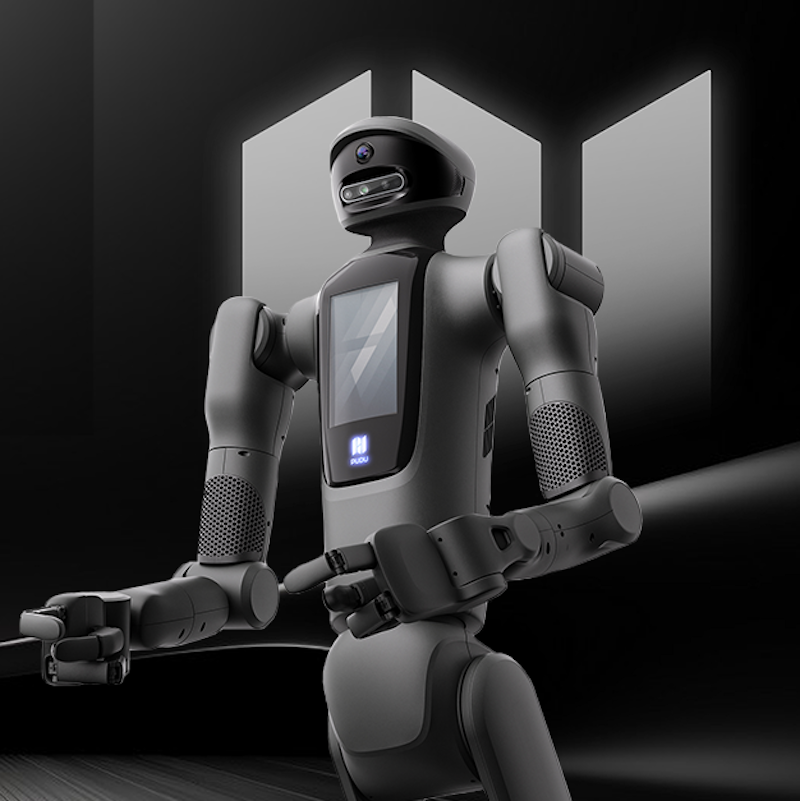
Pudu Robotics, best known for the delivery and cleaning robots increasingly found in restaurants, hotels and other commercial environments, is expanding its technology portfolio into semi-humanoid robots and quadrupeds as it looks beyond its established service robotics business.
The company demonstrated the direction of that expansion at IFA 2026 in Berlin in early September, where it exhibited a range of robots spanning commercial cleaning, industrial manipulation and four-legged mobility.
Among them was the D7, an industrial semi-humanoid robot that made its European debut at the event, alongside the D5-W quadruped robot and the CC1 Pro autonomous cleaning robot.
The diversification represents a significant broadening of Pudu’s product range. The company says it now has more than 130,000 robots operating in more than 85 countries, having built much of its business around commercial service robots such as its distinctive cat-faced BellaBot delivery robot.
Frost & Sullivan ranked Pudu as the world’s largest commercial service robot company by both revenue and shipments in 2025.
The D7 takes a somewhat different approach from the growing number of fully humanoid robots being developed for industrial applications.
Rather than using articulated legs to reproduce human walking, the semi-humanoid concentrates its 23 joints in its arms, waist and head. Pudu says the robot can lift loads weighing up to 20 kg.
The design reflects one of the emerging debates surrounding humanoid robotics: whether a human-like bipedal form is necessary for many industrial applications, or whether manufacturers can achieve greater reliability and lower complexity by combining humanoid manipulation capabilities with alternative forms of mobility.
Pudu also demonstrated the D5-W, a quadruped robot capable of carrying payloads of up to 30 kg and navigating stairs and uneven terrain.
The robot combines wheels and articulated legs, enabling it to switch between wheeled and legged locomotion depending on the environment. It can also recover autonomously after falling.
Pudu demonstrated the robot climbing stairs at IFA and staged an unusual demonstration in which the D7 semi-humanoid took the D5-W for a walk.
Alongside the newer robot forms, Pudu also showed how it is adding greater autonomy to the more established commercial robotics markets on which it built its business.
Its CC1 Pro autonomous cleaning robot incorporates a system that evaluates the results of its own cleaning operations. Rather than simply reporting that it has completed a planned route, the robot inspects areas it has cleaned and can return to sections that require additional work.
Pudu’s appearance at IFA was the company’s first at the Berlin consumer electronics exhibition.
Although the company remains closely associated with food delivery and hospitality robots, the D7 and D5-W indicate that Pudu is increasingly applying its experience in autonomous mobile robotics to a wider range of machines and applications.
That puts the company into increasingly competitive areas of robotics, particularly as manufacturers explore whether humanoid, semi-humanoid and quadruped machines can move beyond demonstrations and into economically viable industrial work.
