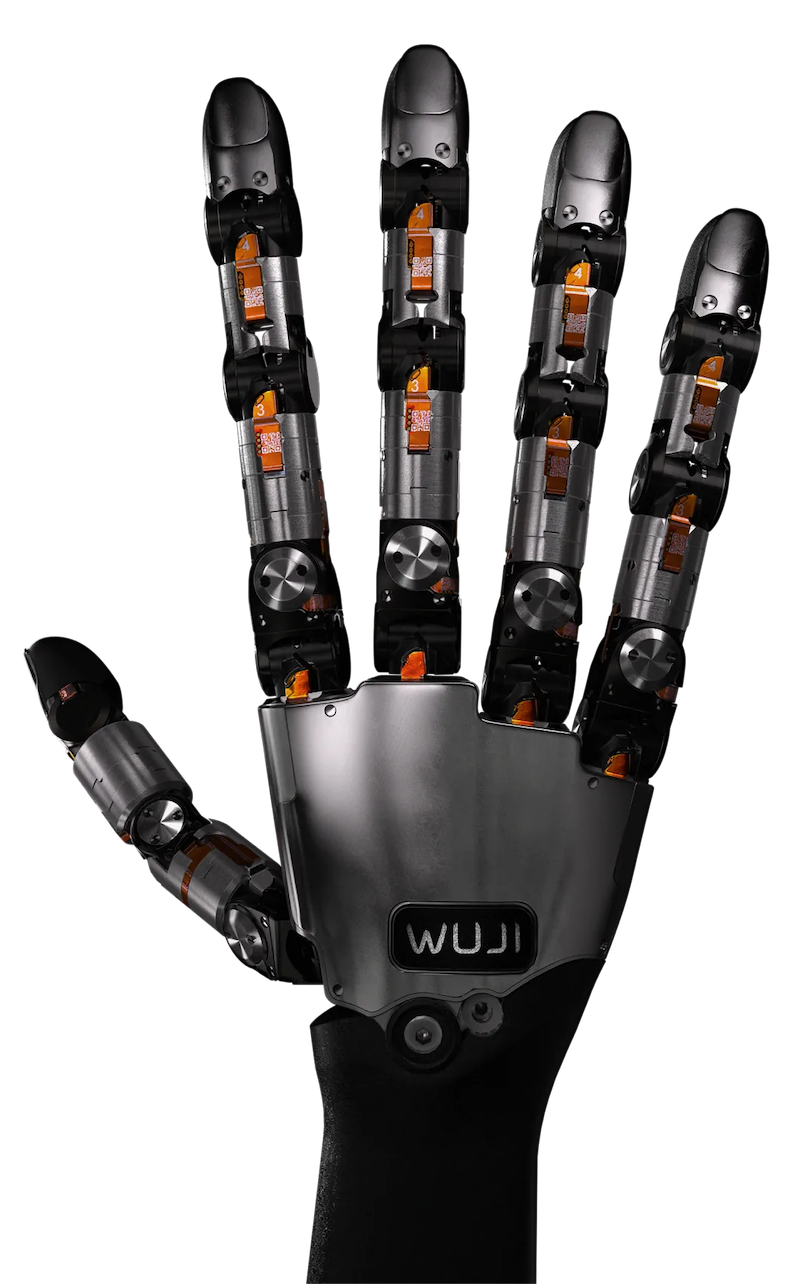
Scientists at ETH Zurich have demonstrated how an anthropomorphic robotic hand can use its fingers not only for manipulation but also for locomotion, enabling the hand to crawl, recover from falls and move around its environment without a separate mobility system.
The research used an off-the-shelf robotic hand from WUJI, a developer of dexterous robotic hands and teleoperation technology.
Rather than mounting the hand on a conventional robot arm or mobile platform, the researchers trained it to support its own weight and move using the same fingers normally intended for grasping and manipulation.
The resulting system was capable of untethered crawling, steering and recovering after falls. It could also perform manipulation tasks while supporting itself, including pressing successive keys on a keyboard and pushing an object toward specified targets.
The researchers describe the system as a “compact mobile manipulator” that eliminates the need for a separate locomotion mechanism.
The work was presented in a paper titled “Fingers as Legs: Learning Self-Supported Locomotion and Manipulation with an Anthropomorphic Hand”, by Amirhossein Kazemipour, Hehui Zheng and Robert Katzschmann.
The researchers used reinforcement learning to develop the locomotion capabilities, taking into account the unequal dimensions and characteristics of the individual fingers.
Training took place in simulation, with the simulated environment calibrated using measurements from the physical hardware.
According to the researchers, their reward formulation allowed the hand to move faster in simulation than when using tuned rewards originally developed for quadruped robots.
The physical system incorporated onboard power and computation, allowing it to operate as a self-contained platform.
For manipulation experiments, the hand performed successive keyboard commands without relying on vision. In another demonstration, it used overhead visual feedback to push an object toward target positions.
The research illustrates an unusual approach to mobile manipulation by allowing the same mechanisms to perform both locomotion and physical interaction.
It also highlights the increasing role of commercially available dexterous hands as research platforms for robot learning.
WUJI has been developing this area further with its WUJI Hand 2 and WUJI Glove, which are designed to support real-time teleoperation and the collection of motion and tactile data for robot learning.
The company demonstrated the two systems at IROS 2026, held in Pittsburgh from September 27 to October 1.
During demonstrations, the WUJI Glove was used to control the company’s dexterous hand in real time, providing a means of capturing human motion and translating it into robotic manipulation.
Such teleoperation systems are increasingly being used not simply for remote robot control, but as data-generation tools for training embodied AI and robotic manipulation models.
By recording human demonstrations, developers can collect examples of how objects are grasped, repositioned and manipulated, providing training data for systems intended eventually to perform those tasks autonomously.
WUJI is also among the hardware manufacturers providing native device support for Nvidia Isaac Teleop, Nvidia’s teleoperation framework for robotics.
The combination of increasingly capable dexterous hardware, teleoperation and reinforcement learning is broadening the role of robotic hands beyond their traditional position as end effectors attached to robot arms.
The ETH Zurich work takes that idea to an unusual extreme: instead of giving a robot a hand, the researchers effectively turned the hand itself into the robot.
