
Virtual data rooms are designed for business processes where confidential documents must be shared with multiple internal and external parties under controlled access.
M&A due diligence is the best-known example, but VDRs are also used for fundraising, audits, restructuring, real estate transactions, and other document-heavy projects.
This review looks at the Ideals virtual data room from a practical buyer’s perspective: what the platform offers, how its pricing is structured, and which workflows it is designed to support.
The aim is not to label one platform universally superior, but to identify the factors organizations should verify against their own requirements.
What does Ideals VDR offer?
The Ideals data room combines document management, access control, reporting, Q&A, and security settings in a single project environment.
Administrators can organize participants into groups and assign permissions according to the information each group should be able to access.
According to the current Ideals Help Center, the platform provides eight document permission levels. Permissions are assigned at the group level, can be applied to folders and supported files, and can be changed during the project.
This structure is useful when bidders, advisers, specialists, and internal teams require different views of the same data room.
Document organization and controlled access
Document organization is central to a VDR because security alone does not make a review efficient. Ideals supports folder-based organization, document access controls, search, reporting, and other tools intended to help participants work through large document sets.
Administrators can also use project security settings such as two-step verification and restrictions based on IP addresses or domains. These controls are especially relevant when a project includes external users working from different organizations or locations.
The access model is consistent with the NIST principle of least privilege, which recommends restricting users to the minimum access necessary to perform assigned tasks. Buyers should still test the actual permission configuration they plan to use rather than relying only on a feature list.
Q&A, reporting, and transaction workflows
For due diligence, document access is only part of the workflow. Reviewers also need a controlled way to ask questions, while administrators need visibility into project activity.
Ideals includes a Q&A module that can categorize, assign, and track questions, with administrators controlling participation and workflow settings.
Reporting tools include activity logs and other views of user interaction. These can help administrators monitor project usage, investigate unusual behavior, and confirm whether access controls are working as intended.
Activity data should not, however, be treated as a reliable indicator of a bidder’s intentions or likelihood of completing a transaction.
Security controls and authentication
Security evaluation should look beyond encryption claims. A VDR buyer should consider authentication, permissions, document controls, auditability, provider assurance, and the way administrators manage users throughout the project.
CISA guidance on multifactor authentication recommends requiring MFA wherever possible and notes that stronger, phishing-resistant methods provide better protection against account compromise. Ideals supports multi-factor authentication as part of its project security controls.
For a direct product reference, Ideals VDR provides information about the platform and its VDR capabilities. As with any virtual data room provider, organizations should verify that the available controls, assurance documentation, hosting arrangements, and contractual terms fit their own security and compliance requirements.
How does Ideals virtual data room pricing work?
Ideals virtual data room pricing is quote-based rather than presented as a single public flat fee. The current pricing page lists Core, Premier, and Enterprise plans, with differences in project scope, storage, administration, service level, and included functionality.
Core is positioned for small to medium deals and includes a single project, five administrators, unlimited users, and 0.5–2 GB of storage. Premier adds unlimited administrators and tailored storage for more complex transactions.
Enterprise is intended for organizations with broader or ongoing VDR requirements. Exact commercial terms should be confirmed directly for the planned project.
This pricing approach means buyers should look beyond the headline quote. Relevant questions include how storage is measured, whether the project term is fixed, what happens if the transaction is extended, which services are included, and whether additional projects or administrators change the cost.
Where is Ideals VDR typically useful?
The platform is most relevant when a project combines confidential information, multiple participants, and a need for controlled disclosure. Typical examples include sell-side and buy-side M&A, fundraising, audits, restructuring, real estate transactions, and secure collaboration with external advisers.
In an M&A process, for example, a seller can organize diligence documents, create bidder groups, restrict sensitive folders, manage Q&A, and adjust access as the process moves from initial review to later-stage diligence.
In fundraising, similar controls can be used to share selected corporate and financial information with potential investors.
How should buyers compare Ideals with other providers?
There is no objective best virtual data room provider for every organization or transaction. The right choice depends on project size, sensitivity, user roles, workflow complexity, support expectations, security requirements, and commercial terms.
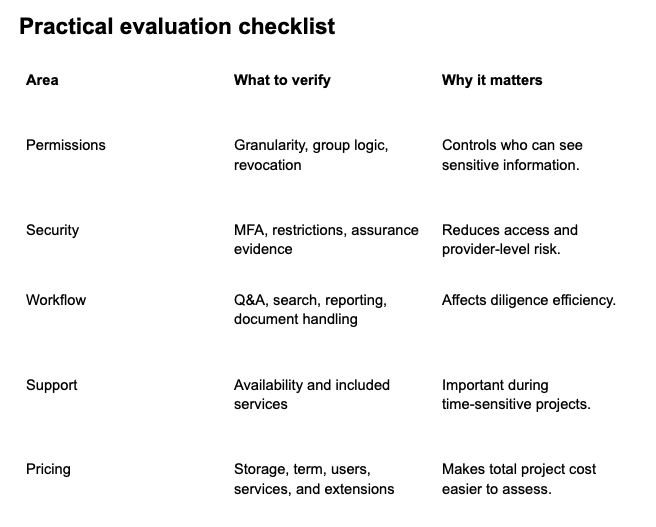
A useful comparison starts with a list of requirements and a realistic trial. Instead of testing an empty demo, teams can upload representative documents, create several user groups, apply different permissions, run a sample Q&A workflow, inspect reports, and test how quickly access can be changed or revoked.
The same evaluation method should be applied to every data room provider. This keeps the comparison focused on operational fit rather than marketing claims.
Conclusion
Ideals VDR provides the core capabilities expected from a transaction-focused virtual data room: controlled document access, multiple permission levels, security settings, Q&A, and reporting.
Its quote-based plans allow the service to be matched to different project scopes, but buyers need a project-specific quote to assess total cost.
The strongest way to evaluate the platform is to test it against a real workflow. Define the required user groups, document controls, security standards, reporting needs, support expectations, and commercial assumptions first; then verify whether the platform meets them in practice.
