A dashboard shows a temperature spike. That number came from somewhere. An API picked it up. A service moved it along. A query pulled it out of storage.
One weak spot anywhere in that chain and the reading can lie. The tools in this article look at the software that builds those chains. Not the cables. Not the switches. Not the machines themselves.
Five platforms, all aimed at teams writing factory apps, cloud services, and the dashboards people watch on the floor.
Two topics sit outside what follows. Watching a control network. Certifying a safety function. Those need their own tools.
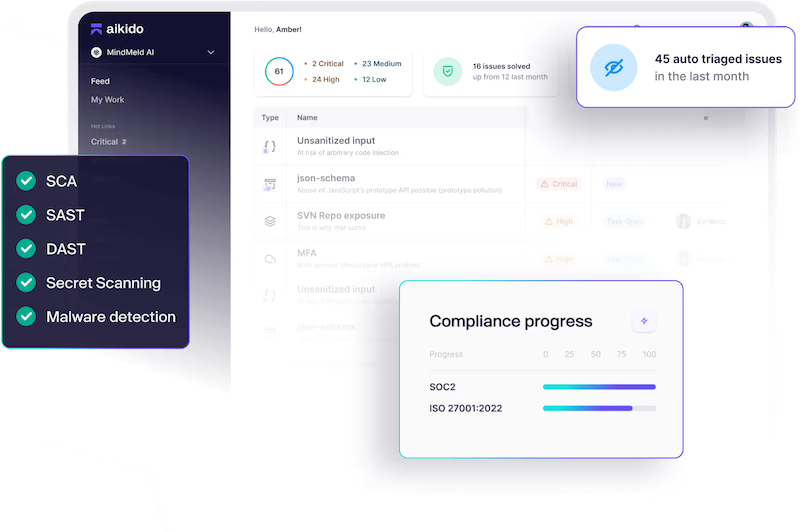
1. Aikido
The software running a factory floor gets written by people, not machines. Aikido was put together for those people. Robots and assembly lines used to run on hardware alone. These days the code carries just as much of the load.
Three surfaces get watched at once:
- First, the source a developer types. Injection holes. Cross-site scripting. Buffer overruns. Each checked against published CVE records.
- Second, everything pulled in from public registries. Packages, frameworks, helper libraries. A reachability pass drops whatever never executes, so the image stays free of junk.
- Third, the image a service ships inside. Scanning goes down to the base operating system layer, where old packages like to hide.
Spotting a flaw is the easy half. The hard half is getting it closed.
Three separate scans normally mean three separate queues. Aikido pulls them onto one screen. What floats to the top follows context, not raw severity. Four people do not have time for a hundred warnings. They have time for the few that could genuinely bite.
Noise falls by up to 85%. From there, an AI step takes each real hit and pushes it toward a patch, so nobody faces a blank page.
Setup barely registers. Nothing installed on any machine. Nothing to maintain. The whole thing talks over an API. GDPR and ISO 27001 checks arrive built in, which saves a step for anyone working under a regulator.
Source. Libraries. Images. One screen, one queue, and a person who knows what happens next.
Key capabilities:
- SAST across major languages, with CVE database checks
- Software composition analysis with reachability filtering and one-click auto-fix
- Container image scanning with sensitivity-based prioritization
- IaC scanning for Terraform, CloudFormation, and Kubernetes Helm charts
- API and DAST coverage for exposed endpoints
- No agents, API-based setup
2. Snyk
Snyk got its start on the outside parts. Imported packages. Pulled-in libraries. That is still where it shines. Later it added the code your team writes and the images you deploy. Extensions exist for editors, repositories, and build servers.
Now think about a typical factory project. A dashboard pulls in a charting library. An API rests on a web framework. A worker pulls a queue client and a database driver. None of those were written in-house. All of them came from somewhere else.
That is the problem. Every import is a possible hole. Snyk walks the pile. Matches each package against published CVE lists. Then drops the suggested patch right beside the line that needs it, in the editor the developer already has open.
Image scanning rides along. A service packaged for a plant machine gets checked the same way as the code stuffed inside it.
Tiers decide the depth. Some hooks stay locked behind higher plans. Check what your level covers before pushing it across a whole team.
Key capabilities:
- Open-source dependency scanning for known CVEs
- Container image scanning for deployment packages
- IDE, repository, and CI integrations for in-workflow feedback
- License compliance checks for third-party packages
- Fix suggestions tied to specific findings
3. Semgrep
You aim Semgrep at a folder. It works through the files inside.
The rules are where it gets interesting. They read like the language they check. A Java coder opens one and follows it without help. If a rule needs a tweak, the edit takes a minute.
It moves fast too. Quick enough to fire on every pull request, so a service handling machine data gets scanned each time a commit lands. That beats waiting for release week. It also tracks values moving between functions, which is where a one-file scanner usually quits.
Then the limits. Source only. Packages and images need other tools. Rule availability changes by tier, so see what your plan opens up.
Key capabilities:
- Rule syntax that mirrors the analyzed language
- Cross-file dataflow for Python and Java
- Fast scans suited to pull-request checks
- Framework-specific rules for common web stacks
- Edition-dependent feature sets that need verification
4. Checkmarx
Checkmarx speaks Java. It speaks Python. Plus a long list of others. What it really sells is structure. Reports. Audit records. The kind of paperwork a security group needs when it has to answer for twelve applications at once.
That structure comes at a cost. A full pass takes longer than the quick tools built for developers. Teams usually schedule the heavy scan overnight. Nobody waits for it before merging a small change.
The payoff is depth and evidence. When an auditor asks how a finding was handled, the answer lives in the platform.
A manufacturer running separate products across several sites gets real value from that. A five-person group pushing code every afternoon will find the process too slow for daily work.
Key capabilities:
- SAST without a required compilation step
- Reporting and audit trails for compliance reviews
- Language coverage across enterprise repositories
- Workflow for assigning findings across multiple teams
- Integration with established build and release pipelines
5. GitLab
GitLab holds the source. It runs the builds. The scans sit in the same place. Code checks, package checks, image checks. Each one fires as a stage in the pipeline, and the output lands next to the commit that set it off.
A factory team already working this way gets something for free. No second tool to install. No second login. The finding appears in the merge request the coder has open, in the same tab they were already using.
Not everything is unlocked, though. Lower plans leave some checks out. Look at what your tier actually includes before telling the team what to expect.
Key capabilities:
- Static analysis as a pipeline job
- Dependency scanning for third-party packages
- Container scanning for deployment images
- Findings posted next to the merge request
- Tier-dependent security features that need verification
How to integrate application security into smart manufacturing development
A tool sitting in a menu does nothing on its own. The habits around it do the real work.
Catch an issue while the branch is still open, and it costs an edit. The developer is already in the file. The fix takes minutes.
Catch the same issue after the release ships and the bill changes. A rollback. A hotfix pushed under pressure. A meeting to figure out how it slipped through.
Same flaw. Two very different afternoons. Keep an eye on what you borrow. Charts, web frameworks, queue clients, database drivers. All of it comes from somewhere else. Put the check on a schedule so new CVEs get noticed instead of waiting for someone to think about it.
Do the same for images. A base layer that was clean a year ago is not clean now. Packages inside it age quietly.
Order the results by who can see them. A hole facing the public internet deserves more attention than the same hole in a tool only staff use.
Put a name on every ticket. A finding with nobody assigned collects dust. A finding with an owner gets closed.
A worker process pulls in readings from a temperature probe. It hands them to a dashboard and saves them in a table. Before that code merges, a check spots a gap where user input was never validated. A different scan notices a helper library that just landed on a CVE list.
A third finds a base image pulled months ago and never refreshed. All three surface inside the same afternoon the developer is already spending on that branch. Nothing gets postponed to a review week.
Bottom Line
Look at how your team already ships software, then pick the tool that fits that rhythm.
Three things decide the answer. Does it cover the surfaces you actually run: written code, borrowed packages, deployed images? Does a finding turn into a fix without a fight? Does it sit inside the pipeline your developers open every morning?
Aikido pulls those three together for groups building manufacturing apps and cloud services. Line it up against the others. Then choose what matches how your people already work.
